
Table of Contents
Introduction
Spain packs an unusual amount of variety into one country: Gothic quarters and futuristic architecture, snow-capped mountains a short drive from beaches, and regional cultures that each feel like a separate trip. Picking just five places means leaving plenty out, but these five cover the range best - from Catalonia's design capital to Andalusia's flamenco heartland and the Basque coast's culinary scene.
Each destination below includes a short, realistic itinerary so you can see roughly how much time to budget and what to prioritize if your trip is tight on days.
Barcelona: Gaudí's Architectural Playground
Why Visit
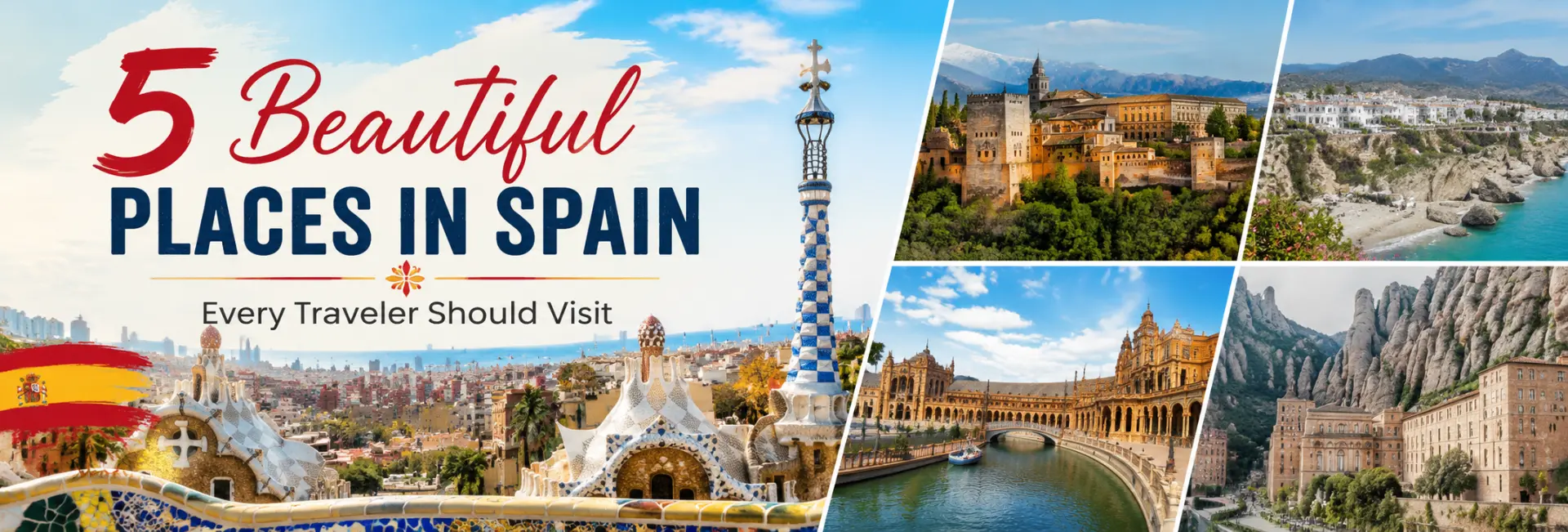
Barcelona is where Antoni Gaudí's imagination reshaped an entire city. The Sagrada Família reached its full height of 172.5 meters in February 2026, when its central Tower of Jesus Christ was completed, though decorative work on the Glory Façade is expected to continue for years - the interior and main towers are open to visitors now, so it's very much worth seeing in its current state rather than waiting.
- Park Güell's mosaic terraces and gingerbread-style gatehouses
- La Rambla and the Gothic Quarter's narrow medieval streets
- Casa Batlló and Casa Milà (La Pedrera), Gaudí's residential masterpieces
- Barceloneta Beach for an afternoon by the Mediterranean
2-Day Itinerary
Day 1: Start early at the Sagrada Família to beat the crowds, then walk the Gothic Quarter and Barcelona Cathedral before an evening tapas crawl in El Born. Day 2: Book a timed slot for Park Güell in the morning, visit Casa Batlló or La Pedrera midday, and finish with sunset drinks near Barceloneta Beach.
Madrid: Spain's Art-Filled, Round-the-Clock Capital
Why Visit
Madrid trades Barcelona's seaside energy for grand boulevards, royal history, and one of the world's most concentrated art districts. The "Golden Triangle" of museums - the Prado, Reina Sofía, and Thyssen-Bornemisza - sits within walking distance of each other, and the city's tapas culture runs late into the night in neighborhoods like La Latina and Malasaña.
- The Prado Museum for classical European painting, including Velázquez and Goya
- Retiro Park's Crystal Palace and boating lake
- The Royal Palace, Spain's largest palace by floor area
- Mercado de San Miguel for a fast introduction to Spanish food
2-Day Itinerary
Day 1: Visit the Royal Palace in the morning, wander Plaza Mayor and Mercado de San Miguel for lunch, then spend the afternoon in Retiro Park. Day 2: Dedicate the morning to the Prado, walk to the Reina Sofía for modern art (including Picasso's Guernica), and spend the evening bar-hopping through La Latina's tapas streets.
Seville: The Passionate Heart of Andalusia
Why Visit
Seville is where flamenco, Moorish architecture, and orange-tree-lined plazas come together. The city's Real Alcázar palace complex and its Gothic cathedral - the largest in the world by volume - make it one of Spain's densest concentrations of historic sites, while summer evenings are best spent watching a live flamenco show in the Triana or Santa Cruz neighborhoods.
- Real Alcázar, a still-functioning royal palace with Mudéjar architecture
- Seville Cathedral and the Giralda bell tower, a former minaret
- Plaza de España, built for the 1929 Ibero-American Exposition
- Barrio Santa Cruz for tapas bars and flamenco venues
2-Day Itinerary
Day 1: Tour the Real Alcázar in the cooler morning hours, climb the Giralda for cathedral views, and explore Santa Cruz's alleyways before dinner. Day 2: Spend the morning at Plaza de España and Maria Luisa Park, cross the river to Triana for lunch and ceramics shopping, and end the night with a flamenco performance.
Granada: Moorish Legacy and Mountain Views
Why Visit
Granada's Alhambra is one of the best-preserved examples of Islamic-era architecture in Europe, and its hilltop position gives views over the Albaicín's whitewashed houses toward the Sierra Nevada mountains. Because entry tickets are limited and often sell out weeks ahead, this is one destination where booking in advance genuinely matters more than spontaneity.
- The Alhambra and Generalife gardens, best booked online in advance
- Albaicín, the old Moorish quarter, for sunset views from Mirador de San Nicolás
- Free tapas culture - many bars still serve a small plate with every drink
- Sacromonte's cave dwellings and flamenco heritage
Half-Day Itinerary
If you only have a few hours: take a morning slot at the Alhambra to tour the Nasrid Palaces and Generalife gardens before midday heat, have lunch and free tapas in the city center, then walk up to Albaicín in the late afternoon to watch the sunset over the Alhambra from Mirador de San Nicolás.
San Sebastián: Beaches, Bites, and Basque Charm
Why Visit
San Sebastián (Donostia in Basque) pairs a curved city beach with one of the highest concentrations of Michelin-starred restaurants per capita anywhere in the world. It's a slower, more compact destination than the others on this list, making it a good add-on for travelers heading toward the French border or wanting a coastal break between bigger cities.
- La Concha Beach, consistently ranked among Europe's best urban beaches
- Parte Vieja (Old Town) for pintxos bar-hopping
- Monte Igueldo's funicular and viewpoint over the bay
- San Telmo Museum for Basque history and culture
1-Day Itinerary
Morning: walk or swim at La Concha Beach, then take the funicular up Monte Igueldo for panoramic views. Afternoon: explore the Parte Vieja's pintxos bars, sampling small plates at three or four different spots rather than a single sit-down meal. Evening: catch sunset from Paseo Nuevo along the harbor before dinner.
Conclusion
These five cities show just how different one country can feel from region to region - Barcelona's modernist skyline, Madrid's museum-dense center, Seville's Moorish palaces, Granada's mountain backdrop, and San Sebastián's beach-and-food combination. Even a two-week trip covering all five would mean fast-paced travel, so most visitors are better off picking two or three and spending real time in each rather than rushing through a checklist.
Whichever combination you choose, book high-demand sites like the Alhambra and Sagrada Família well ahead of your trip, since both routinely sell out during peak season.
Frequently Asked Questions
What is the best time of year to visit Spain? +
Spring (April–June) and early fall (September–October) offer mild weather and smaller crowds than the peak summer months, when southern cities like Seville and Granada can see extreme heat.
How many days do I need to see all five destinations? +
Realistically, plan on 10–14 days to visit all five without constantly rushing; if you only have a week, most travelers pair Barcelona and Madrid or focus on the Andalusian cities of Seville and Granada together.
Do I need to book Alhambra or Sagrada Família tickets in advance? +
Yes, both are among the most visited sites in Spain and frequently sell out days or weeks ahead during high season, so booking online before your trip is strongly recommended.
Is it easy to travel between these cities without a car? +
Yes, Spain's high-speed AVE train network connects Madrid, Barcelona, and Seville in a few hours each, though Granada and San Sebastián are best reached by regional train, bus, or a short flight.
Which city is best for first-time visitors to Spain? +
Madrid or Barcelona are the most common starting points thanks to major international airports and easy onward rail connections, but either works well as an introduction to the country.
Is San Sebastián worth visiting if I'm not interested in fine dining? +
Yes, the beach, Old Town architecture, and coastal walks stand on their own, and the city's more casual pintxos bars offer an affordable way to sample the food scene without a formal tasting menu.
