
Table of Contents
Overview
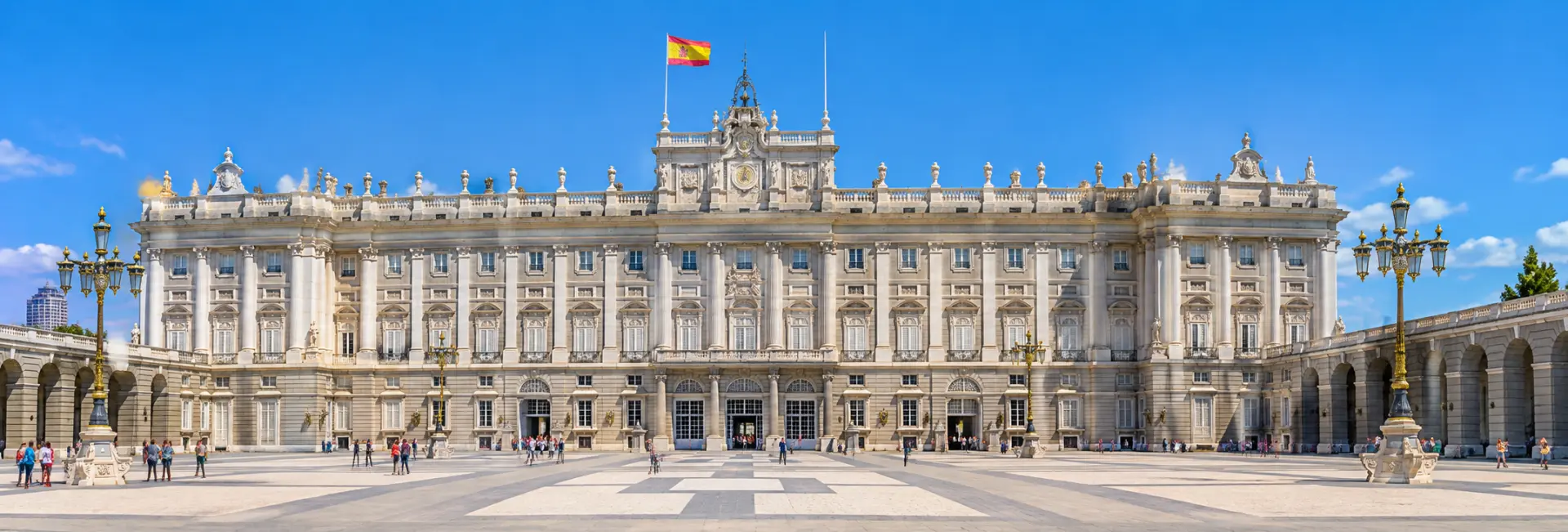
Rising above the western edge of Madrid's old town, the Royal Palace is the official seat of the Spanish monarchy and, by floor area, the largest functioning royal residence in Western Europe. Its stone façades and more than 3,000 interior rooms were built to project the authority of a young Bourbon dynasty determined to rival the great courts of France and Austria, and that ambition still shows in every gilded ceiling and marble staircase inside.
Although no monarch has lived here full-time for decades, the palace remains active: it hosts state banquets, official receptions, and the ceremonial welcome of visiting heads of state. For visitors, it offers a rare combination — a working seat of government dressed as an 18th-century art museum, with a Royal Armoury, a chapel holding rare stringed instruments, and gardens that stretch down toward the Manzanares River.
History
From Fortress to Ashes
The site has held a fortified structure since at least the 9th century, when a Muslim garrison built an alcázar to guard the approach to the Manzanares valley. Over the following centuries, Castilian kings expanded the stronghold into a royal residence, and by the 16th century it had become one of the regular seats of the Spanish court under the Habsburg monarchs.
That structure was destroyed on Christmas Eve 1734, when a fire tore through the old alcázar under King Philip V. The blaze consumed centuries of furnishings and artwork, but it also cleared the ground for something far grander.
Building the Bourbon Palace
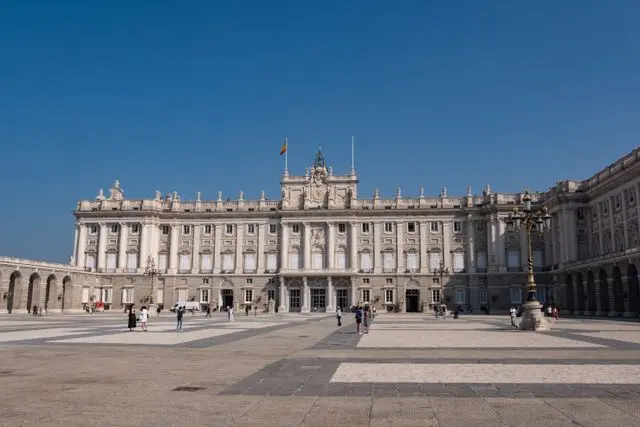
Philip V commissioned an entirely new palace on the same site, turning first to the Italian architect Filippo Juvarra and, after Juvarra's death, to his pupil Giovanni Battista Sachetti, who adapted the plans into the square, courtyard-centered design seen today. Construction began in 1738 and continued for over two decades, with the Italian architect Francesco Sabatini later adding the southeast wing and the ceremonial Grand Staircase.
The building was largely finished by 1764, though Philip V did not live to see it completed; it was his son, Charles III, who became the first monarch to actually reside there. Successive Bourbon rulers continued to furnish and redecorate the interior well into the 19th century, filling it with tapestries, porcelain, and paintings collected across the Spanish empire.

Architecture & Notable Rooms
Sachetti and Sabatini gave the palace a restrained, classically balanced exterior of white stone and granite, wrapped around a large central courtyard known as the Plaza de la Armería. Scholars still debate whether the overall style leans closer to Italian Baroque or to the calmer lines of early Neoclassicism, a tension visible in the contrast between the palace's sober façades and its extravagant interiors.
The State Rooms
- The Grand Staircase, carved from a single type of San Agustín marble and lit by a ceiling fresco, sets the tone before visitors even reach the first state room.
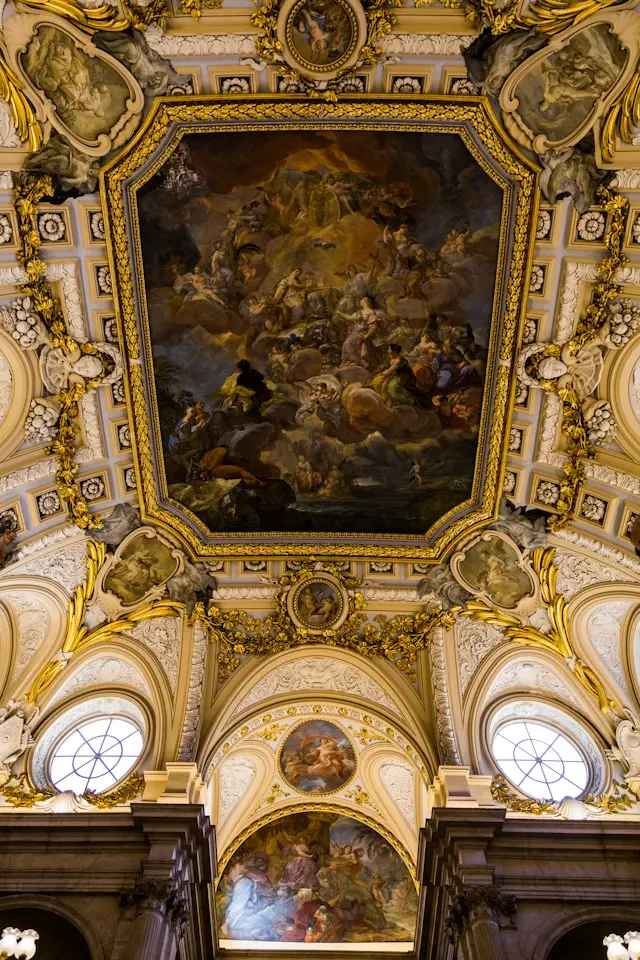
- The Throne Room retains its 18th-century red velvet wall coverings and a ceiling painting by Giovanni Battista Tiepolo, glorifying the Spanish monarchy above a pair of ceremonial thrones.
- The Gasparini Room, designed by the Neapolitan decorator Matteo Gasparini, is covered floor to ceiling in Rococo floral embroidery and inlaid marble, and functioned as Charles III's private dressing chamber.
- The Royal Chapel houses a set of stringed instruments crafted by Antonio Stradivari, one of the few complete Stradivarius quartets still kept together anywhere in the world.
Collections and Curiosities
Beyond the state apartments, the palace holds a working Royal Pharmacy stocked with historic apothecary jars and ceramics, and a Royal Armoury ranked among the finest collections of historic arms and armor in Europe, with pieces dating back to the 15th century. The building is also famously full of clocks — well over a hundred are kept running throughout its halls, a personal obsession of several Bourbon monarchs.
Grounds & Gardens
The palace sits within its own green buffer against the surrounding city, giving visitors somewhere to slow down before or after the interior tour.
Sabatini Gardens
Laid out on the palace's northern side, the Sabatini Gardens follow a formal, geometric plan of clipped hedges, statues, and reflecting pools, all overlooked by the palace's rear façade. They're a popular spot for photographing the building's exterior without the crowds of the main plaza.
Campo del Moro
On the western, riverside slope lies the Campo del Moro, a much larger English-style landscape park of fountains, wooded paths, and open lawns that runs down toward the Manzanares. Its name recalls a medieval Moorish encampment once stationed on the site, and its layout offers one of the best distant views back up at the palace's western façade.

Royal Ties & Cultural Significance
The Royal Palace remains the official residence of the Spanish royal family, even though King Felipe VI and his household actually live at the more modest Zarzuela Palace outside the city. Instead, the Bailén Street palace is reserved for the ceremonial side of the monarchy: state banquets for visiting presidents and monarchs, the swearing-in of government ministers, and the annual reception marking Spain's National Day.
The building was formally designated a Bien de Interés Cultural, Spain's top tier of national heritage protection, in 1931, recognizing both its architectural value and its role at the center of Spanish political history. Its rooms have witnessed the abdications and coronations of multiple monarchs, and its art collection — including works connected to Goya and other court painters — reflects three centuries of royal patronage.
Ways to Experience It
Most visitors follow a self-guided route through the state apartments using an included multimedia guide, which covers the Throne Room, the Gasparini Room, and the royal chapel at a comfortable pace. Timed-entry tickets can be booked online in advance, which is strongly recommended in high season to avoid long queues at the ticket windows.
- Guided tours in Spanish or English go deeper into the palace's history and art than the self-guided route alone.
- The Royal Armoury and Royal Kitchen can be visited on the same ticket or as an add-on, and reward visitors with extra time to spare.
- The Changing of the Guard takes place on Wednesdays and Saturdays outside the summer months, with a longer, more elaborate Solemn Changing staged on the first Wednesday of most months.
- Photography without flash has been permitted throughout the visiting route since 2025, though tripods and selfie sticks remain off-limits.
Best Time to Visit
Spring and autumn offer the most comfortable conditions for combining the palace with a walk through its gardens, avoiding both the summer heat and the shortest winter opening hours. Within any given day, arriving right at opening time or in the final ninety minutes before closing tends to mean noticeably thinner crowds than the mid-morning rush of tour groups.
Visitors hoping to catch the Changing of the Guard should plan around Wednesdays and Saturdays, and check the current calendar before traveling, since the ceremony is suspended during summer months and on days when the palace is in official use for state functions.
Visitor Tips
- Book timed-entry tickets online ahead of your visit; walk-up lines at the ticket office can run long, especially in spring and summer.
- Allow at least ninety minutes for the state rooms and Royal Armoury together, and closer to two and a half hours if adding the Royal Kitchen and gardens.
- The palace occasionally closes to the public at short notice for state ceremonies, so it's worth checking the official visiting calendar the day before.
- The nearest metro stop is Ópera, served by two lines, and the walk from there to the entrance takes about five minutes.
- Comfortable shoes help, since the visiting route covers long stretches of stone floor and several staircases with no seating along the way.

Nearby Attractions
The palace sits at the heart of Madrid's historic Austrias district, within easy walking distance of several other major sights. The Almudena Cathedral stands directly alongside it, sharing the same plaza and often visited on the same stop.
- Plaza de Oriente, just outside the main entrance, offers the classic frontal view of the palace façade and is lined with cafés for a break afterward.
- The Royal Collections Gallery, a newer museum built into the hillside below the palace, displays royal carriages and artworks from the same collections.
- Plaza Mayor and Puerta del Sol, Madrid's historic civic squares, are roughly a ten-minute walk east through the old town.
- The Templo de Debod, an ancient Egyptian temple relocated to Madrid, sits a short walk northwest and is a popular sunset spot with the palace visible in the background.
FAQs about visiting the Royal Palace of Madrid
Does the Spanish royal family actually live in the Royal Palace? +
No — while it remains the official residence of the monarchy, King Felipe VI and his family live at the smaller Zarzuela Palace outside the city center. The Bailén Street palace is used mainly for state ceremonies, official receptions, and banquets.
How much time should I plan for a visit? +
Budget at least ninety minutes for the state rooms and Royal Armoury together, and closer to two to two and a half hours if you also want to see the Royal Kitchen, temporary exhibitions, and the gardens without rushing.
Do I need to book tickets in advance? +
It's strongly recommended, especially in spring and summer. Timed-entry tickets can be bought online, which helps you skip the often-long queues at the on-site ticket windows.
When is the Changing of the Guard? +
The regular ceremony takes place on Wednesdays and Saturdays, weather permitting, while a longer Solemn Changing of the Guard is staged on the first Wednesday of most months. Both are suspended during the summer months and on days when the palace is in official use.
Is photography allowed inside the palace? +
Yes, non-flash personal photography has been allowed throughout the visiting route since 2025, though tripods, monopods, and selfie sticks are not permitted.
What's the best time of year to visit? +
Spring and autumn tend to offer the most comfortable weather and lighter crowds than the peak summer months, and arriving near opening time or shortly before closing usually means a quieter visit.
How do I get there by public transport? +
The closest metro station is Ópera, served by two lines, about a five-minute walk from the entrance. Several bus routes also stop near Plaza de Oriente, right outside the palace.
Is the palace suitable for visitors with limited mobility? +
The main visiting route involves a fair amount of walking over stone floors and staircases with limited seating, so visitors with mobility concerns may want to check current accessibility arrangements before their visit.
What else is nearby that I can combine with the palace? +
The Almudena Cathedral sits right next door, and the Royal Collections Gallery, Plaza Mayor, Puerta del Sol, and the Templo de Debod are all within easy walking distance.