Table of Contents
Introduction
Traveling from Paris to Amsterdam by train is one of the easiest city-to-city connections in Europe. A direct high-speed service links Paris Gare du Nord to Amsterdam Centraal in as little as 3 hours and 20 minutes, with no transfers required, dropping you in the heart of each city rather than at an airport well outside it.
This guide covers what you need before booking, how to find the best fare, what the journey itself is like, and the mistakes that trip up first-time travelers on this route.
What You'll Need Before You Go
- A valid passport or EU national ID card - this is an international journey between France and the Netherlands
- A booked ticket with a specific train time, since most fares on this route are tied to a departure rather than open for any train that day
- Arrival at Gare du Nord at least 30–45 minutes before departure to allow for security and passport checks
- Luggage within the carrier's allowance - typically two pieces plus one item of hand luggage, with no strict weight limit but a requirement that you can carry and store your own bags
Booking Your Ticket
Which operator runs this route
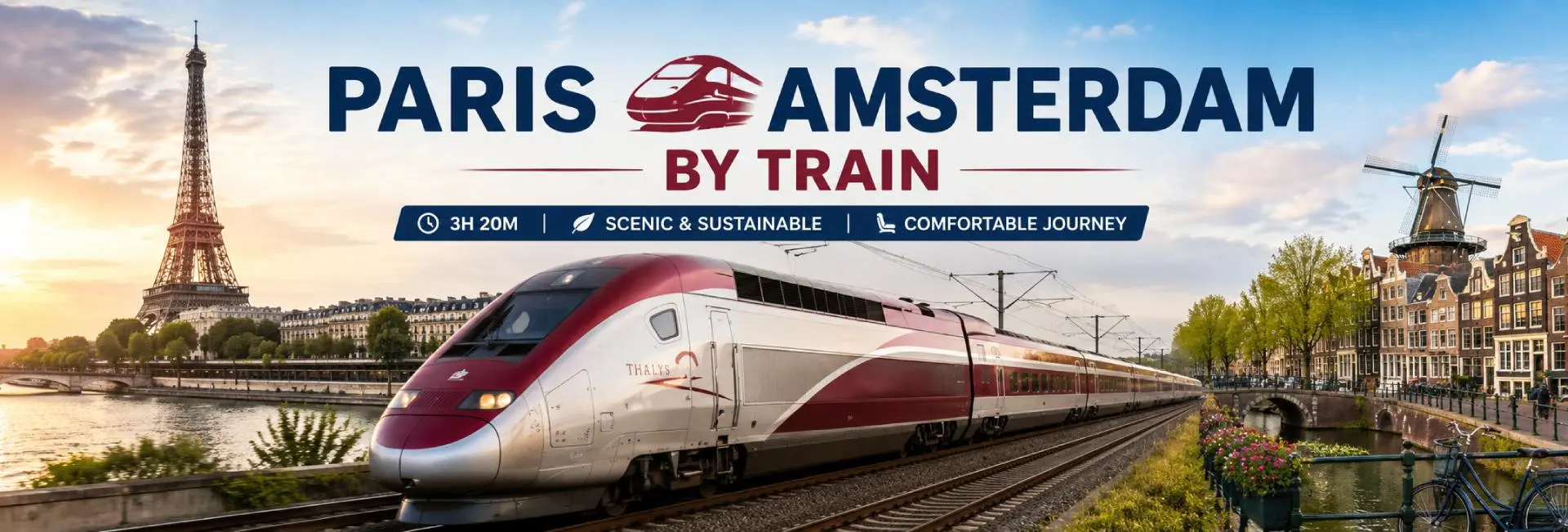
Eurostar operates the direct high-speed service between Paris and Amsterdam. The route was previously run under the Thalys brand, which merged into Eurostar in 2023 - if you see red trains with a Thalys-style livery, that's the same operator under its current name.
Journey time and stops
The fastest direct trains cover the route in around 3 hours and 20 minutes, though scheduled times vary by service, with some trains taking closer to 4 hours depending on how many stops they make. Trains call at Brussels-Midi and Rotterdam Centraal along the way, but you stay on board - no change of train is required for the direct service.
What it costs
Fares typically start from around €29–40 when booked well in advance, with standard one-way tickets more commonly ranging from €59 to €120 depending on how close to departure you book and how full the train is. Prices rise sharply in the final weeks before travel, so this is a route where early booking has a real effect on cost.
Classes of service
Most trains offer a Standard class with power outlets and free Wi-Fi, a Plus class with extra legroom and a light meal served at your seat, and a Premier class with flexible ticket changes, priority boarding, and a full meal included. For a 3-to-4-hour journey, Standard is sufficient for most travelers, and the extra cost of Plus or Premier is generally more about comfort and flexibility than necessity.
The Journey: What to Expect
Departure is from Paris Gare du Nord, one of the busiest international rail stations in Europe, so it's worth building in extra time if you're unfamiliar with the station's layout. Security and passport screening for this route typically take place before boarding rather than on the train itself.
Once underway, the route passes through the French countryside before crossing into Belgium and the Netherlands, with the landscape flattening out noticeably as you approach Amsterdam. The train arrives directly at Amsterdam Centraal, which sits right on the edge of the city center, within walking distance of the canal ring and a short tram ride from most central neighborhoods.
Tips for Getting the Best Fare
- Book as early as you can - advance fares are limited in number and sell out well before the cheapest tickets in the standard fare range
- Compare fares across a few days if your dates are flexible, since prices can shift noticeably even within the same week
- Midweek departures are often cheaper than Friday or Sunday trains, which see the heaviest demand from weekend travelers
- Check whether your fare is exchangeable or refundable before booking - cheaper advance fares are often non-refundable, while flexible fares cost more but allow changes closer to departure
Common Mistakes to Avoid
- Assuming any ticket works for any train - most fares on this route are valid only for the specific departure printed on the ticket
- Arriving at the station without enough buffer time, especially during peak summer travel when security lines are longer
- Booking a non-refundable fare too far in advance of a trip with an uncertain schedule
- Overlooking Rotterdam Centraal as a stop - it's a useful option if your final destination is closer to Rotterdam than Amsterdam
Conclusion
The Paris-to-Amsterdam train route is a straightforward, city-center-to-city-center alternative to flying, with a journey time of roughly 3 to 4 hours depending on the service. Booking early is the single biggest factor in keeping costs down, and Standard class is a comfortable, practical choice for most travelers. Since fares and schedules change with demand and season, confirm current prices and timetables directly with Eurostar or a booking platform before finalizing your trip.
FAQs about Paris to Amsterdam by Train
How long does the train from Paris to Amsterdam take? +
The fastest direct trains take around 3 hours and 20 minutes, though some scheduled services take closer to 4 hours depending on the number of stops.
Do I need to change trains between Paris and Amsterdam? +
No — the direct Eurostar service travels from Paris Gare du Nord to Amsterdam Centraal without requiring a change, even though it calls at Brussels-Midi and Rotterdam Centraal along the way.
How much does a ticket cost? +
Advance fares can start from around €29–40, while standard one-way tickets more commonly range from €59 to €120 depending on how close to departure you book; prices rise as the travel date approaches.
Which station do I depart from and arrive at? +
Trains depart from Paris Gare du Nord and arrive at Amsterdam Centraal, both of which sit in the heart of their respective cities.
Is it better to take the train or fly between Paris and Amsterdam? +
For most travelers, the train is more convenient, since it avoids airport transfers and security lines and drops you directly in the city center; total door-to-door time is often comparable to or faster than flying once airport time is factored in.
What's the difference between Eurostar Standard, Plus, and Premier? +
Standard includes seating, power outlets, and Wi-Fi; Plus adds extra legroom and a light meal; and Premier includes a full meal, flexible ticket changes, and priority boarding — Standard is sufficient for most trips on this route.
Do I need a passport for this journey? +
Yes, since it crosses an international border between France and the Netherlands, so a valid passport or EU national ID card is required.
How far in advance should I book? +
Book as early as possible, since advance fares are limited and sell out before standard-priced tickets, and prices generally rise the closer you get to the travel date.