Table of Contents
Overview
The Eiserner Steg, or "Iron Footbridge," is one of Frankfurt's most recognizable landmarks, spanning the Main River to connect the historic Altstadt with the Sachsenhausen district on the south bank. Pedestrians have crossed it for more than 150 years, making it as much a part of daily Frankfurt life as it is a tourist draw.
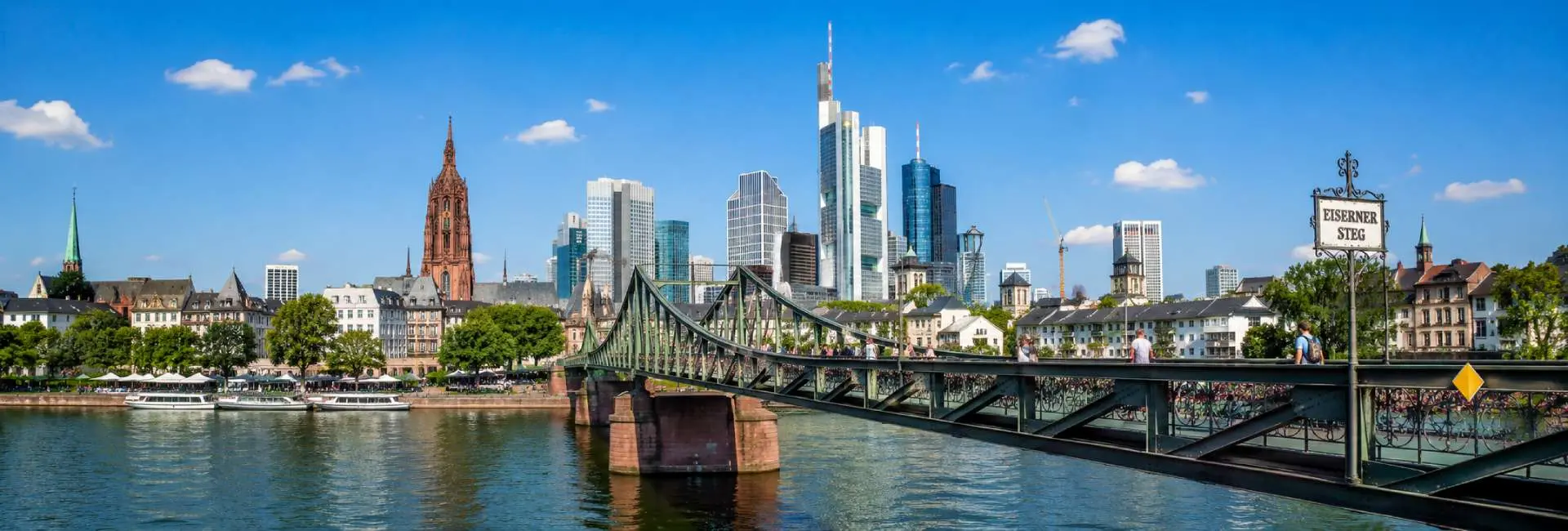
Beyond its function as a river crossing, the bridge offers one of the best vantage points in the city, framing the medieval Römerberg on one side and the glass-and-steel towers of Frankfurt's financial district, often nicknamed "Mainhattan," on the other. Free to cross and open at all hours, it remains a favorite spot for a quiet walk, a photograph, or simply watching the river traffic pass below.
History
Origins and Construction
The first Eiserner Steg was built between 1868 and 1869, funded through a public subscription organized by Frankfurt citizens and designed by architect Peter Schmick. It was a wrought-iron structure with neo-Gothic detailing, reflecting the city's growing industrial confidence at the time. The bridge opened to pedestrians on 29 September 1869.
Rebuilding for a Changing River
By the early twentieth century, the canalization of the Main and the rise in river shipping made the original bridge impractical. Between 1911 and 1912, it was replaced with a larger steel cantilever structure built on the existing piers, then widened and lengthened to its current form of roughly 170 metres.
Destruction and Postwar Rebuilding
On 25 March 1945, in the final weeks of the Second World War, German military engineers destroyed the bridge to slow the advancing Allied forces. Frankfurt, like much of the city center, had already suffered extensive bombing damage. Remarkably, the Eiserner Steg was rebuilt by 1946, becoming one of the first major structures restored in the devastated city and an early symbol of its recovery.
Later Renovation
The bridge underwent a thorough structural renewal in 1992 and 1993, during which accessibility features such as lifts for wheelchairs and pushchairs were added.
Architecture & Design
The current Eiserner Steg is a riveted steel cantilever bridge roughly 170 metres long and just over 5 metres wide, supported by two piers set into the riverbed. Its exposed trusswork gives it an industrial, functional silhouette quite different from the ornamental ironwork of the original 1869 structure, though it still carries a certain nineteenth-century engineering charm.
- Riveted steel truss construction typical of early 20th-century engineering
- Two river piers supporting the main span
- Pedestrian-only, with no vehicle access
- Wheelchair and pushchair lifts added during the 1992–93 renovation
Cultural Significance
The bridge has long captured the imagination of Frankfurt's artists and residents. Its steel form inspired expressionist painters Max Beckmann and Ernst Ludwig Kirchner, who each depicted it in their work during the early twentieth century.
Locally, the bridge is tied to a piece of Frankfurt dialect: crossing it means going from "Hibb de Bach" to "Dribb de Bach," roughly "this side of the brook" to "that side," an affectionate nod to the Main River dividing the city's two banks.
For years, the bridge's railings were covered in thousands of padlocks left by couples as a symbol of enduring love. In July 2025, city authorities removed an estimated five tons of these love locks to allow for renewal of the bridge's electrical and lighting systems, though the tradition of adding new locks continues.
Best Time to Visit
The Eiserner Steg is open around the clock and rewards visits at very different times of day. Early morning offers a quieter crossing with soft light on the river, while sunset is especially popular, when the skyline's glass towers catch the last light and the city begins to glow.
- Early morning: fewer crowds, calmer photos
- Sunset: the classic view of the illuminated skyline against the Main
- Evening: the bridge and skyline lights reflect on the water
Visitor Tips
- The bridge is free and always open, with no set visiting hours
- Walk to the middle of the span for the best photos of both the Altstadt and the modern skyline
- Pair a crossing with a stroll along the Museumsufer, the museum-lined embankment on the Sachsenhausen side
- The bridge can get crowded with tourists and cyclists passing through in peak season, so hold onto belongings and be mindful of foot traffic
- Bring a padlock if you'd like to take part in the bridge's love lock tradition
Nearby Attractions
The Eiserner Steg sits at the heart of Frankfurt's most walkable sightseeing stretch. On the north bank, it leads directly to the Römerberg, the city's reconstructed medieval square and historic seat of government, just steps from Frankfurt Cathedral (Kaiserdom).
On the south bank, it opens onto Sachsenhausen, known for its traditional Apfelwein (apple wine) taverns and lively restaurant scene, as well as the Museumsufer, a row of more than a dozen museums lining the riverbank, including the Städel Museum and the Museum Angewandte Kunst.
FAQs about Eiserner Steg (Iron Footbridge)
What is the Eiserner Steg? +
It's a historic pedestrian bridge in Frankfurt, Germany, spanning the Main River to connect the Old Town (Altstadt) with the Sachsenhausen district.
How old is the Eiserner Steg? +
The first bridge on this site opened in 1869. It was rebuilt in its current steel form in 1911–1912, destroyed in 1945, and reconstructed in 1946.
Is it free to cross the Eiserner Steg? +
Yes, the bridge is free and open to pedestrians at all times, with no tickets or set hours required.
What's the best time to visit for photos? +
Sunset is the most popular time, when the modern skyline lights up against the sky, though early morning offers a quieter, less crowded crossing.
Can you still add a love lock to the bridge? +
Yes, though city authorities removed a large number of older locks in 2025 for maintenance work, visitors still attach new padlocks to the railings as part of the tradition.
What's within walking distance of the bridge? +
The Römerberg square and Frankfurt Cathedral sit just off the north end, while the Museumsufer museum district and Sachsenhausen's apple wine taverns are a short walk from the south end.
Is the Eiserner Steg accessible for wheelchairs or strollers? +
Yes, lifts for wheelchairs and pushchairs were added during the 1992–93 renovation, making the bridge accessible from both banks.
Why was the bridge rebuilt so quickly after World War II? +
As a vital pedestrian link across the Main and a low-cost structure to reconstruct compared to Frankfurt's larger buildings, it was restored by 1946, making it one of the first landmarks rebuilt after the war's destruction.