Table of Contents
Overview
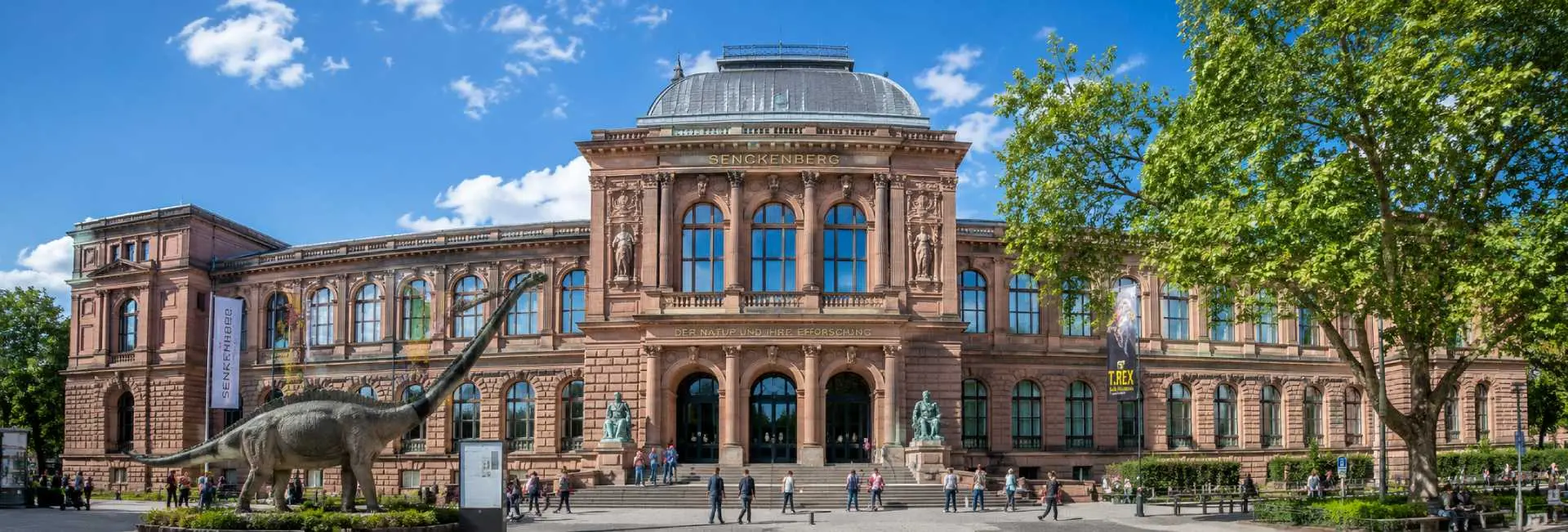
The Senckenberg Natural History Museum in Frankfurt is one of Germany's leading natural history museums, drawing visitors into a journey that spans millions of years of life on Earth. Its sandstone facade is flanked by a life-size Tyrannosaurus rex and a long-necked Diplodocus, a preview of the dinosaur gallery that has made the museum famous across Europe.
Beyond the dinosaurs, more than 10,000 exhibits cover everything from deep-sea creatures to birds, mammals, and the story of human evolution. The museum is run by the Senckenberg Nature Research Society, which means the exhibits are continually updated with findings from active scientific research rather than remaining a static historical collection.
History
Origins
The museum's roots trace back to 1763, when physician and naturalist Johann Christian Senckenberg left an endowment that funded scientific and medical institutions in Frankfurt, including a natural history collection. The public collection itself, then known as the Öffentliches Naturalienkabinett, was formally established in 1821 under the newly founded Senckenberg Nature Research Society.
A New Home on Senckenberganlage
As the collection grew through expeditions and donations, it outgrew its original premises. A purpose-built museum, designed by architect Ludwig Neher, was constructed between 1904 and 1907 at its current address on Senckenberganlage, where it has remained ever since.
Growth of the Collection
Over the following century, the museum expanded through global expeditions, major fossil acquisitions, and contributions from notable figures, including pieces donated by Johann Wolfgang von Goethe. Today the wider Senckenberg collection holds tens of millions of specimens, only a fraction of which are on public display at any time.
Recognition & Scientific Significance
The Senckenberg Natural History Museum is counted among the largest natural history museums in Germany and is widely regarded as home to the biggest dinosaur exhibition in Europe. It sits within a larger research network, the Senckenberg Nature Research Society, whose scientists actively use the museum's specimens in ongoing paleontological and biological research.
- One of Germany's largest natural history museums by collection size and exhibit count
- Recognized as home to Europe's most extensive dinosaur exhibition
- Backed by an active research institute, so exhibits reflect current scientific findings
- Attracted well over 800,000 visitors across 2022 and 2023 combined
The Dinosaur Gallery
Giants at the Entrance
Visitors are greeted before they even step inside: a Tyrannosaurus rex and a Diplodocus stand outside the museum's entrance, making the building itself a recognizable Frankfurt landmark. Inside, the dinosaur gallery expands on this first impression with one of the most complete dinosaur exhibitions on the continent.
Highlights Inside
The gallery includes casts and original fossils of species such as Triceratops, Iguanodon, Parasaurolophus, and a wall-mounted Plateosaurus, alongside a collection of fossilized dinosaur eggs. A particular scientific highlight is the Edmontosaurus specimen, a near-complete skeleton so well preserved that fossilized impressions of its skin remain visible, making it one of only two such specimens known worldwide.
Also on display is a Psittacosaurus fossil that was used in pioneering research to determine the actual coloration of a dinosaur's skin, giving visitors a rare link between a museum object and cutting-edge paleontology.
Key Collections & Exhibits
Deep Sea and Marine Research
The "Deep Sea" and "Marine Research" themed halls recreate the mysterious world of the oceans, including a representation of an Indonesian coral reef. A 21 to 22-meter fin whale skeleton, from the second-largest animal on Earth, is displayed alongside an outline on the wall that helps visitors grasp its true scale.
Birds and Mammals
The museum holds one of the world's largest and most diverse collections of preserved birds, with roughly 1,000 species represented. Among the standout exhibits is a life-size reconstruction of the extinct dodo, alongside galleries dedicated to mammals from around the world.
Earth Sciences and Human Origins
Exhibits also explore geological processes such as earthquakes and volcanic activity, connecting the story of life to the story of the planet itself. Displays on human evolution and fossil finds round out a collection that moves fluidly between biology, paleontology, and geology.
Ways to Experience the Museum
The museum can be explored independently at a visitor's own pace, following the flow from the dinosaur gallery through to the deep sea and mammal halls, or joined through guided tours and changing special exhibitions for a deeper dive into specific topics.
- Self-guided walk through the permanent dinosaur, marine, and mammal galleries
- Guided tours covering highlights or specific themes, useful for first-time visitors
- Rotating special exhibitions that showcase new research and rare specimens
- The "Aha?! Science Lab," an interactive space where visitors examine real objects from nature, take part in hands-on activities, and talk directly with Senckenberg scientists
- The Senckenberg Bistro on site for a break between galleries
Best Time to Visit
The museum is an indoor attraction, which makes it a reliable choice regardless of the weather, and a particularly good option on rainy or cold days in Frankfurt. Weekday mornings tend to be quieter, since school groups and family visits are more common on weekends and during German school holidays.
Because the museum draws well over 800,000 visitors across a typical two-year period, arriving early on weekends and public holidays helps avoid the busiest crowds around the most popular dinosaur exhibits.
Visitor Tips
- Arrive early on weekends or during school holidays, when the dinosaur gallery gets busiest
- Check current opening hours and ticket prices on the official Senckenberg website before visiting, as these can change
- Budget at least two to three hours to see the main galleries without rushing
- Look for the wall outline near the fin whale skeleton, which helps put its scale into perspective
- Visit the "Aha?! Science Lab" if traveling with children, since it is designed for hands-on engagement
- The museum is easily reached by public transit, with Bockenheimer Warte station just a few minutes' walk away
Nearby Attractions
The museum sits close to Frankfurt's university district and is within easy reach of several other attractions, making it simple to combine with a broader day of sightseeing.
- Palmengarten, Frankfurt's botanical garden, a short distance away
- Bockenheimer Warte, a historic city gate and transit hub near the museum
- Frankfurt West train station, offering onward connections around the city
- Frankfurt's wider Museumsufer district along the Main river, home to numerous other museums
FAQs about Senckenberg Natural History Museum
What is the Senckenberg Natural History Museum known for? +
It is best known for having one of the largest and most complete dinosaur exhibitions in Europe, alongside standout exhibits like a fin whale skeleton, a life-size dodo reconstruction, and a rare Edmontosaurus with preserved skin impressions.
How much time should I plan for a visit? +
Most visitors spend two to three hours seeing the main galleries, though dinosaur enthusiasts or those joining a guided tour may want to allow longer.
Is the museum suitable for children? +
Yes, the museum is popular with families, and the interactive "Aha?! Science Lab" is specifically designed to let children and adults engage hands-on with real scientific objects and activities.
Do I need to book tickets in advance? +
This can vary by season and special exhibitions, so it's best to check the official Senckenberg website shortly before your visit for current ticket options and any advance booking requirements.
How do I get to the museum? +
The museum is centrally located in Frankfurt on Senckenberganlage and is easily reached on foot from Bockenheimer Warte station, with Frankfurt West station also nearby for onward travel.
What's the best time of day to visit? +
Weekday mornings tend to be the quietest, while weekends and German school holidays bring larger crowds, especially around the dinosaur gallery.
What can I combine this visit with? +
The Palmengarten botanical garden and Frankfurt's Museumsufer district along the Main river are both within easy reach, making it simple to build a fuller day of sightseeing around the museum visit.