Table of Contents
Overview
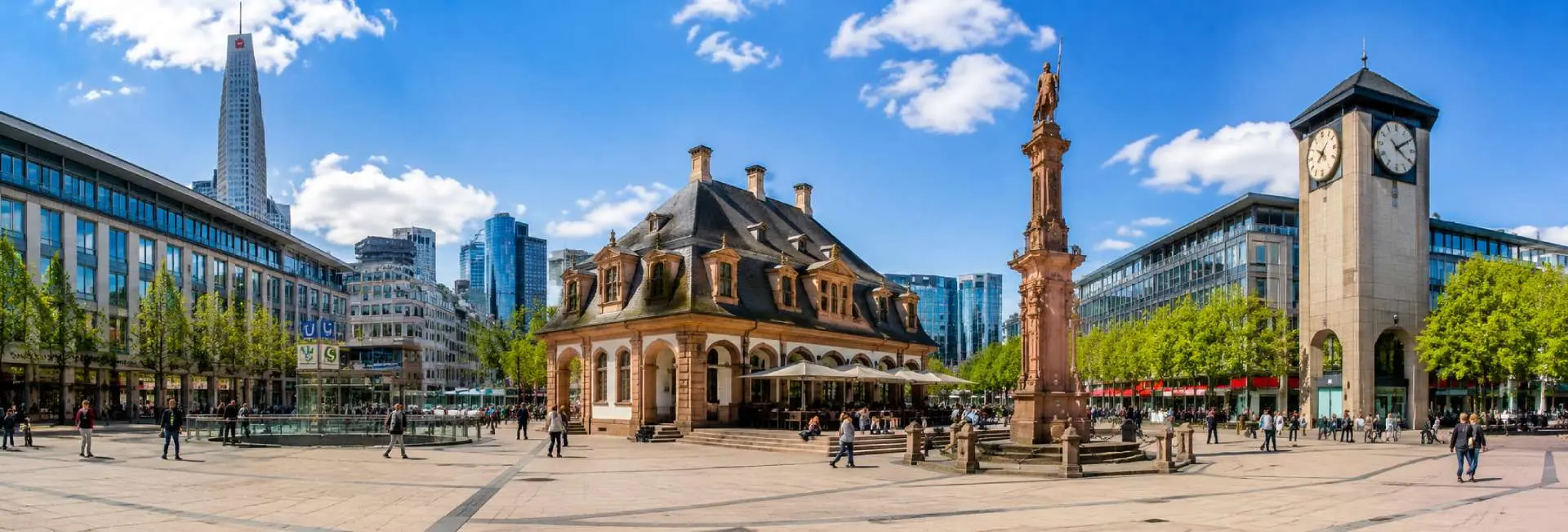
The Hauptwache is one of Frankfurt's most recognizable landmarks: a small baroque building at the centre of a large public square that has been the symbolic heart of the city for nearly three centuries. Built as a military guardhouse in 1729-30, it has since served as a police station, a prison, and, since 1904, a popular café.
Today the building lends its name to the surrounding square and to one of the busiest transit interchanges in the Rhine-Main region. For most visitors, the Hauptwache is less a single sight to tick off and more a natural starting point: a landmark to get oriented by before heading into Frankfurt's old town, its shopping streets, or its museums along the river.
History
Origins and Construction (1729-1730)
The Hauptwache was built between 1729 and 1730 to a design by the city's master builder, Johann Jakob Samhaimer (also spelled Samhammer). At the time, Frankfurt was a Free Imperial City within the Holy Roman Empire, governing and defending itself independently.
The new building served as the headquarters of the city's militia, the Stadtwehr, and included guard rooms as well as a small prison. Its distinctive hipped mansard roof and arcaded ground floor were designed to project civic authority in a style fitting the city's status.
The Wachensturm Uprising of 1833
On 3 April 1833, the Hauptwache became the scene of the Frankfurter Wachensturm, an attempted uprising in which a group of revolutionary students stormed the guardhouse in an effort to free prisoners and spark a broader revolt against the German Confederation. Several soldiers were killed in the clash, but the uprising was quickly suppressed and failed to achieve its wider aims.
The building's prison had a colourful history of its own: it once held the notorious robber Johannes Bückler, known as Schinderhannes, one of the most feared outlaws of the era.
From Guardhouse to Café (1866-Present)
The Hauptwache lost its military role in 1866 and continued as a police station for several more decades. In 1904, the building was converted into a café, a use it has retained ever since. It was heavily damaged during Allied bombing raids in the Second World War and rebuilt in the 1950s, closely following its original baroque appearance.
- 1729-30: Built as a militia guardhouse and prison
- 1833: Site of the Frankfurter Wachensturm uprising
- 1866: Military function ends; becomes a police station
- 1904: Converted into a café
- 1944: Heavily damaged in wartime bombing
- 1950s: Rebuilt in its historic baroque style
Architecture & Design
The Hauptwache is a compact but striking example of civic baroque architecture. Its ground floor is framed by arcaded pillars, above which sits a tall, steeply pitched mansard roof, a hallmark of 18th-century German baroque design. The façade combines warm yellow plasterwork with red sandstone detailing, giving the building a softer, more decorative look than its original function as a guardhouse and prison might suggest.
Because the surrounding square was almost entirely rebuilt after the Second World War in a modern commercial style, the Hauptwache now stands out even more sharply as the one clearly historic structure at the centre of an otherwise contemporary streetscape. Its scale is deliberately human and low-rise, a contrast that helps it read as a landmark despite being dwarfed in footprint by the department stores and office buildings around it.
Hauptwache Square Today
The square that takes its name from the building, An der Hauptwache, is one of the most heavily used public spaces in Frankfurt. Historically known as Paradeplatz and later Schillerplatz, it has functioned over the centuries as a parade ground, a marketplace, and now as a pedestrian meeting point and transit hub above one of the city's busiest underground stations.
The Hauptwache building itself operates as a café and restaurant, with seating inside the historic arcades and, in warmer months, outdoor tables spilling onto the square. It remains a popular, informal meeting spot for both Frankfurt residents and visitors, sitting at the point where the city's main shopping street meets several older, quieter side streets.
Nearby Attractions & Shopping
The Hauptwache's central location makes it a natural base for exploring several of Frankfurt's best-known sights and shopping streets on foot.
- Zeil: Germany's high-turnover pedestrian shopping street, running east from the square toward Konstablerwache
- St. Catherine's Church (Katharinenkirche): the city's largest Protestant church, on the square's south side, where Goethe was baptised in 1749
- Goethe House and Goethe Museum: the birthplace of Johann Wolfgang von Goethe, a short walk away
- Alte Oper: Frankfurt's grand former opera house, now a concert venue, reachable via Goethestraße and Grosse Bockenheimerstraße
- Römerberg and the Old Town (Altstadt): Frankfurt's historic city square and reconstructed medieval quarter
- Eschenheimer Turm: a well-preserved medieval city gate tower to the north
Getting There
By U-Bahn and S-Bahn
Hauptwache station sits directly beneath the square and is one of the busiest rapid-transit stations in the Rhine-Main region, used by tens of thousands of passengers daily. Multiple U-Bahn lines and S-Bahn lines serving the city's underground City Tunnel stop here, making it one of the easiest points in Frankfurt to reach without a car.
By Bus and Tram
Several bus routes stop close to the square, and tram lines run nearby along adjacent streets, connecting Hauptwache to other parts of the city centre.
On Foot
Frankfurt's compact city centre means the Hauptwache is within easy walking distance of the Römerberg old town, the Goethe House, the Alte Oper, and the riverside museum district along the Main.
Visitor Tips
- Use Hauptwache as an orientation point: most of Frankfurt's central sights, from the Old Town to the Alte Oper, are within a 10-15 minute walk
- Grab a coffee or a light meal at the café inside the historic building itself for a chance to sit within the guardhouse's original arcades
- Visit in the morning or early afternoon if you want a quieter experience, since the square gets very busy with shoppers and commuters, especially around midday and after work
- Combine a stop here with a walk down the Zeil for shopping, or head the opposite direction toward Goethestraße for higher-end boutiques
- The underground station can be confusing on first visit; look for clear signage toward An der Hauptwache exits to surface directly at the square
FAQs about Hauptwache (Main Guardhouse)
What is the Hauptwache in Frankfurt? +
It's a baroque building constructed in 1729-30 as a military guardhouse and prison, which today houses a café and gives its name to the large public square around it.
Is the Hauptwache free to visit? +
Yes, the square and the exterior of the building are free and open at all times; you only pay if you sit down at the café inside.
How much time do I need at the Hauptwache? +
Most visitors pass through in 10-20 minutes as part of a longer walk through the city centre, though you can easily linger longer over a coffee at the café.
How do I get to the Hauptwache? +
It sits directly above Frankfurt's Hauptwache station, one of the city's busiest transit hubs, served by multiple U-Bahn and S-Bahn lines as well as several bus routes, making it easy to reach from almost anywhere in the city.
What is the Hauptwache used for today? +
The historic building operates as a café and restaurant, while the surrounding square functions as a pedestrian meeting point, transit interchange, and gateway to Frankfurt's main shopping street, the Zeil.
What happened at the Hauptwache in 1833? +
It was the site of the Frankfurter Wachensturm, a failed uprising in which revolutionary students stormed the guardhouse to try to free prisoners and spark a broader revolt.
What's nearby the Hauptwache worth visiting? +
St. Catherine's Church, the Goethe House, the Alte Oper, and the Römerberg old town are all within easy walking distance, along with the Zeil shopping street.
Is the Hauptwache suitable for visitors with mobility needs? +
Yes, the square is an open, flat pedestrian area, and the underground station has accessible access, though the café's historic interior may have limited step-free options.