Table of Contents
Overview
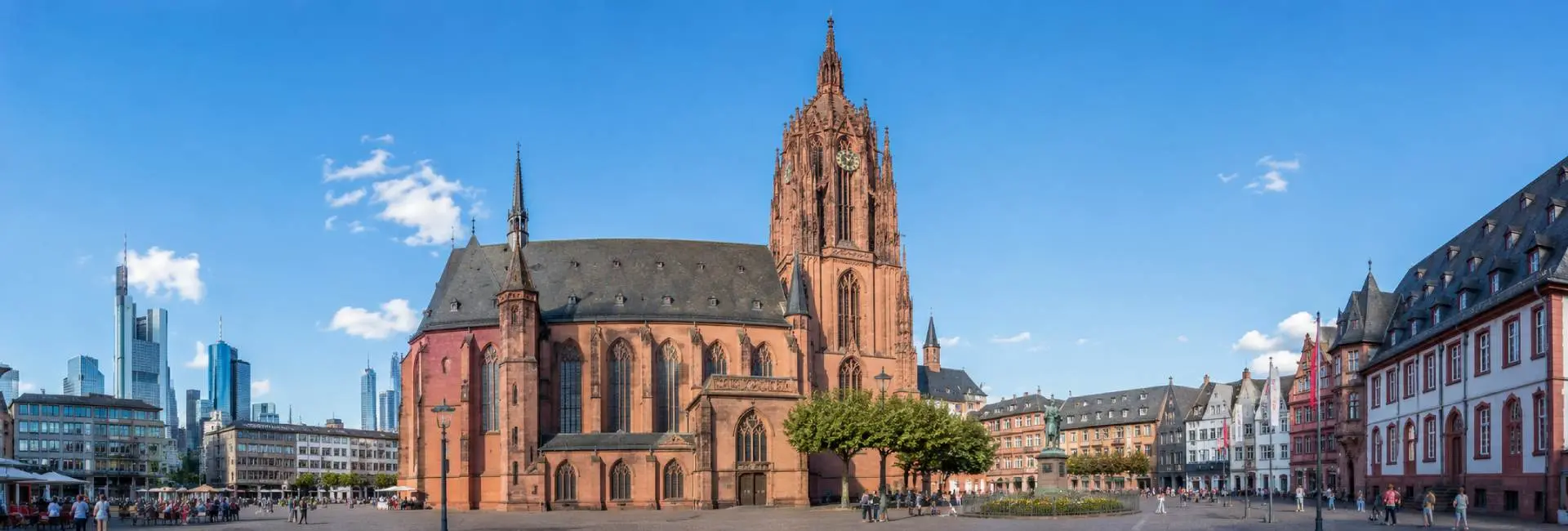
Rising above Frankfurt's Old Town, the Kaiserdom St. Bartholomäus is the city's largest and most historically significant church. Built from distinctive red sandstone, this Gothic landmark was never technically a bishop's cathedral, yet it earned the nickname "Kaiserdom" (Imperial Cathedral) for its central role in the Holy Roman Empire: from 1356 onward, it was the church where German kings were elected, and later where emperors were crowned. Today it remains an active place of worship and one of Frankfurt's most visited historic sites, drawing travelers for its soaring 95-metre tower, layered history, and treasured relics.
History
Ancient Origins
The site has hosted a place of worship since the 7th century, when a small Merovingian royal chapel stood here. It was enlarged in 794 to host the Council of Frankfurt under Charlemagne, then rebuilt as the Salvatorstift church, which was consecrated on September 1, 852. The church was rededicated to Saint Bartholomew in 1239, and shortly afterward the cathedral received a relic believed to be the apostle's skull, still part of the treasury today.
Becoming the Imperial Church
Construction of the Gothic building visitors see today began around 1250 and continued into the early 16th century. Its importance grew dramatically in 1356, when Emperor Charles IV's Golden Bull decreed that the seven imperial electors would gather here to choose the King of the Romans. From 1562 to 1792, ten Holy Roman Emperors were also crowned in front of the church's coronation altar, cementing its status as the empire's ceremonial heart.
Fire, War, and Reconstruction
The cathedral has been rebuilt from ruin twice. A major fire in 1867 gutted much of the structure, leading to a careful neo-Gothic restoration completed around 1880, which finally gave the west tower its spire based on designs originally drawn up in 1415. Far greater damage came during Allied bombing of Frankfurt's old town in March 1944, which left the cathedral a burnt-out shell. Reconstruction began after the war and continued through the 1950s, shaping the building's present-day appearance.
Recognition & Imperial Status
Despite its common name, the Kaiserdom has never actually been a cathedral in the strict sense, since Frankfurt was never the seat of a bishop; it functioned instead as a collegiate church from 852 until secularization in 1803, and today serves as a Catholic parish church within the Diocese of Limburg. Its "Imperial Cathedral" title is an honorary one, earned through its unique role as the election and coronation church of the Holy Roman Empire for over four centuries. That legacy makes it one of only a handful of churches in Germany to carry the designation Kaiserdom.
Architecture & Design
Gothic Structure
The cathedral is a cruciform hall church built largely of striking red sandstone, giving it a warmer tone than the grey stone typical of many northern European Gothic churches. Inside, a central nave is flanked by two aisles, separated by six Gothic pillars, three on each side, with construction and expansion of this core structure beginning around 1260.
The West Tower
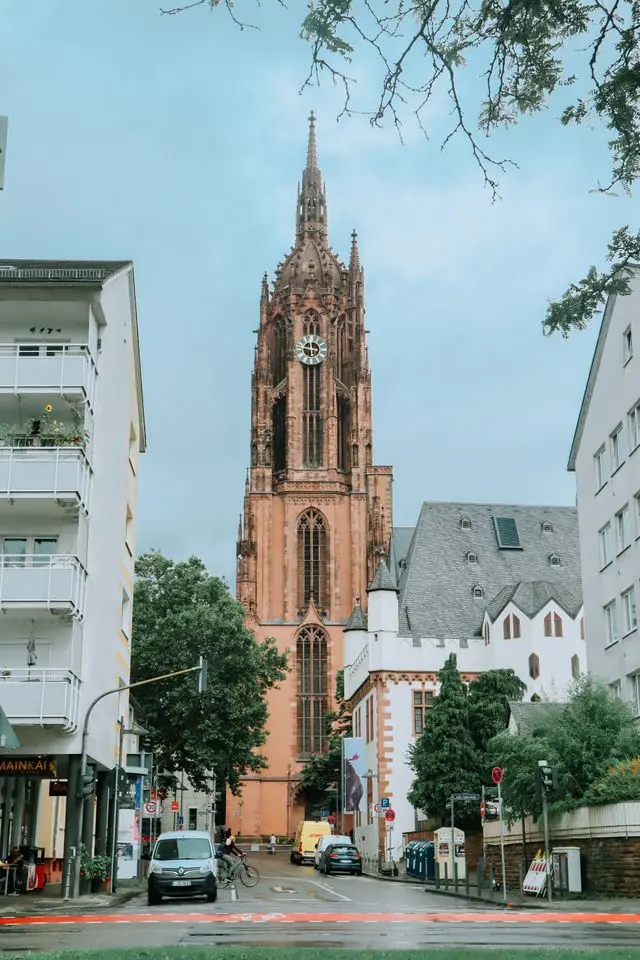
The cathedral's most recognizable feature is its 95-metre-high west tower, sometimes called "Frankfurt's first skyscraper" because it already dominated the skyline in the 15th century. The tower was designed by master builder Madern Gerthener in 1415, though its spire was not actually completed until the 1880s restoration following the 1867 fire.
Interior Highlights
Visitors enter through a stone-vaulted atrium built in 1879–80, which houses the Baroque Altar of the Assumption of Mary, the cathedral's only surviving Baroque altar. Inside, an impressive hammerbeam roof, historic choir stalls dating to 1352, and displays of historic weaponry and armor offer glimpses into the building's long past.
The Wahlkapelle: Where Emperors Were Chosen
Tucked at the end of the right aisle, the small vaulted Wahlkapelle (Election Chapel) is where the seven imperial electors met to choose a new king or emperor. Of the empire's rulers, sixteen were elected within this modest room, making it one of the most historically weighted spaces in German history. Look for the chapel's distinctive "skull" altar, a detail that has made the room memorable to generations of visitors.
In front of the choir, a white modern altar installed in 1994 marks the spot where the coronations themselves took place, standing in quiet contrast to the medieval stonework that surrounds it.
Notable Features & Artworks
The Skull Relic of St. Bartholomew
The cathedral's most venerated object is a skull relic attributed to St. Bartholomew, housed here since the 13th century and central to the building's dedication and pilgrimage history.
Historic Altars
The Maria Schlaf Altar in the Mary Chapel, created in 1434, is the only altar that has belonged to the cathedral since its original construction; it depicts a dying Virgin Mary surrounded by the apostles. A separate retable illustrating the life of Christ was originally made for a church in Salzwedel before coming to Frankfurt.
The Dommuseum
Adjoining the cathedral, the Dommuseum (Cathedral Museum) holds a compact but rich collection of liturgical objects, vestments, and sacred art connected to the building's centuries as an imperial church.
Climbing the Cathedral Tower
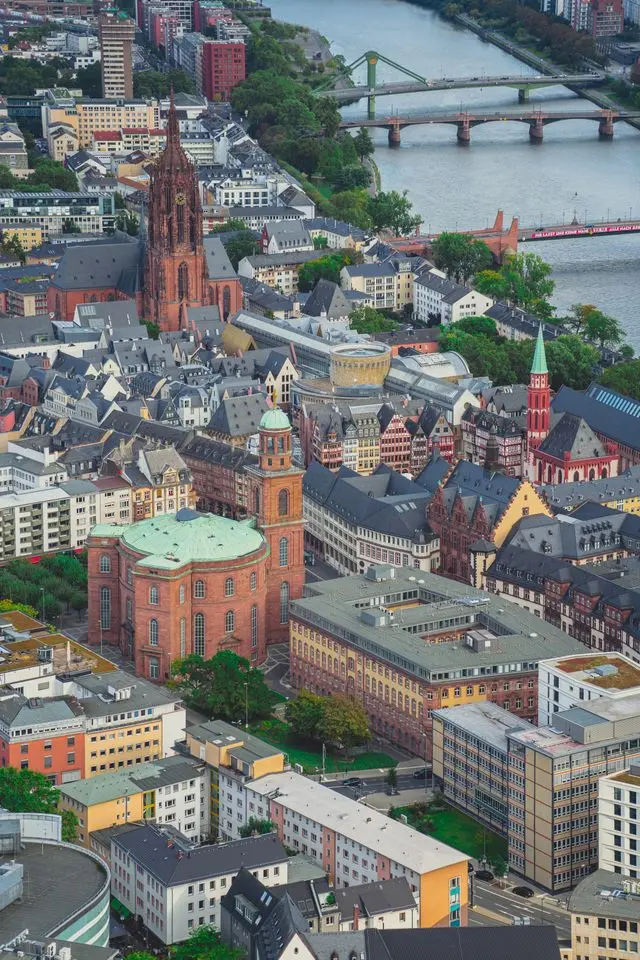
For panoramic views over Frankfurt's skyline, the Main River, and the surrounding old town, visitors can climb the cathedral's tower via several hundred spiral stone steps. The narrow stairwell makes for a memorable, if snug, ascent, and the platform near the top rewards the climb with one of the best vantage points in the city center.
- The climb involves a few hundred narrow stone steps, so comfortable shoes are recommended
- The tower has separate opening hours from the main cathedral and typically closes earlier
- Last entry is usually around 30 minutes before closing time
- A small admission fee applies to the tower, unlike the free main cathedral interior
Ways to Experience It
- Self-guided visit: explore the nave, chapels, and Wahlkapelle at your own pace, free of charge
- Tower climb: ascend for sweeping views of Frankfurt's skyline and the Main River
- Dommuseum visit: see liturgical treasures and sacred art on a separate ticket
- Guided tours: available for both the cathedral and the tower, with advance registration typically required for tower tours
- Combined old-town walking tours: many city tours pair the cathedral with the nearby Römerberg and Main Tower observation deck
- Organ recitals and concerts: held periodically inside the cathedral; check the official schedule before visiting
Best Time to Visit
Mornings shortly after opening tend to be quieter, especially before tour groups arrive from the Römerberg nearby. Late afternoon light is well suited to tower photography, offering softer views over the rooftops of the old town.
- Spring and autumn bring comfortable temperatures for the tower climb and outdoor old-town exploration
- Summer weekends are the busiest, particularly around midday
- Winter visits are quieter but come with reduced tower opening hours
- Sunset offers particularly striking exterior views of the red sandstone facade
Visitor Tips
- Entry to the main cathedral interior is free; only the tower and museum require a ticket
- No advance reservation is needed for the cathedral itself, but tower guided tours may require booking ahead
- Allow roughly 30–60 minutes for the interior, plus another 30–45 minutes if climbing the tower
- Photography is generally permitted inside for personal use, though flash is discouraged out of respect for the space
- The tower stairwell is narrow with no elevator, so it may not suit visitors with mobility limitations
- Check official opening hours and current ticket prices before your visit, as tower and museum hours differ from the main cathedral and can change seasonally
Nearby Attractions
- Römerberg: Frankfurt's historic central square, lined with reconstructed half-timbered buildings and the Old Town Hall
- Gutenberg Museum: a museum dedicated to the history of printing, located directly opposite the cathedral
- Museumsufer: a cluster of museums along the Main River, a short walk from the cathedral
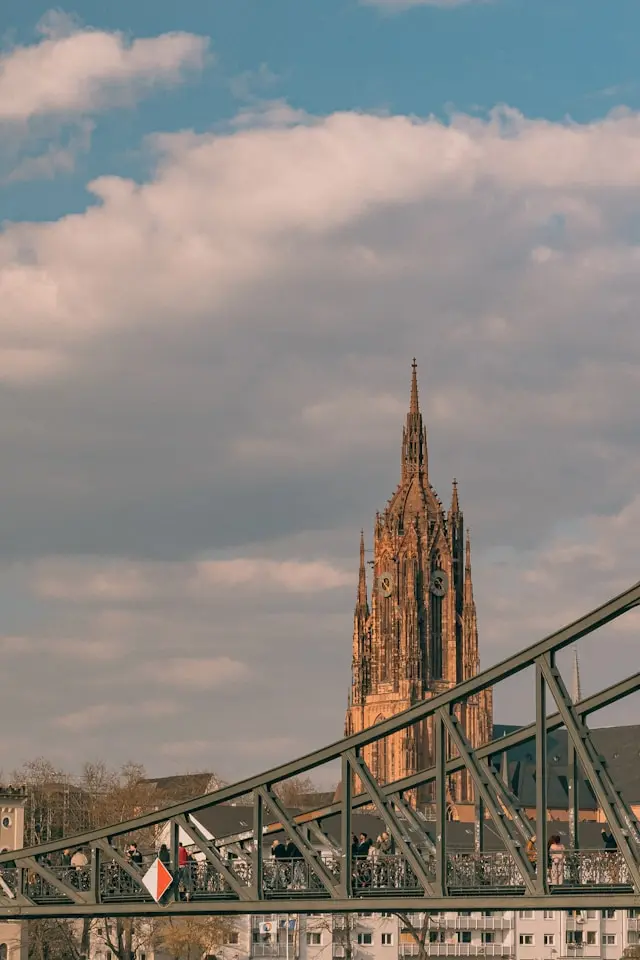
- Eiserner Steg: a historic pedestrian iron bridge over the Main River, popular for photos
- Main Tower: a modern skyscraper observation deck offering contrasting 360-degree views of the city
FAQs about Frankfurt Cathedral
Is entry to Frankfurt Cathedral free? +
Yes, entry to the main cathedral interior is free. A separate small fee applies only if you want to climb the tower or visit the Dommuseum.
How many steps are there to the top of the tower? +
The climb involves a few hundred narrow spiral stone steps, so wear comfortable shoes and expect a fairly tight stairwell along the way.
How long does a visit take? +
Exploring the cathedral interior typically takes 30 to 60 minutes; add another 30 to 45 minutes if you plan to climb the tower.
Is Frankfurt Cathedral actually a cathedral? +
Not technically. It has never been a bishop's seat, but it earned the honorary title "Kaiserdom" because Holy Roman Emperors were elected and crowned here for centuries.
What is the cathedral best known for? +
It's best known as the election and coronation church of the Holy Roman Empire, where German kings were chosen from 1356 and emperors crowned from 1562 to 1792, as well as for its 95-metre Gothic tower.
Do I need to book tickets in advance? +
No advance booking is needed for the cathedral itself. Guided tower tours, however, often require registration in advance, so it's worth checking ahead if you want a guided climb.
What's nearby that I can combine with a visit? +
The Römerberg square and the Gutenberg Museum are both within a short walk, making it easy to pair a cathedral visit with Frankfurt's historic old town.
Is the tower climb suitable for everyone? +
The tower has no elevator and a narrow stone stairwell, so it may be difficult for visitors with mobility issues, young children, or anyone uncomfortable with confined spaces.