Table of Contents
Overview
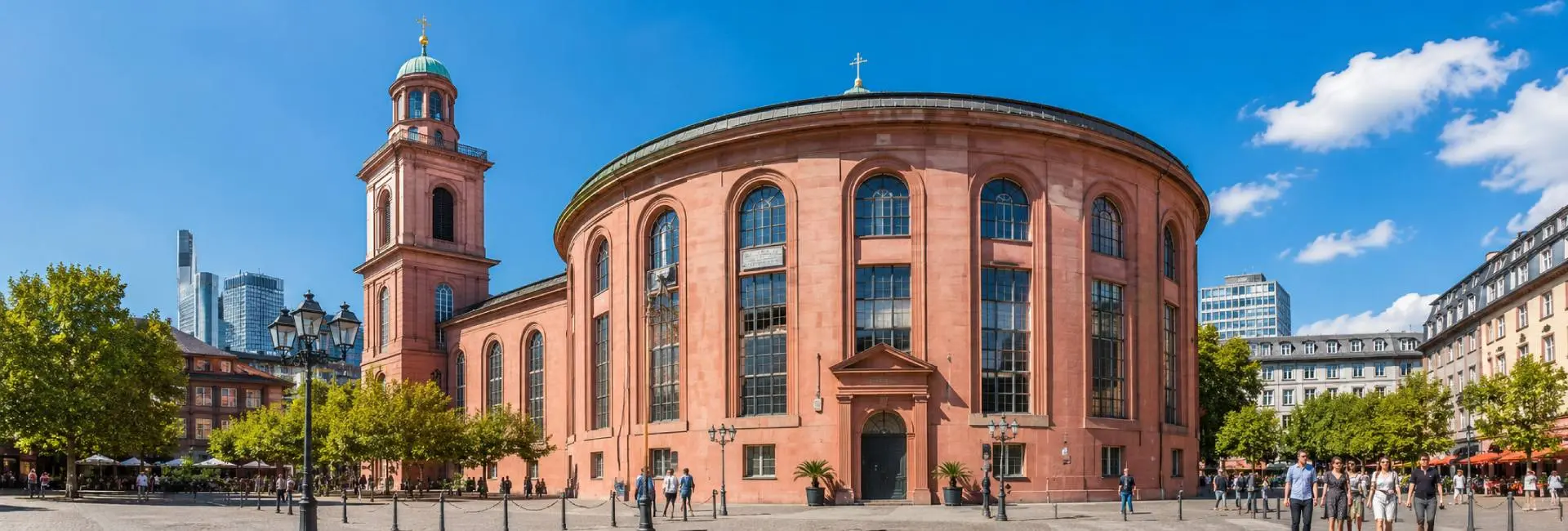
St. Paul's Church, known in German as the Paulskirche, is one of Frankfurt's most historically significant landmarks, though it hasn't functioned as a place of worship for decades. This oval, red sandstone building in the heart of the city is remembered above all as the meeting place of the Frankfurt National Assembly in 1848, Germany's first freely elected parliament.
Today the Paulskirche serves as a memorial and event venue, hosting exhibitions, award ceremonies, and civic gatherings that continue to link the building to its democratic legacy. For visitors, it offers a compact but powerful stop: a chance to stand in the room where modern German democracy took its first steps.
History
Origins and Construction
The church was built between 1789 and 1833 on the site of the medieval Barfüßerkirche, which had been torn down in 1786. Architect Johann Friedrich Christian Hess (with later work carried out under Johann Andreas Liebhardt) designed an unusual oval hall in the neoclassical style, intended to serve Frankfurt's Evangelical Lutheran congregation as its main church.
The Frankfurt National Assembly of 1848–49
The building's oval, centralized layout, originally chosen so that every worshipper could easily hear the pulpit, turned out to be ideally suited to a very different purpose. In 1848, during the wave of revolutions sweeping Europe, delegates from across the German states gathered in the Paulskirche to form the Frankfurt National Assembly, the first parliament elected by the German people as a whole.
Over the following months, the assembly drafted a constitution for a unified Germany, including a charter of basic rights. The effort ultimately collapsed in 1849 when Prussia and other major states refused to accept the new constitutional order, and the parliament was dissolved. Despite its failure, the assembly's work is regarded as the foundation of German constitutional democracy.
Destruction and Reconstruction
The Paulskirche was gutted by fire following an Allied bombing raid on Frankfurt in March 1944, leaving only its outer walls standing. Because of its symbolic weight, it was chosen as the first major building to be rebuilt in the devastated city center. Reconstruction began shortly after the war and the building reopened on 18 May 1948, timed to coincide with the centenary of the National Assembly. It was renovated again between 1988 and 1991.
Recognition & National Significance
- Widely referred to in Germany as the "cradle of German democracy" for hosting the 1848 National Assembly
- Recognized, alongside Hambach Castle, as one of the country's two great symbols of the 19th-century democratic movement
- Designated a national memorial after its 1948 reconstruction, rather than being restored to religious use
- Chosen by US President John F. Kennedy as the site of a major address in 1963, in recognition of its democratic symbolism
Architecture & Design
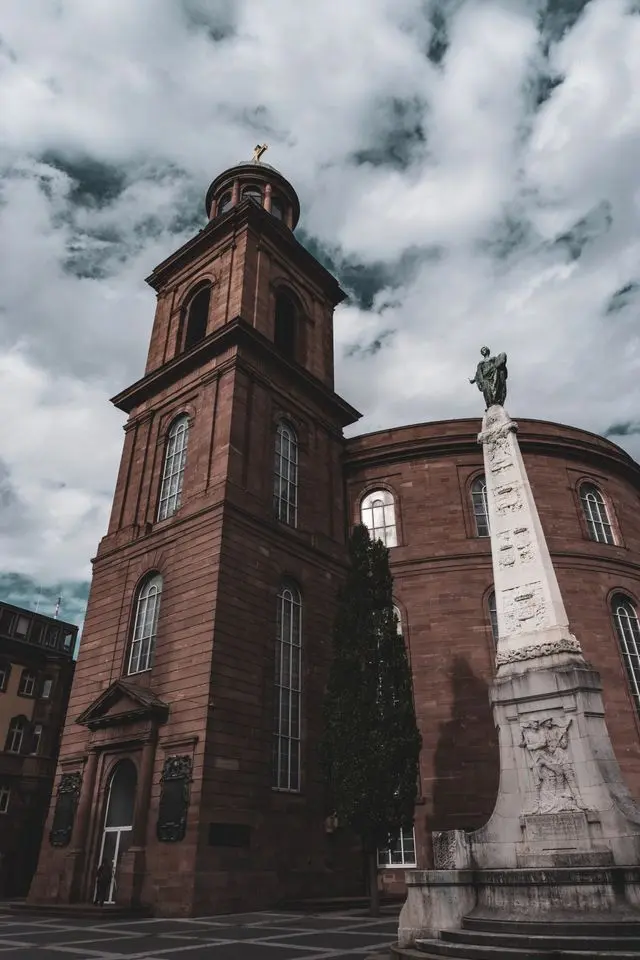
The Paulskirche is built from distinctive red sandstone in a restrained neoclassical style, centered on an oval nave rather than the traditional cross-shaped church layout. A single clock tower rises from one end of the building, while the roofline is capped by a shallow dome.
The interior was deliberately simplified during postwar reconstruction, favoring an open, functional hall over the ornate decoration of a traditional church. Its most notable interior feature today is a large modern mural depicting the delegates of 1848 processing into the building, a visual reminder of the room's political history rather than its religious one.
Notable Moments & Modern-Day Role
A Venue for National Ceremony
Since its reconstruction, the Paulskirche has hosted the Goethe Prize of the City of Frankfurt and, most famously, the Peace Prize of the German Book Trade, awarded each year during the Frankfurt Book Fair. Both events reinforce the building's role as a stage for public recognition of democratic and cultural achievement.
International Attention
In 1963, John F. Kennedy delivered a major speech in the Paulskirche during his visit to West Germany, calling it a building with the most justified claim in the country to the title "cradle of German democracy." In 1994, French high-wire artist Philippe Petit walked a rope strung between the Paulskirche and Frankfurt Cathedral as part of the city's 1,200th anniversary celebrations.
Ways to Experience It
Most visitors experience the Paulskirche through its permanent exhibition, which explores the story of the 1848 National Assembly and the building's role in German democratic history using documents, images, and historical context. The exhibition can typically be viewed independently at your own pace.
- Self-guided visit to view the exhibition hall and mural
- Combine with a guided walking tour of Frankfurt's Altstadt (old town), which often includes the Paulskirche as a stop
- Attend a public lecture, ceremony, or civic event, when the schedule allows
Best Time to Visit
The Paulskirche is an indoor attraction, so it makes a good option regardless of weather. Visiting on a weekday morning tends to be quieter, since the building sits close to Römerberg square and can see more foot traffic from tour groups later in the day.
Keep in mind that the building occasionally closes to the public for official ceremonies or events, particularly around the Frankfurt Book Fair in October, when it hosts the Peace Prize of the German Book Trade.
Visitor Tips
- Entry is generally free, making it an easy addition to a walk through the old town
- Check current opening hours before visiting, since these can change around events, ceremonies, or closures
- The visit is fairly short, roughly 30–45 minutes, making it easy to combine with other nearby sights
- Information panels are presented in German and English, so international visitors can follow the history without a guide
- The building is wheelchair accessible, though it's worth confirming current accessibility arrangements if needed
Nearby Attractions
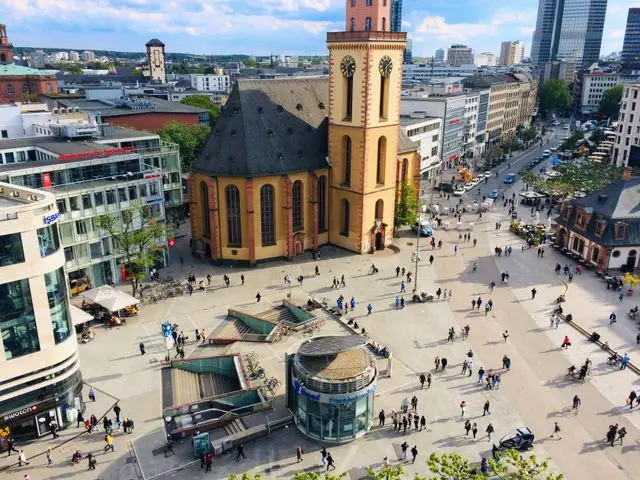
- Römerberg square and the Römer (Frankfurt's historic city hall), just a short walk away
- The reconstructed medieval Altstadt (old town) around the Hühnermarkt
- Frankfurt Cathedral (Kaiserdom), a few minutes on foot
- Museumsufer, Frankfurt's riverside museum district, reachable by a longer walk or short tram ride
Common Questions about St. Paul's Church (Paulskirche)
What is St. Paul's Church famous for? +
It's best known as the meeting place of the Frankfurt National Assembly in 1848–49, Germany's first freely elected parliament, which earned it the nickname "cradle of German democracy."
Is the Paulskirche still used as a church? +
No. It hasn't served as a place of worship since before World War II; today it functions as a memorial and event venue used for exhibitions, ceremonies, and award presentations.
How much time do I need to visit? +
Most visitors spend around 30 to 45 minutes viewing the exhibition and interior, making it easy to pair with a walk through Frankfurt's old town.
Is entry free? +
Entry is generally free of charge, though it's worth confirming current details before your visit since arrangements can change.
Is the Paulskirche wheelchair accessible? +
The building generally offers good accessibility, but visitors with specific needs should confirm current arrangements ahead of time.
What's nearby that I can combine with a visit? +
Römerberg square, the Römer city hall, Frankfurt Cathedral, and the reconstructed old town are all within easy walking distance.
Can the church close to visitors? +
Yes. Because it's an active event venue, the Paulskirche can close for official ceremonies, including the annual Peace Prize of the German Book Trade during the Frankfurt Book Fair, so it's worth checking ahead if visiting in October.
Why does the building look more like a hall than a traditional church? +
Its oval, centralized layout was originally designed so every seat had a clear view of the pulpit, a Protestant design choice that later made it a practical, hall-like space for parliamentary debate.