Table of Contents
Overview
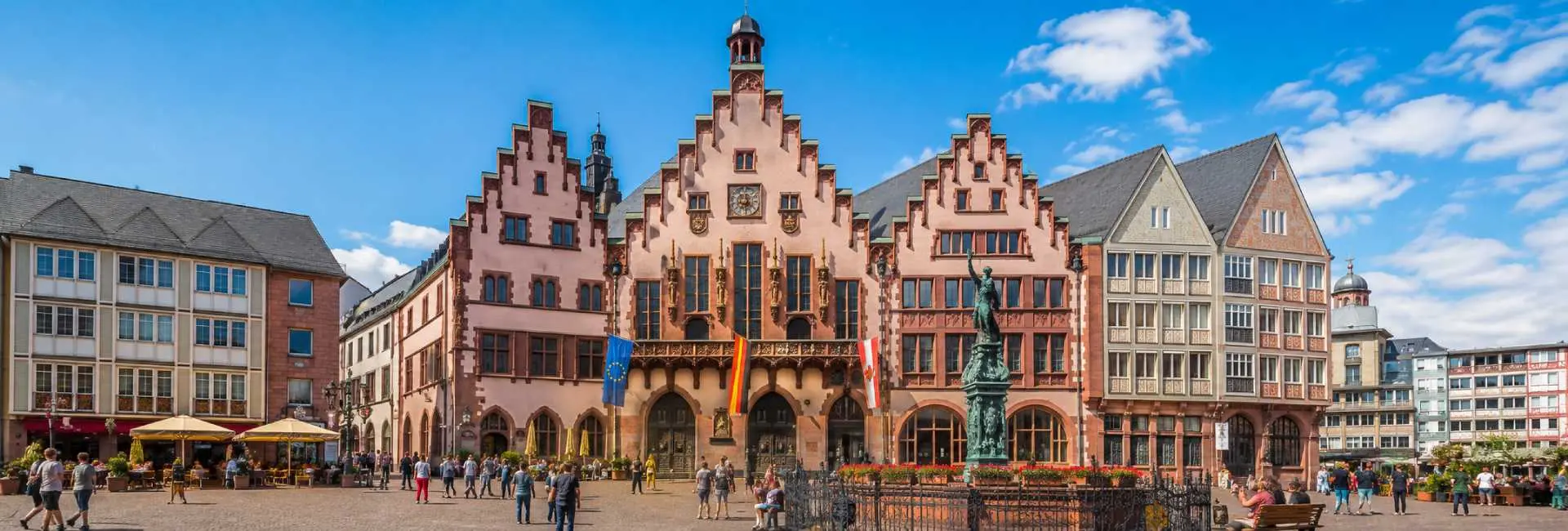
The Römer is Frankfurt's historic city hall, a cluster of medieval patrician houses standing at the heart of Römerberg Square in the Altstadt. For more than six centuries it has served as the seat of Frankfurt's city government, and its distinctive three-gabled facade is one of the most photographed sights in the city.
Beyond its administrative role, the Römer has a history that reaches far beyond Frankfurt itself. Its grand Kaisersaal once hosted the coronation banquets of Holy Roman Emperors, making the building a stage for events of national significance long before it became simply a municipal landmark.
History
Origins
On March 11, 1405, Frankfurt's city council purchased two neighboring patrician houses, known as "Zum Römer" and "Zum Goldenen Schwan" (the Golden Swan), to serve as a new town hall. The city's earlier town hall had become too small for a growing, prosperous trading city, and had been demolished a decade earlier to make way for the cathedral tower.
Over the following centuries, additional houses were absorbed into the complex, gradually forming the cluster of interconnected buildings that still forms Frankfurt's municipal government seat today. The central building, "Zum Römer," gave the whole complex its name, possibly a reference to Roman merchants or Roman-era settlement on the site, though the exact origin of the name is debated.
Imperial Importance
From an early stage, the Römer's significance extended well beyond city politics. After Holy Roman Emperors and German kings were crowned at Frankfurt Cathedral, they processed to the Römer's Kaisersaal for the coronation banquet and to present themselves to the public from its windows, cementing the building's place in the history of the empire.
In 1848, the newly formed National Assembly initially considered meeting at the Römer but relocated to nearby St. Paul's Church because the halls were too small to accommodate the delegates.
Destruction and Restoration
The Römer suffered extensive damage during Allied bombing raids in the Second World War, with much of the historic old town around it reduced to ruins. Reconstruction began in 1945, and the rebuilt city hall was formally reopened in 1955 by German President Theodor Heuss.
It wasn't until 1975 that the city restored the famous three-gabled facade to match its appearance from 1897, the look most visitors recognize today.
Architecture & The Three Gables
The Römer's signature image is its row of three stepped-gable houses facing Römerberg Square, built in the Gothic style between the 15th and 18th centuries. The central house, "Zum Römer," is flanked by "Alt-Limpurg" to the left and "Löwenstein" to the right.
Behind this famous facade, the complex is far larger than it first appears: a three-story arrangement of connected buildings and courtyards accumulated over hundreds of years of expansion, including a substantial administrative wing added in the early 20th century.
- Two towers, nicknamed "Langer Franz" (Tall Franz) and "Kleiner Cohn" (Little Cohn), were added during the early 1900s expansion.
- At roughly 70 meters, Langer Franz was once the second-tallest structure in Frankfurt, surpassed only by the cathedral.
- Both towers were damaged in the war and rebuilt afterward, though Langer Franz was given a flatter roofline than its original turreted top.
The Kaisersaal (Emperor's Hall)
The Kaisersaal, built around 1612, is the Römer's most celebrated interior space. Its walls are lined with 52 portraits of Holy Roman Emperors, forming a visual record of the coronations and imperial history tied to the building.
Historically, the hall was where newly crowned emperors and kings held their coronation banquets after their ceremony at Frankfurt Cathedral. Unlike most of the Römer's working municipal rooms, the Kaisersaal remains open for public visits today, giving travelers a rare look inside the building's ceremonial past.
Römerberg Square
The Römer forms the western backdrop of Römerberg, Frankfurt's historic central square and one of the best-preserved corners of the reconstructed Altstadt. The square is anchored by the Gerechtigkeitsbrunnen (Fountain of Justice) and lined with half-timbered houses that echo the medieval character of the district.
Römerberg is also the traditional heart of Frankfurt's Christmas Market, one of Germany's oldest, first documented in 1393. Each winter, market stalls and a towering illuminated Christmas tree fill the square, with an accompanying artists' market held inside the Römer's own halls.
Ways to Experience It
- Photograph the three-gabled facade from Römerberg Square, especially from the fountain side for the classic view.
- Step inside the Kaisersaal to see the 52 imperial portraits and learn about Frankfurt's coronation history.
- Join a walking tour of the Altstadt that includes the Römer alongside the cathedral and St. Paul's Church.
- Visit during the Christmas Market season, when the Römerhallen host a seasonal artists' fair.
- Attend a civil wedding ceremony at the Römer, which remains a functioning venue for official proceedings.
Best Time to Visit
Römerberg Square is worth visiting at any time of year, but early morning or early evening tends to offer the best light for photos and the smallest crowds, since the square is a popular stop on group tours during the day.
Late November through December brings a different atmosphere entirely, as the Christmas Market transforms the square with lights, a large decorated tree, and food stalls, though this is also the busiest and most crowded period.
Visitor Tips
- The Römerberg facade and square are free to view at any time; only the Kaisersaal requires a ticket, and it occasionally closes for official city events.
- Most of the Römer's interior remains a working government building and is not open to the public - the Kaisersaal is the main exception.
- The nearest public transit stop is Dom/Römer on U-Bahn lines U4 and U5, or Römer/Paulskirche on several tram lines.
- Check current opening hours and Kaisersaal ticket details on the official Frankfurt tourism site before visiting, since access can change around civic events and holidays.
- The square gets crowded during the Christmas Market; visiting on a weekday morning helps avoid the biggest crowds.
Nearby Attractions
- Frankfurt Cathedral (Kaiserdom) - a short walk away, the site of imperial coronations that preceded the Römer's banquets.
- St. Paul's Church (Paulskirche) - the historic meeting place of Germany's first freely elected national assembly.
- Old St. Nicholas Church - the small church overlooking Römerberg, known for its bell chimes.
- Museumsufer (Museum Embankment) - a row of museums along the River Main, a short stroll south of the old town.
Frequently Asked Questions about Römer
What is the Römer famous for? +
It's Frankfurt's historic city hall and one of Germany's most recognizable medieval landmarks, known for its three-gabled facade and its Kaisersaal, where Holy Roman Emperors once held coronation banquets.
Is the Römer still used as Frankfurt's city hall today? +
Yes, it remains the seat of Frankfurt's Lord Mayor and city government, alongside its role as a historic landmark.
Can visitors go inside the Römer? +
Most of the building is used for official city business and isn't open to the public, but the Kaisersaal (Emperor's Hall) can typically be visited, subject to occasional closures for city events.
Is visiting Römerberg Square free? +
Yes, the square and the exterior of the Römer are free to visit at any time; only entry to the Kaisersaal usually involves a ticket.
How long should I spend at the Römer? +
Most visitors spend 20 to 30 minutes admiring the square and facade, or up to an hour if they also visit the Kaisersaal and nearby Old St. Nicholas Church.
What's the best time to visit the Römer? +
Early morning or early evening offers quieter crowds and better light for photos; late November through December adds the atmosphere of Frankfurt's Christmas Market, though it's also the busiest time of year.
How do I get to the Römer? +
Take U-Bahn lines U4 or U5 to the Dom/Römer stop, or a tram to Römer/Paulskirche; the square is also an easy walk from Frankfurt's old town and riverfront.
What's nearby the Römer worth visiting? +
Frankfurt Cathedral, St. Paul's Church, Old St. Nicholas Church, and the Museumsufer museums along the River Main are all within easy walking distance.