Table of Contents
Overview
The Palmengarten is a 22-hectare botanical garden in Frankfurt's Westend district, widely regarded as one of Germany's finest. Since opening in 1871, it has drawn visitors into a world of exotic flora arranged across sweeping outdoor gardens and a series of remarkable glasshouses, from the Victorian-era Palm House to the modern Tropicarium.
More than a collection of plants, the Palmengarten functions as a living museum, research site, and cultural venue rolled into one. Concerts, flower shows, and seasonal exhibitions run alongside its scientific work, making it as much a part of Frankfurt's civic life as its skyline or its river.
History
A Citizens' Initiative
The Palmengarten's origins trace back to 1866, when Prussia annexed the Duchy of Nassau and left Duke Adolph von Nassau in financial difficulty. Forced to sell his prized exotic plant collection from the Biebrich Winter Gardens, the duke turned to renowned landscape gardener Heinrich Siesmayer to find a buyer.
Rather than see the collection scattered, Siesmayer proposed a bold alternative: bring the plants to Frankfurt and build a public garden around them. Wealthy citizens, bankers, and merchants bought "Palmengarten shares" to fund the project, and the garden opened to the public on 16 March 1871.
Expansion and Wartime Disruption
The garden's centerpiece, the Palm House, was completed in 1869 and was among the largest greenhouses in Europe at the time. The city of Frankfurt took over management of the Palmengarten in 1931.
The Second World War brought heavy damage to the garden and its structures, and the site was later placed under American occupation authority before returning to city control in the 1960s. A major reconstruction effort followed, restoring and expanding the greenhouses, with the work fully complete by 1992.
Modern Growth
In 1987, the Palmengarten unveiled the Tropicarium, a striking modern greenhouse complex. In 2012, Frankfurt's Botanical Garden was brought under the Palmengarten's administration, joining the two green spaces into one of the largest connected garden areas in the city.
The Palm House and Tropicarium
The Palm House (Palmenhaus)
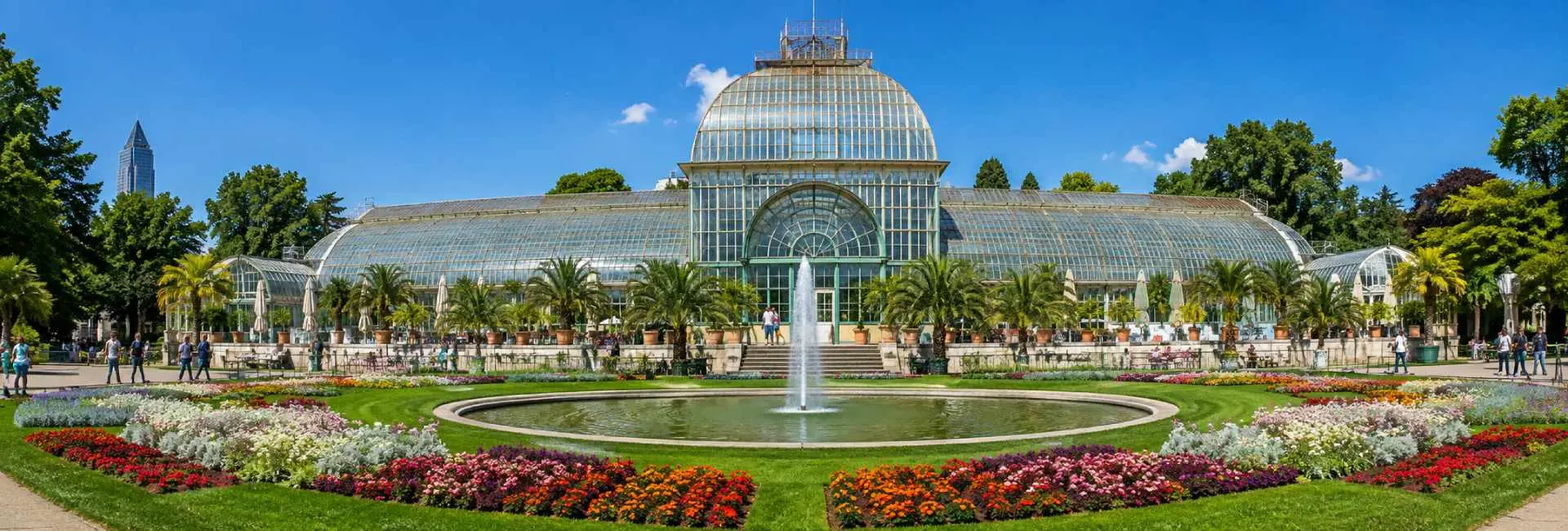
Built in 1869 by architect Friedrich Kaysser, the 18-meter-high Palm House was inspired by grand 19th-century glasshouses such as the Palm House at Kew Gardens in London. It once ranked among the largest greenhouses in Germany and remains the garden's most iconic structure, sheltering towering palms alongside subtropical plants beneath its iron-and-glass canopy.
The Tropicarium
Opened in 1987 and designed by architect Hermann Blomeier, the Tropicarium is the largest construction project in the Palmengarten's history. Its geometric design, inspired by the cross-section of a cactus, links together 14 individual greenhouses of varying height, the tallest reaching 15 meters.
Inside, visitors move through simulated climate zones from around the world, including rainforest, monsoon forest, mangrove swamp, desert, and cool sub-Antarctic vegetation. Special glazing and heating systems protect the plants from both sunburn and cold condensation, allowing genuinely tropical conditions to thrive within a temperate city.
Flower and Butterfly House
Opened to mark the Palmengarten's 150th anniversary, the Flower and Butterfly House lets visitors walk among free-flying Monarch, Morpho, and Banana butterflies amid decorative blooms, adding a lively, hands-on dimension to the garden's greenhouse collection.
Key Areas and Gardens
- Rose Garden – A fragrant highlight in summer, filled with flowering rose varieties.
- Boat Pond and Octagon Fountain – A scenic water feature at the heart of the park's outdoor landscape.
- Cactus and Fuchsia Garden – Dedicated beds showcasing succulents and flowering fuchsias.
- Rhododendron Garden – A springtime showcase of color and one of the garden's most photographed areas.
- Steppe, Perennial, Heath, and Rock Gardens – A set of themed outdoor plantings representing different natural habitats.
- Aripuca Garden – A distinctively designed planting area inspired by traditional Amazonian structures.
- Botanical Garden – The adjoining university botanical garden, administratively joined with the Palmengarten since 2012.
Plant Collections and Notable Specimens
The Palmengarten is home to a vast and scientifically significant plant collection, with thousands of species and varieties represented across its greenhouses and outdoor beds. Behind the public display houses, gardeners cultivate plants of high botanical value, including bromeliads, orchids, carnivorous species, and the dramatic Amorphophallus (titan arum).
Among the garden's most striking living exhibits are its mature palm specimens, some more than a century old, which give the garden both its name and its distinctive character. The February Orchid Exhibition is a particular draw for plant enthusiasts, showcasing rare and exotic varieties at their peak.
Seasonal Highlights and Events
- Rose Festival – A summer celebration of the garden's blooming Rose Garden.
- Winter Lights – An illuminated evening event that transforms the garden after dark.
- Orchid Exhibition – A February showcase of exotic and rare orchid species.
- Live Music and Concerts – Performances spanning jazz, opera, pop, electronic, and sound art throughout the year.
- Rhododendron Bloom – A spring spectacle in the dedicated Rhododendron Garden.
The Palmengarten has also hosted memorable one-off moments in its history, including a performance by American entertainer Buffalo Bill and his Wild West show in 1890, a reminder of the garden's long-standing role as a public gathering place.
Ways to Experience It
- Self-guided wandering – Explore the greenhouses and outdoor gardens at your own pace.
- Guided tours – Regularly scheduled tours offer deeper insight into the garden's plant science and history.
- Seasonal exhibitions – Flower shows and themed displays rotate throughout the year.
- Family visits – Playgrounds, water features, and the Flower and Butterfly House make it a popular choice for children.
- Concerts and cultural events – Evening performances add a different atmosphere to a garden visit.
Best Time to Visit
The Palmengarten rewards visits in every season. Spring brings the Rhododendron Garden into full color, while summer is peak season for the Rose Garden and outdoor plantings. Because the greenhouses maintain tropical and subtropical conditions year-round, the Palmengarten also makes an excellent rainy-day or winter destination, when the Winter Lights event adds an extra reason to visit after dark.
Weekday mornings tend to be quieter than weekend afternoons, particularly during flower shows and festivals, which draw larger crowds.
Visitor Tips
- Plan for at least two to three hours to see the main greenhouses and gardens comfortably.
- Combine a visit with the adjoining Botanical Garden, now administered together with the Palmengarten.
- Wear layers, since the Tropicarium's climate zones range from humid rainforest heat to cooler sub-Antarctic conditions.
- Check opening hours and ticket prices on the official website before visiting, as these can change seasonally.
- Arrive by public transit where possible; the garden is well served by nearby U-Bahn and tram stops, and an underground car park is available for drivers.
Nearby Attractions
- Botanical Garden (Botanischer Garten) – Directly adjoining the Palmengarten and administered together with it.
- Grüneburgpark – A large public park bordering the Palmengarten to the north.
- Westend District – A leafy residential area known for its historic villas and green streets.
- Frankfurt City Center – Museums, the Römerberg old town square, and the Zeil shopping district are a short ride away.
FAQs about Palmengarten Frankfurt
What is the Palmengarten and what makes it famous? +
The Palmengarten is a historic 22-hectare botanical garden in Frankfurt, known for its Victorian-era Palm House, the modern Tropicarium with its simulated world climate zones, and its extensive plant collections spanning over 150 years of history.
How much time should I plan for a visit? +
Most visitors spend two to three hours exploring the main greenhouses and gardens; allow closer to half a day if you also want to visit the adjoining Botanical Garden.
Is the Palmengarten open year-round? +
Yes, the garden and its heated greenhouses are open year-round, making it a good option even in winter or on rainy days, though opening hours vary by season and should be confirmed on the official website before visiting.
Do I need tickets, and how much does entry cost? +
Entry requires a paid ticket; exact pricing and any seasonal discounts change periodically, so it's best to check current rates on the official Palmengarten website before your visit.
How do I get to the Palmengarten? +
The garden is easily reached by public transit, with nearby U-Bahn and tram stops including Bockenheimer Warte, Westend, and Palmengartenstraße; an underground car park is also available for those driving.
Is it suitable for children and visitors with limited mobility? +
Yes, the garden has playgrounds, water features, and the interactive Flower and Butterfly House, making it popular with families, and its paved pathways are generally accessible, though visitors with specific mobility needs should check current accessibility details in advance.
What's nearby that I can combine with a visit? +
The adjoining Botanical Garden and neighboring Grüneburkpark make for an easy extended green-space visit, while Frankfurt's city center, with its museums and old town square, is only a short trip away.
What should first-time visitors know before going? +
Bring layers for the Tropicarium's varied climate zones, check for seasonal flower shows or festivals that may affect crowd levels, and set aside extra time if you plan to explore the adjoining Botanical Garden as well.