Table of Contents
Overview
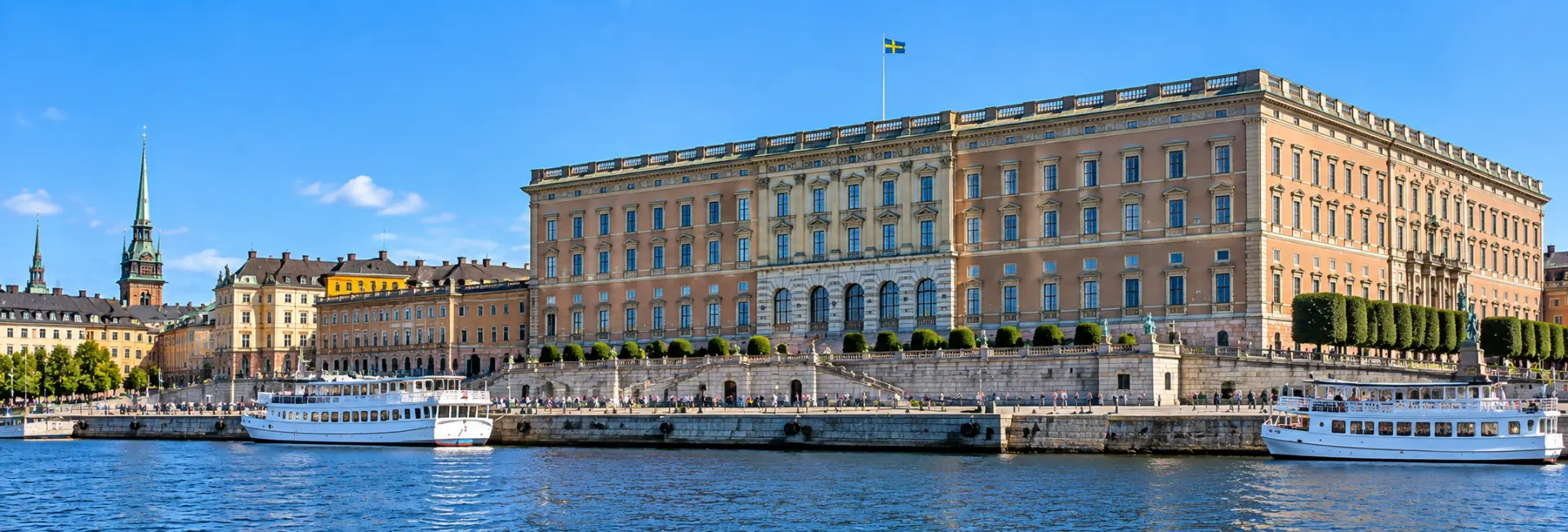
Stockholm Palace, known in Swedish as Kungliga slottet, is the official residence of the King of Sweden and one of the largest royal palaces in Europe still used for its original purpose. It stands on a hill at the northern edge of Gamla Stan, facing the water, and its massive Baroque bulk dominates the skyline of the Old Town.
Unlike many palaces that have become pure museums, this one is a working building. The Royal Court has its offices here, roughly two hundred people work inside, and most of the monarchy's official receptions and state ceremonies take place in its grand rooms. At the same time, a large part of the building is open to the public throughout the year, which gives visitors an unusually direct look at how a modern monarchy operates.
A visit combines several experiences in one address: opulent state apartments, a collection of royal regalia, a museum in the cellars of the medieval castle that once stood here, and one of the oldest museums in Sweden. Outside, the daily Changing of the Guard adds pageantry to the courtyards. Together they make the palace one of the most rewarding stops in Stockholm for anyone interested in Swedish history.
History
From Medieval Fortress to Tre Kronor
The palace stands on the site where Stockholm itself began. In the mid-thirteenth century a fortified stronghold rose on the island's high ground, traditionally linked to the city's founder, Birger Jarl. Over the following centuries it grew into a royal castle known as Tre Kronor, or Three Crowns, and served as the seat of Swedish kings during the medieval and Vasa periods.
The Fire of 1697
On 7 May 1697, a devastating fire tore through the castle and destroyed most of it. Only the north wing survived, along with a few treasures that were carried out during the blaze, including a silver throne made for Queen Kristina. The disaster left the Swedish crown without a proper royal seat, and it was decided almost at once to build a new palace on the same site.
Building the New Palace
The architect Nicodemus Tessin the Younger, who had studied in Italy and France, designed a monumental Baroque palace inspired by Roman models. Construction was slowed by the Great Northern War and by Tessin's death in 1728, after which Carl Hårleman took over as master builder. The royal family was finally able to move in during 1754, and interior work continued for years afterward. The palace was also planned to house the state administration and the Royal Library, which partly explains its enormous size.
A Palace in the Modern Era
Over the past two centuries the palace has adapted to changing times. Parliament once met in its Hall of State, the National Library moved out in the nineteenth century, and new suites were created for later royal families. Today the palace remains the King's official residence and the stage for state visits and receptions, while a long-running restoration of the sandstone facade has been underway since 2011.
Architecture & Notable Rooms
A Roman-Inspired Baroque Palace
The exterior is strict and monumental rather than decorative. The building is enormous, roughly 230 meters long and 125 meters wide, and its facades of stone and brick are calm and orderly. The overall effect is more grand than ornate, a deliberate choice that reflects the palace's role as a seat of state as well as a home.
The Royal Apartments
The interiors are far more lavish. The Royal Apartments is the collective name for the sequence of state rooms that includes the State Apartments, the Guest Apartments, the Bernadotte Apartments, and the Apartments of the Orders of Chivalry. Their salons are filled with tapestries, painted ceilings, gilded furniture, and portraits from the eighteenth and nineteenth centuries, and they are still used for official receptions and dinners.
The Hall of State
One of the most impressive rooms is Rikssalen, the Hall of State. It was ready for the parliament of 1755 and was used for ceremonial occasions for generations, including the annual opening of parliament until 1974. Its best-known object is the silver throne bought for Queen Kristina's coronation in 1650, one of the few items saved from the fire that destroyed Tre Kronor.
The Royal Chapel
Designed by Tessin and completed by Hårleman, the Royal Chapel is a richly decorated space that hosts concerts, special events, and regular services. It also contains pew doors carved by the cabinetmaker Georg Haupt that came from the earlier castle chapel and survived the fire.
Museums & Collections
Within the palace walls are several museums, each focusing on a different chapter of royal history. They differ enough in tone that many visitors choose one or two rather than trying to see everything in a single visit.
The Treasury
Housed in dark vaulted cellars, the Treasury displays the Swedish regalia, including crowns, scepters, and orbs. Highlights include the sword of state of King Gustav Vasa, the crown and orb of King Erik XIV, and a silver baptismal font from 1696 that is still used for royal christenings.
The Tre Kronor Museum
Opened in 1999 in the surviving cellar vaults, this museum tells the story of the medieval castle. Models, archaeological finds, and displays trace how the fortress developed into a royal residence, and visitors can see a section of the old city wall dating back to the thirteenth century.
Gustav III's Museum of Antiquities
This gallery opened in 1794 and is one of the oldest museums in Europe. It preserves the collection of around two hundred sculptures that King Gustav III acquired on his travels in Italy, still displayed much as they were arranged in his day. Among the best known pieces are the sleeping Endymion and the group of Apollo and the Nine Muses.
The Royal Armoury
Known as Livrustkammaren, the Royal Armoury is the oldest museum in Sweden, founded in the seventeenth century when King Gustavus Adolphus decided to preserve his clothing from a military campaign. Its collection of armor, royal costumes, and weapons is supplemented by coronation carriages and elegant coaches from the Royal Stables.
The Royal Guard & Courtyards
The Changing of the Guard
The Royal Guards have watched over the palace and the royal family since 1523, and their ceremonial handover is one of the most popular free attractions in Stockholm. It takes place in the Outer Courtyard, lasts around forty minutes, and usually begins at 12:15 on weekdays and Saturdays and at 13:15 on Sundays and public holidays.
Parades and Music
On selected days the guards march or ride through the city, accompanied by a military music corps, and arrive at the palace in a full parade. The mounted version with horses and music takes place on certain days from April to August, while in winter the parade is smaller and starts from the Old Town. Times and routes can change, so it is best to check the current schedule.
Courtyards and Surroundings
The palace is approached by the sloping street of Slottsbacken, and its courtyards and terraces are part of the experience. The Outer Courtyard is where the crowds gather for the guard ceremony, while the Lejonbacken terrace is the entrance to the Museum of Antiquities and offers a view over the water.
Ways to Experience It
- Explore the state rooms: Walk through the Royal Apartments and the Hall of State at your own pace, or join a guided tour that explains the history and etiquette of royal life.
- Choose your museums: The Treasury, the Tre Kronor Museum, the Museum of Antiquities, and the Royal Armoury each take a different approach, so pick the ones that appeal most.
- Watch the guard ceremony: Arrive early to claim a spot in the Outer Courtyard, since crowds build quickly. The ceremony is free and needs no ticket.
- Attend a concert or service: The Royal Chapel is used for events and services throughout the year, so check the calendar if you want to hear it in use.
- Use an audio guide or app: Digital guides and audio tours add background to the rooms and collections.
- Visit the gift shop: The Royal Gift Shop sells souvenirs inspired by the palace collections and royal history.
Most visitors spend two to three hours inside the palace, and longer if they want to see several museums in depth.
Best Time to Visit
By Season
The palace is open throughout the year, but the experience changes with the seasons. Summer offers the fullest guard programme, with parades and mounted units on many days, and the longest opening hours, but also the largest crowds. In winter the parade is scaled back and the guard schedule is thinner, yet the palace is quieter and the interiors are pleasant on a cold day.
By Time of Day
Mornings are usually the calmest time to tour the state rooms. Around midday the Outer Courtyard fills up for the guard ceremony, so it works well to visit the museums first and then watch the changeover, or the other way around. Note that some state rooms are partly or fully closed during official receptions, which can happen on any given day, so check the palace calendar before you plan your visit.
Visitor Tips
- Check current details: Opening hours, ticket prices, guided tour times, and the guard schedule change by season, so confirm them on the official palace website before you go.
- Bags: Large bags and backpacks generally have to be left in lockers at the ticket office in the Outer Courtyard, so it is easiest to travel light.
- Accessibility: Most areas are wheelchair accessible, and there are accessible toilets at the entrance to the state apartments and in the Tre Kronor Museum. Some historic sections still have stairs or uneven floors.
- Getting there: The nearest metro station is Gamla stan, a few minutes on foot. The palace is also an easy walk from central Stockholm across the bridge.
- Combine tickets: The nearby Riddarholmen Church, the royal burial church, is about five minutes away on foot and is often sold together with the palace on a combined ticket, so ask when booking.
- Dress warmly in winter: Courtyards can be windy, and waiting for the guard ceremony outdoors can be chilly.
Nearby Attractions
The palace sits at the center of the Old Town, so many of Stockholm's best-known sights are only a few minutes away on foot.
- Storkyrkan: Stockholm's cathedral stands right beside the palace and is the traditional setting for royal weddings and coronations, with the celebrated sculpture of Saint George and the Dragon inside.
- Stortorget: The oldest square in the city is just a short walk away, surrounded by colorful gabled houses.
- Nobel Prize Museum: On Stortorget, the museum tells the stories of Nobel laureates through personal objects and changing exhibitions.
- Riddarholmen Church: Across the water, the medieval church serves as the burial place of many Swedish kings and queens.
- The Old Town lanes: The narrow cobbled streets of Gamla Stan, including Stockholm's narrowest alley, are worth exploring after the palace.
FAQs about visiting Stockholm Palace
What is Stockholm Palace? +
Stockholm Palace, also called the Royal Palace, is the official residence of the King of Sweden and the setting for most state ceremonies and receptions. It is also open to the public, with state apartments, a treasury, and several museums.
How long does a visit take? +
Most visitors spend two to three hours, though it can take longer if you tour several museums. Add another half hour if you plan to watch the Changing of the Guard.
Is the Changing of the Guard free? +
Yes, the ceremony in the Outer Courtyard is free and does not require a ticket. It usually starts at 12:15 on weekdays and Saturdays and at 13:15 on Sundays and public holidays, lasts about forty minutes, and the schedule can change, so check the official site first.
Can I visit the palace if the royal family lives there? +
Yes, large parts of the palace are open to visitors year-round. Some rooms close during official receptions and state events, so it is worth checking the calendar before you go.
What are the highlights inside the palace? +
The Royal Apartments, the Hall of State with Queen Kristina's silver throne, and the Treasury with the royal regalia are the top draws. The Tre Kronor Museum, the Museum of Antiquities, and the Royal Armoury add depth for those with more time.
How do I get to Stockholm Palace? +
The easiest route is the metro to Gamla stan station, followed by a short walk up to the palace. It is also within walking distance of central Stockholm over the bridge.
Is the palace accessible for visitors with reduced mobility? +
Most areas are wheelchair accessible, with accessible toilets at key points. Some historic sections have stairs or uneven floors, so it is wise to check with the palace in advance if you have specific needs.
Is Stockholm Palace suitable for children? +
Yes, many children enjoy the guard ceremony, the armor and coaches in the Royal Armoury, and the vaulted cellars of the Treasury. The state rooms are better suited to older children who can appreciate the history.
What else can I visit nearby? +
Storkyrkan, Stortorget, the Nobel Prize Museum, and Riddarholmen Church are all within a short walk, so the palace fits neatly into a day exploring Gamla Stan.