Table of Contents
Overview
Tucked into a corner of Stockholm's medieval Old Town, the Nobel Prize Museum tells the story of one of the world's most recognized awards through the people who have received it. Rather than focusing only on trophies and ceremonies, the museum builds its exhibits around the individuals behind more than a century of Nobel Prizes in physics, chemistry, medicine, literature, peace, and economic sciences.
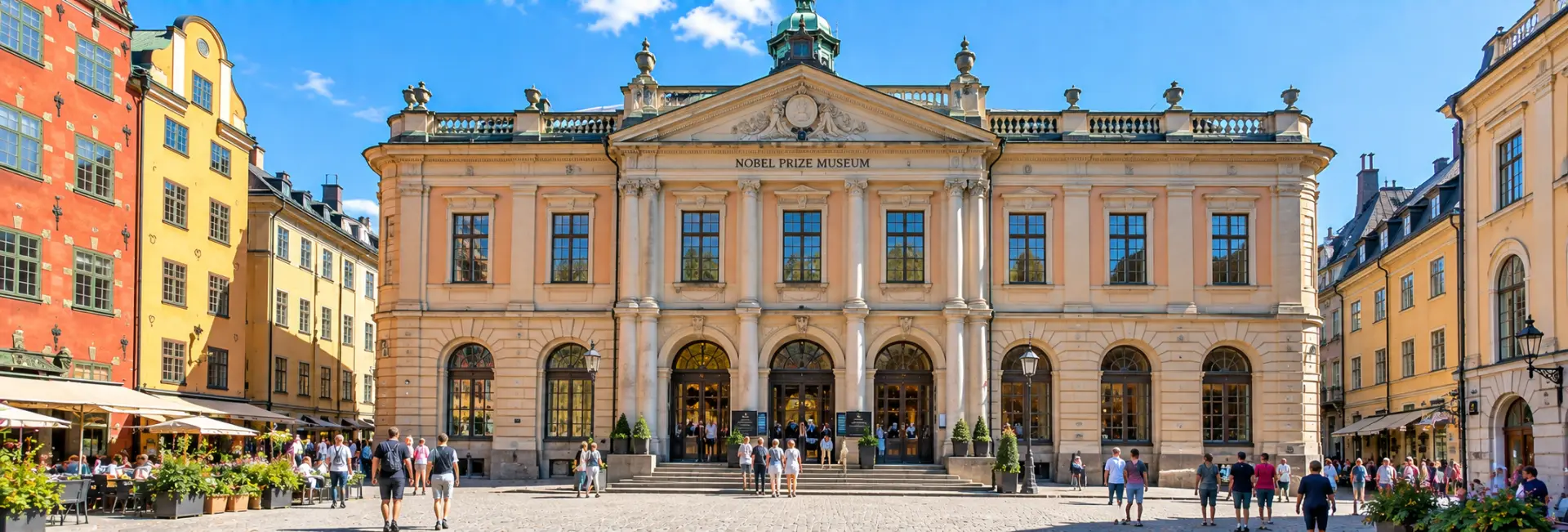
The museum occupies the ground floor of a grand 18th-century building on Stortorget, Gamla Stan's main square, putting it within easy walking distance of the Royal Palace and the cathedral. Its scale is modest compared with Stockholm's larger museums, but its subject matter - human curiosity, discovery, and perseverance - gives it an outsized sense of purpose for visitors willing to slow down and read the stories on display.
History of the Museum
A Centenary Project
The museum opened its doors in 2001, timed to coincide with the 100th anniversary of the first Nobel Prizes awarded in 1901. It was originally known as the Nobel Museum and was conceived as a temporary home for exhibitions about the prize while a larger, purpose-built Nobel Center was planned elsewhere in the city.
A Search for a Permanent Home
Plans for that larger center have shifted several times over the past two decades. A proposal to build on Blasieholmen, designed by David Chipperfield Architects, was scrapped after a change in political leadership at Stockholm City Hall. A new site was later chosen at Slussen, where a Nobel Center is now planned to open in 2031, on a stretch of the waterfront that Alfred Nobel's own father once helped to engineer.
While that project moves forward, the institution changed its name to the Nobel Prize Museum and has remained in its original home in Gamla Stan for more than two decades - far longer than the "temporary" label first suggested.
Architecture & Building
The museum is housed inside Börshuset, the former Stockholm Stock Exchange Building, on the north side of Stortorget. Built between 1773 and 1776 to a neoclassical design by the young Swedish architect Erik Palmstedt, the building was commissioned by King Gustav III to give the city's merchants a proper home for stock exchange trading.
The building's trapezoidal footprint follows the shape of the plot it replaced, and its rounded corner widens the narrow lanes that flank the square. Its facade reads much like that of a private palace, with a central pediment and a lantern-style cupola marking its public role. The upper floor has long been the meeting place of the Swedish Academy, the body that awards the Nobel Prize in Literature, while the museum occupies the more open ground floor below.
Stock exchange trading moved out of the building for good by the late 1990s, freeing the space for the museum that opened in 2001. The result is a rare pairing: a working 18th-century civic building that still hosts the Swedish Academy's formal meetings upstairs, with a modern museum about human achievement below.
Collections & Exhibits
Telling the Laureates' Stories
The museum's core exhibitions focus on the people who have won Nobel Prizes rather than presenting a dry list of dates and disciplines. Short films, original artifacts, and interactive touchscreens let visitors search laureates by year, category, or field of work, then dig into the personal and scientific journey behind each prize.
These Things Changed the World
A permanent exhibition introduced in 2024 brings together, for the first time, a wide range of objects donated to the museum by laureates over the years - equipment, manuscripts, and everyday items that connect visitors directly to specific discoveries and their creators.
Alfred Nobel's Own Story
A dedicated section is devoted to Alfred Nobel himself: his work as a chemist and engineer, his invention of dynamite, and the reasoning behind his will, which redirected his fortune into the prizes that carry his name. Visitors can see a copy of that will alongside replicas of the medals and diplomas presented to laureates each year.
- Interactive screens for browsing laureates by category and year
- Original artifacts and personal items donated by prize winners
- Short documentary films on individual laureates and discoveries
- A copy of Alfred Nobel's will and background on the prize's founding
Must-See Highlights
Suspended from the ceiling, a rotating display carries portraits of Nobel Laureates slowly along a track, each paired with a brief note on the work that earned their prize. It is one of the simplest exhibits in the museum, yet it does the most to convey just how many lives the prize has touched since 1901, from early literature winners like Rudyard Kipling to scientists whose names now fill textbooks.
Inside Bistro Nobel, the museum's café and restaurant, visiting laureates have signed the underside of a chair on their trip to Stockholm - a quiet, almost hidden tradition that turns an ordinary lunch stop into a small treasure hunt. The bistro is also where visitors can try Nobel Ice Cream, a dessert with roots in the menus once served at official Nobel Prize banquets.
Look for the "Creative Moments" material woven through the exhibitions, which focuses less on the finished discoveries and more on the working habits, false starts, and moments of insight that led laureates to their breakthroughs - a useful counterweight to the museum's more polished trophy cases.
Ways to Experience It
Most visitors move through the museum independently, following the interactive stations and film screens at their own pace, with a visit typically taking somewhere between ninety minutes and two and a half hours depending on how much is read in full.
- Multilingual audio guides for a self-paced but narrated visit
- Guided tours covering the museum's history and key exhibits in more depth
- A workshop room and children's activity area, including a trivia hunt for younger visitors
- Evening programs with panel discussions, quizzes, music, and food and drink tastings
- Rotating temporary exhibitions tied to current laureates and world events
The museum also plays host to the Nobel Prize Teacher Summit, an international conference for educators, reflecting its ongoing role as a resource for schools as well as casual visitors.
Best Time to Visit
Opening hours shift with the seasons, with longer daily hours in summer and a reduced schedule from Tuesday to Sunday in winter; the museum closes on a small number of public holidays. Arriving earlier in the day generally means smaller crowds around the interactive stations, since tour groups tend to build up through the afternoon.
Early December brings a noticeable buzz to the museum and to Stockholm more broadly, as Nobel Week leads up to the prize ceremonies and the anniversary of Alfred Nobel's death on December 10. The museum runs special events and exhibitions tied to that year's laureates during this period, though it can also be its busiest stretch.
Visitor Tips
Tickets are inexpensive relative to Stockholm's larger museums, and children under 18 are admitted free; students and seniors typically receive a discount. The Stockholm Pass, where used, generally includes admission as well.
- Set expectations for a compact museum rather than a sprawling one - the reward is in the stories, not square footage
- Check the underside of chairs in Bistro Nobel for laureate signatures before you sit down to eat
- Confirm current opening hours and ticket prices on the museum's official website before visiting, since these can change seasonally
- The museum is a short, flat walk from Gamla Stan metro station, making it an easy stop without a car
- Street parking nearby is limited and expensive, so public transport or walking is the more practical option
Nearby Attractions
The museum sits at the heart of Gamla Stan, Stockholm's Old Town, putting several of the city's best-known sights within a few minutes' walk. The Royal Palace, one of Europe's largest still in active royal use, is just around the corner, alongside Storkyrkan, Stockholm's medieval cathedral.
- Stortorget - the historic square the museum overlooks, site of the city's oldest well
- Stockholm Royal Palace - a short walk away, with its own museums and changing of the guard
- Storkyrkan Cathedral - Stockholm's oldest church, a few minutes on foot
- The narrow lanes of Gamla Stan - ideal for continuing on foot after the museum
FAQs about visiting the Nobel Prize Museum
What is the Nobel Prize Museum? +
It's a museum in Stockholm's Old Town dedicated to the history of the Nobel Prize and the laureates who have received it since 1901, using interactive exhibits, films, and donated personal artifacts rather than a simple hall of trophies.
How long should I plan for a visit? +
Most visitors spend somewhere between ninety minutes and two and a half hours inside, depending on whether they stop to read every exhibit or focus on the highlights.
Do I need to book tickets in advance? +
Advance booking isn't essential outside of peak periods like Nobel Week in early December, but buying tickets online ahead of a visit can help you skip a line during busy summer afternoons.
Is the museum suitable for children? +
Yes - younger visitors can join a trivia hunt tied to the exhibits, and there's a dedicated workshop room and children's activity area, though the subject matter (science and world affairs) tends to land best with school-age kids and older.
Is the museum free to enter? +
No, there is an admission charge, though it's modest compared with Stockholm's larger museums, and children under 18 are admitted free.
What's the best time of year to visit? +
Any time of year works, but early December brings the added atmosphere of Nobel Week, while quieter mornings outside that period offer more space around the interactive displays.
What's nearby if I want to continue exploring? +
The Royal Palace, Storkyrkan Cathedral, and the historic square of Stortorget are all within a few minutes' walk, making it easy to combine the museum with a longer stroll through Gamla Stan.
How do I get there? +
The museum is on Stortorget in Gamla Stan, about a three-minute walk from Gamla Stan metro station (green line) and roughly fifteen minutes on foot from Stockholm's Central Station.