Table of Contents
Overview
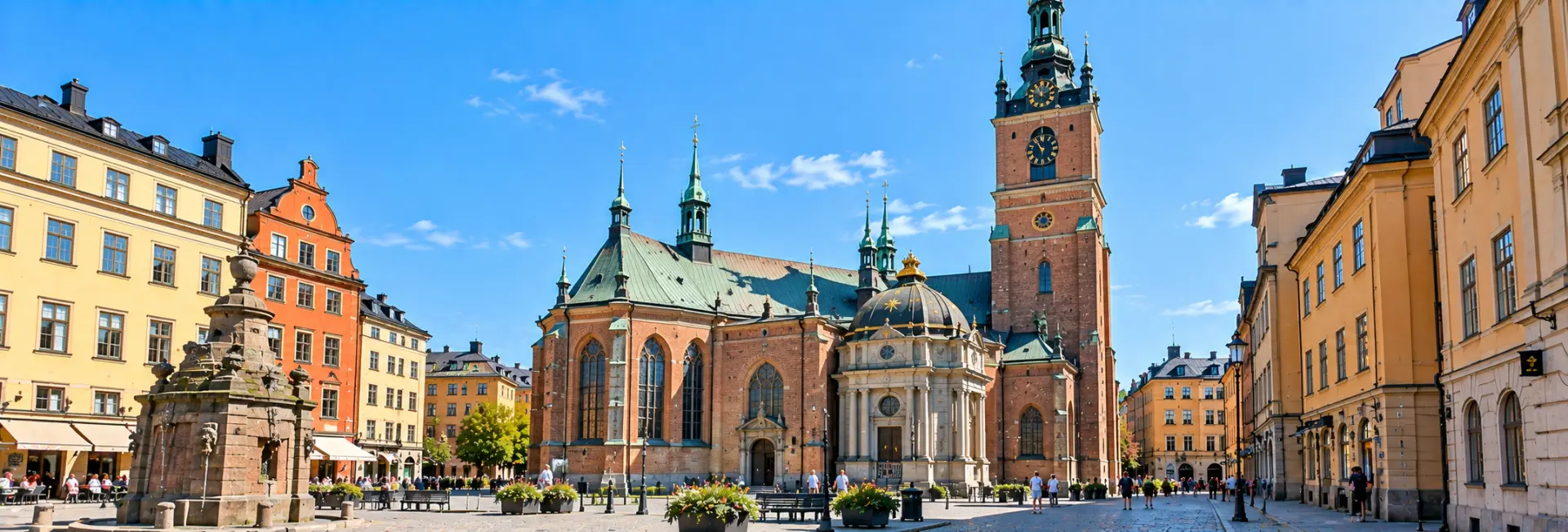
Storkyrkan, known in English as Stockholm Cathedral, is the oldest church in the city and sits at the highest point of Gamla Stan, wedged between the Royal Palace and Stortorget. Officially dedicated to Saint Nicholas, it has been known simply as "the Great Church" for centuries, a name that reflects its long-standing role as the mother church of Stockholm rather than its physical size.
From the outside, the cathedral's plain, orange-yellow Baroque facade gives little away, but its interior tells a much older and richer story: brick Gothic vaulting, royal coronation history, and one of Scandinavia's most striking pieces of medieval sculpture. It remains an active parish church within the Church of Sweden as well as one of Gamla Stan's most visited sites.
History
Medieval Origins
The earliest written mention of Storkyrkan dates to 1279, though construction likely began even earlier in the 13th century. The church was consecrated to Saint Nicholas in 1306, and for a long period it served as Stockholm's only parish church, giving it an outsized role in the city's civic and religious life from the very beginning.
The Reformation and Royal Ties
Storkyrkan played a pivotal role in the Swedish Reformation, serving as the site where Mass was first celebrated in Swedish rather than Latin. Its connection to the Swedish royal family runs just as deep: the cathedral has hosted coronations, and more recently the 2010 wedding of Crown Princess Victoria and Daniel Westling, continuing a tradition of royal weddings and christenings that stretches back centuries. It also serves as a venue for state occasions such as the annual opening of parliament and for the funerals of notable public figures, including author Astrid Lindgren.
Centuries of Renovation
The building visible today is the product of repeated remodeling. Extensive 18th-century changes gave the exterior its uniformly Baroque appearance, even as the interior retained much of its late medieval character. A 1908 restoration removed plaster from the columns supporting the vaulted ceiling, deliberately restoring a more medieval look to the church's interior. Since 1942, Storkyrkan has served as the seat of the Bishop of Stockholm within the Diocese of Stockholm.
Architecture & Design
Storkyrkan is considered an important example of Swedish Brick Gothic, though its architectural story is really one of two overlapping styles. Inside, the church keeps its late medieval form: a hall church design with a vaulted ceiling carried on sturdy brick pillars, giving the nave a weighty, atmospheric quality. Outside, extensive 18th-century remodeling replaced the original Gothic exterior with a smoother Baroque one, so the plain orange-yellow walls seen from Stortorget or the Royal Palace give little hint of the older structure within.
At 63 meters long, 37 meters wide, and rising 60 meters to the top of its tower, the cathedral is a substantial building, even if its restrained exterior can make it easy to walk past without a second look. That contrast between an unassuming shell and an ornate, historically layered interior is part of what makes a visit worthwhile.
Cultural & Religious Significance
As the seat of the Bishop of Stockholm and the city's long-standing mother church, Storkyrkan carries a religious weight that extends well beyond a single congregation. Its role in the Reformation, as the place where Swedish-language Mass was first celebrated, ties it directly to one of the most significant shifts in Swedish religious history.
The cathedral's connection to the monarchy adds a second, parallel layer of significance: for centuries it has been the setting for coronations, royal weddings, christenings, and state ceremonies, including the opening of the Swedish parliament each autumn. Public memorials and funerals for notable Swedish figures are also held here, reinforcing its position as a civic gathering point as much as a place of worship.
Notable Features
Saint George and the Dragon
The cathedral's most celebrated artwork is a large wooden sculpture of Saint George and the Dragon, carved around 1489 by the German sculptor Bernt Notke. Commissioned by the Swedish regent Sten Sture the Elder, it commemorates his victory over Danish forces at the Battle of Brunkeberg in 1471. The knight represents Sture, the dragon stands for the defeated Danish king, and a rescued figure of the Virgin symbolizes the city of Stockholm itself - turning a religious sculpture into a political monument as well.
Vädersolstavlan
Also on display is Vädersolstavlan, or "the Sun Dog Painting," which shows one of the earliest known depictions of Stockholm's cityscape, making it a valuable visual record of the medieval city alongside its religious subject matter.
Royal Chairs, Pulpit, and Silver Altar
- A pair of ornate royal chairs carved in 1684 by Burchart Precht, still used by the royal family during official ceremonies
- An elaborate Baroque pulpit, also by Precht, dating to around 1700
- A silver altar featuring an ebony winged altarpiece decorated with detailed silver reliefs
Visiting Etiquette & Tips
Storkyrkan is an active place of worship as well as a visitor attraction, so it's worth checking the schedule for services, weddings, or concerts before planning a visit, since these can affect access to parts of the church. A modest admission fee applies for tourist visits outside of service times.
- Dress and behave respectfully, as with any active church - keep voices low and avoid walking through areas set up for a service
- An audio guide is available for a small additional fee and adds useful context to the artwork and history
- Photography is generally allowed, though flash photography near the altar or during services should be avoided
- The cathedral occasionally hosts concerts, which are a good way to experience its acoustics alongside its art and architecture
Best Time to Visit
Storkyrkan keeps fairly consistent daily hours, typically opening in the morning and closing in the mid-afternoon, with longer hours in the evening during the summer months from June through August. Visiting earlier in the day tends to mean fewer crowds, since Gamla Stan's foot traffic builds steadily as the day goes on.
Because the cathedral is compact compared with some of Gamla Stan's other sights, a short visit of twenty to thirty minutes is often enough to see the highlights, making it easy to fit into a longer walking tour of the Old Town rather than requiring a dedicated trip.
Nearby Attractions
Storkyrkan's location at the heart of Gamla Stan puts it within a few minutes' walk of several of Stockholm's best-known sights, making it a natural stop on a broader tour of the Old Town.
- Stockholm Royal Palace - directly adjacent, at the eastern end of Slottsbacken
- Nobel Prize Museum - just across Stortorget in the former Stock Exchange Building
- Stortorget - Gamla Stan's historic main square, a short walk from the cathedral's entrance
- Mårten Trotzigs Gränd - Stockholm's narrowest alley, a few minutes away on foot
FAQs about visiting Storkyrkan
What is Storkyrkan known for? +
It's Stockholm's oldest church, known for its Gothic interior, Baroque exterior, and the medieval wooden sculpture of Saint George and the Dragon, as well as its long history of royal coronations and weddings.
How old is Storkyrkan? +
The church was first mentioned in written records in 1279 and was consecrated in 1306, though construction likely began earlier in the 13th century, making it more than 700 years old.
How long does a visit take? +
Most visitors spend twenty to thirty minutes seeing the main highlights, making it easy to combine with a longer walk through Gamla Stan.
Is there an entrance fee? +
Yes, a modest admission fee typically applies for tourist visits, though access during regular worship services is different from a paid visit.
Can I attend a service or concert here? +
Yes - Storkyrkan is an active church that holds regular services, and it also hosts occasional concerts, which can be a good opportunity to experience the building's acoustics.
What is the Saint George and the Dragon sculpture? +
It's a large wooden sculpture carved around 1489, commemorating a Swedish military victory over Danish forces and using the figures of the knight, dragon, and rescued figure as symbols of that political conflict.
Is Storkyrkan connected to the Swedish royal family? +
Yes - the cathedral has hosted royal coronations, weddings, and christenings for centuries, including the 2010 wedding of Crown Princess Victoria, and it continues to host state occasions such as the opening of parliament.
What's nearby if I want to see more of Gamla Stan? +
The Royal Palace, the Nobel Prize Museum, and Stortorget square are all within a few minutes' walk of the cathedral.