Table of Contents
Overview
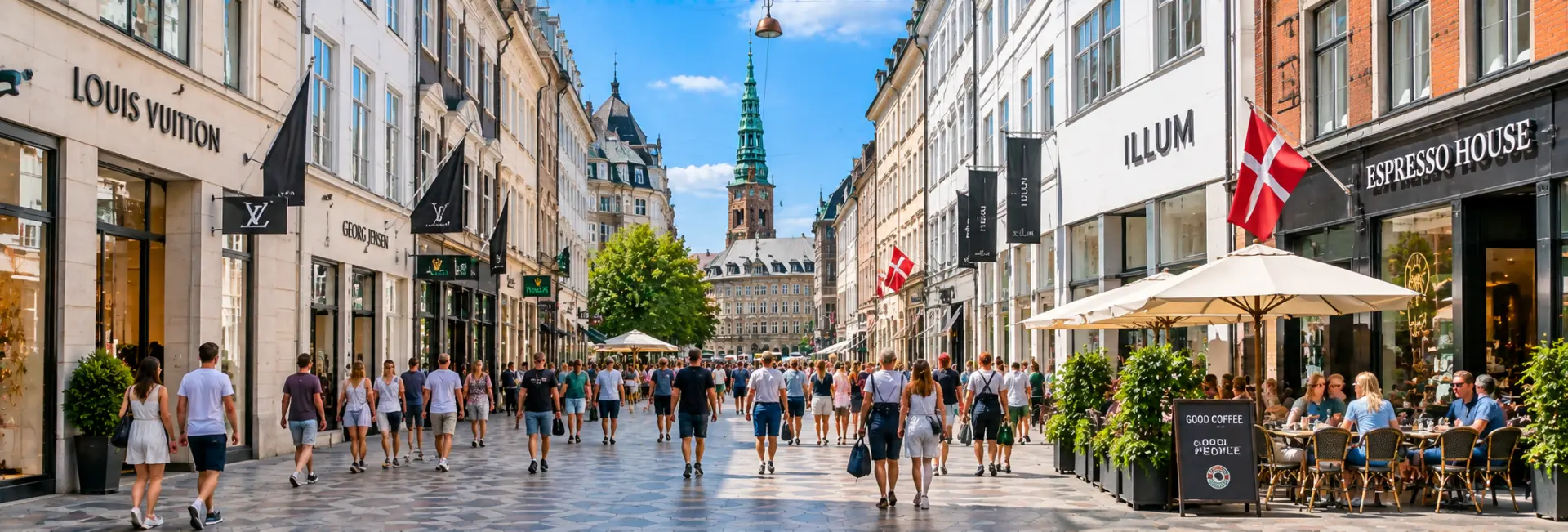
Strøget is Copenhagen's best-known shopping street, a 1.1 kilometer pedestrian corridor that runs through the historic core of the city from City Hall Square to Kongens Nytorv. It is not actually a single street but a chain of older streets and squares strung together, which gives a walk down Strøget a constantly shifting character rather than the uniform feel of a purpose-built shopping mall.
Locals and guidebooks alike often describe it as one of the longest pedestrian shopping streets in Europe, and Copenhagen frequently claims the additional distinction of having created the world's first fully pedestrianized shopping street when cars were banned here in 1962. Whatever the exact ranking, Strøget remains the natural spine of central Copenhagen, connecting many of the city's other landmarks along the way.
History
An Old Route Through the City
The streets that make up Strøget are far older than the pedestrian zone itself, tracing routes through Copenhagen's medieval core that predate any formal street name. The word Strøget itself is a nickname rather than an official street name, first used informally in the 19th century to describe this stretch of connected roads running through the middle of town.
Copenhagen Goes Car-Free
By the early 1960s, growing traffic and increasingly crowded sidewalks in central Copenhagen prompted the city council to try something largely untested at the time: banning cars entirely from this stretch of streets. The change took effect on 17 November 1962 as a trial, inspired partly by pedestrian streets that had already appeared in postwar Germany, and preceded by smaller experiments in which the street had briefly closed to traffic around Christmas during the 1950s. Many local merchants opposed the idea, worried that removing car access would drive customers away and that Danes simply did not have the temperament for the kind of open-air public life such a street required. The opposite happened, shops saw more foot traffic rather than less, and the trial was made permanent in 1964.
A Growing Pedestrian Network
Strøget's early success encouraged the city to keep expanding the car-free zone. Further streets and squares were pedestrianized in 1968, 1973, and 1992, growing Copenhagen's connected pedestrian network from an initial 15,800 square meters around Strøget to roughly 100,000 square meters across the wider city center today. In 1967, the street was even used to mark Copenhagen's 800th anniversary with a public celebration that served hundreds of thousands of cups of coffee along its length.
Layout & Streets
What people call Strøget is technically a sequence of named streets laid end to end: Frederiksberggade nearest City Hall Square, followed by Nygade, one of the shortest streets in the city, then Vimmelskaftet, and finally Østergade as the route approaches Kongens Nytorv. Each section has its own history and character even though they now read as one continuous route underfoot, a legacy of a city center that grew organically over centuries rather than being planned as a single shopping corridor from the outset.
Along the way, the path widens into a series of historic squares rather than running as a plain corridor the whole distance, which breaks the walk into a series of distinct spaces rather than one long shopping aisle. Købmagergade, another major pedestrian street, branches off partway along Strøget and heads north toward Nørreport, giving the wider pedestrian network a rough T-shape through the old city and offering an easy detour for visitors who want to see more of central Copenhagen without straying too far from the main route.
The Squares Along Strøget
Gammeltorv and Nytorv
Near the western end, Strøget passes through the adjoining squares of Gammeltorv and Nytorv, which function today as a single connected space even though each keeps its own name and history. Gammeltorv is generally considered the oldest square in Copenhagen and is home to the Caritas Fountain, a Renaissance-era fountain dating from the early 17th century and one of the few structures in the area to survive the city's later fires largely intact. Nytorv sits alongside it, dominated by the neoclassical facade of the old Copenhagen Court House, which also served as the city's town hall for much of the 19th century before the two civic functions were eventually separated.
Amagertorv
Further along, Amagertorv is often described as the most central square in Copenhagen and marks the point where Strøget meets Købmagergade, the second major pedestrian street branching off toward the city's northern districts. Its centerpiece is the Stork Fountain, created as a gift for the silver wedding anniversary of a Danish crown prince and princess in the 1890s and now one of the most popular meeting points in the city, the kind of spot locals default to when arranging to meet friends downtown. The square's paving, laid in 1993 in a pattern of colored granite stones, was designed by the same artist responsible for the tapestries inside Christiansborg Palace, and one of the buildings facing the square, a distinctive Dutch Renaissance house with a copper roof, dates back to 1616 and today houses a well-known Danish porcelain retailer.
Shopping on Strøget
Strøget's retail mix shifts noticeably along its length. Near City Hall Square, the street leans toward accessible high-street chains, the kind of stores found in shopping districts across Europe, aimed at everyday clothing and quick purchases rather than special occasions. Moving east through Amagertorv and into Østergade, the tone becomes distinctly more upscale, with international luxury houses, jewelers, and design flagships clustered near the Kongens Nytorv end of the street, where storefronts tend to be smaller, quieter, and more curated.
Beyond clothing, Strøget is also known for Danish design and craft, including a long-running porcelain and homeware store housed in one of the square's oldest surviving buildings, as well as smaller boutiques selling ceramics, textiles, and furniture in the distinctly pared-back Danish style. For visitors more interested in browsing than buying, window shopping along the storefronts is itself one of the simplest ways to get a feel for contemporary Danish style without spending a krone.
Street Life & Performers
Beyond the shops, Strøget functions as one of Copenhagen's main public stages, particularly around Amagertorv, where street musicians, magicians, and acrobats regularly draw crowds throughout the day. The open squares along the route give performers natural gathering points, and on a busy afternoon it is common to pass several different acts within the space of a few blocks, from a solo guitarist near a cafe terrace to a larger crowd circled around an acrobatic routine outside the Stork Fountain.
Visitors should stay alert for informal street games involving cups or cards near the busier stretches close to City Hall Square, a common setup for scams aimed at distracted tourists rather than genuine entertainment.
Best Time to Visit
Strøget is busiest on weekend afternoons and throughout the summer tourist season, when both shoppers and street performers are out in full force. Visiting on a weekday morning offers a noticeably calmer walk, with more breathing room around the squares and shorter waits at popular cafes.
Because Strøget is entirely outdoors and unsheltered along most of its length, weather plays a real role in the experience. A clear day naturally draws bigger crowds and more street performances, while a rainy afternoon thins the crowds considerably but still leaves the shops themselves fully open.
Visitor Tips
A few practical points make it easier to enjoy a walk down Strøget without losing time or money along the way, especially since the street can get genuinely crowded during peak shopping hours and major sales periods.
- Keep valuables secure and be cautious around any informal street games involving cups, cards, or quick bets, which are typically scams rather than genuine entertainment.
- Budget-friendly stores cluster near City Hall Square, while luxury brands concentrate closer to Kongens Nytorv, so it helps to know which end suits your shopping plans.
- The side streets branching off Strøget often hold smaller, independent shops and cafes that get overlooked by visitors who stick only to the main route.
- Public benches are limited along the busiest stretches, so the surrounding squares, particularly Gammeltorv and Amagertorv, are the best spots to sit down and rest.
- Strøget connects directly to several metro and bus routes at both ends, making it easy to start at one square and finish the walk elsewhere in the city.
Nearby Attractions
Because Strøget runs directly through the center of Copenhagen, it naturally connects to several major landmarks within a short walk in either direction, making it one of the easiest streets in the city to use as a starting point for a longer day of sightseeing.
- Church of Our Lady, Copenhagen's cathedral, sits just behind Gammeltorv and is where Crown Prince Frederik and Crown Princess Mary were married.
- Christiansborg Palace and its canals are visible from Amagertorv and reachable in a few minutes on foot.
- The Round Tower and Nørreport Station lie a short walk north along Købmagergade, which branches off Strøget at Amagertorv.
- Nyhavn's colorful harbor front sits just beyond Kongens Nytorv, at the eastern end of the street.
FAQs about visiting Strøget
Is Strøget one continuous street? +
No, Strøget is a nickname for a connected chain of streets, Frederiksberggade, Nygade, Vimmelskaftet, and Østergade, along with the squares of Gammeltorv, Nytorv, and Amagertorv.
How long is Strøget? +
The main pedestrian stretch runs about 1.1 kilometers from City Hall Square to Kongens Nytorv, though the wider connected pedestrian network, including side streets and squares, extends much further.
When did Strøget become a pedestrian street? +
Cars were banned from Strøget starting 17 November 1962 as a trial, and the change was made permanent in 1964.
Is Strøget good for budget shopping or luxury shopping? +
Both, the section closer to City Hall Square favors affordable high-street chains, while the stretch near Kongens Nytorv is home to international luxury brands.
Is Strøget free to visit? +
Yes, walking the street and its squares costs nothing, and the shops, cafes, and street performances are all open to browse without any entry fee.
How long does it take to walk the length of Strøget? +
Walking the full route without stopping takes about 15 to 20 minutes, though most visitors spend considerably longer browsing shops and squares along the way.
Is Strøget suitable for visitors with limited mobility? +
Yes, the entire route is flat, paved, and free of car traffic, making it one of the more accessible walking routes in central Copenhagen.
What else is nearby that's worth combining with a visit? +
Church of Our Lady, Christiansborg Palace, the Round Tower, and Nyhavn are all within easy walking distance of different points along Strøget.