Table of Contents
Overview
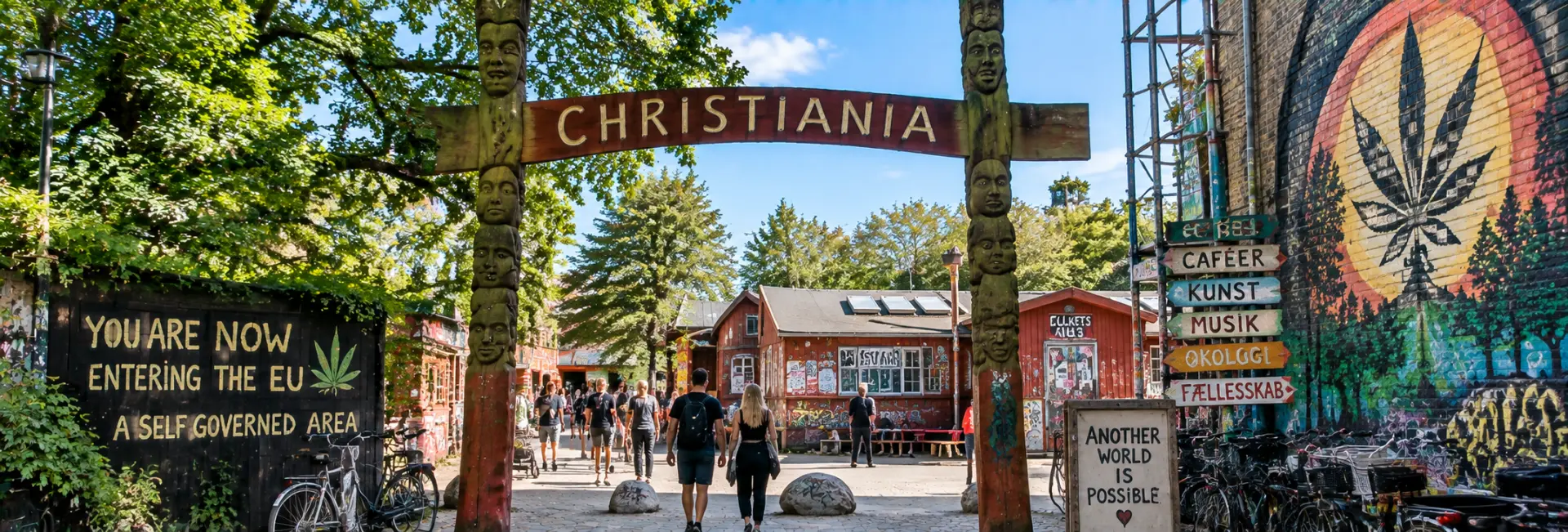
Freetown Christiania is a self-governing community tucked into the eastern edge of Christianshavn, built across a stretch of former military land, earthen ramparts, and a moat that once defended Copenhagen. Since squatters occupied the site in 1971, it has developed its own rules, its own flag, and a look unlike anywhere else in the city, with hand-built houses, workshops, and murals scattered among the trees.
For visitors, it is one of Copenhagen's most talked-about neighborhoods: part open-air gallery, part functioning residential community, and part living experiment in collective decision-making. A walk through its car-free lanes offers a very different rhythm from the rest of the city, just a few minutes from the historic canal streets that surround it.
History
From Fortress Land to Abandoned Barracks
The ground Christiania occupies was originally part of Christianshavn's 17th-century fortifications, laid out under King Christian IV and later reinforced under Christian V. By the late 1800s the site held the Bådsmandsstræde Barracks, home to an artillery regiment and its munitions stores. The military gradually withdrew between 1967 and 1971, leaving behind empty buildings and open ground with no clear plan for their future.
The 1971 Occupation
In May 1971, people from the surrounding neighborhood broke through the perimeter fence to create a playground for local children on the abandoned land. Over the following months, squatters moved into the empty barracks themselves, and an alternative newspaper publicized the occupation, drawing in people looking for a different way of living in the city. Journalist Jacob Ludvigsen gave the settlement its name, and on 26 September 1971 the community was formally proclaimed as Freetown Christiania. The Danish government responded the following year by declaring it a temporary social experiment rather than shutting it down.
Decades of Legal Struggle and Eventual Compromise
For the next four decades, Christiania's legal status remained unsettled, with the state making repeated attempts to reclaim or redevelop the land, none of which succeeded in the face of strong local and public resistance. A 2011 Supreme Court ruling confirmed that the land belonged to the state, but rather than evicting residents, the government negotiated a settlement: a foundation representing the community purchased part of the site and agreed to lease the remainder, allowing Christiania to continue while bringing its buildings gradually into line with Danish regulations.
Closing Pusher Street
For decades, a section of the community known as Pusher Street operated as an open cannabis market, tolerated in practice even though the trade itself remained illegal. Rising gang violence linked to the market, including a string of fatal shootings, led residents themselves to dismantle the stalls in April 2024, physically digging up the street's cobblestones as a symbolic break with that chapter. In the time since, residents and local police alike have reported markedly less violence and no return of the organized stalls, and the area is credited with regaining a calmer, safer feel.
Self-Governance & Community Life
Christiania is run through collective, consensus-based decision-making rather than conventional local government, with residents meeting regularly to discuss shared concerns and manage community affairs. No individual owns land or property within the settlement; instead, everything is held collectively through the community's own foundation, in line with the negotiated arrangement with the Danish state.
A small set of long-standing rules governs daily life, generally summarized as a ban on cars, weapons, and hard drugs alongside an expectation of nonviolence, and these are enforced by the community itself rather than by an outside authority. The settlement has its own flag, three yellow dots on a red field, said to originate from the dots over the letters in a resident's name, and it continues to describe itself as an ongoing social experiment rather than a finished project.
Key Areas
The Ramparts and Moat
Christiania incorporates a stretch of Christianshavn's old defensive ramparts and the Stadsgraven moat that once ringed the city, now a green, tree-lined path popular for a quiet walk or bike ride away from the settlement's busier lanes.
Nemoland
An open square lined with food stalls, bars, and outdoor seating, Nemoland functions as an informal town center, especially lively in warmer months when live music and gatherings spill outdoors.
The Former Pusher Street
Once the site of Christiania's open cannabis market, this central stretch has been physically transformed since 2024 and is being reimagined by residents as an ordinary part of the community rather than a drug market, though it remains one of the first areas most visitors pass through.
Notable Sights
Much of Christiania's appeal lies in wandering rather than sightseeing, but a few features stand out along the way.
- Hand-built houses along the moat, many constructed from salvaged and repurposed materials over the decades
- Large-scale murals and painted facades throughout the settlement, several depicting community history and symbols
- Den Grønne Hal, a former military riding hall converted into an event and concert space
- Loppen, a long-running concert venue housed in an old warehouse building
- Workshops producing crafts, art, and the distinctive three-wheeled cargo bikes originally developed in Christiania and now recognized well beyond Denmark
Ways to Experience It
Christiania is best explored slowly, on foot, with time to look at the architecture and art rather than rush toward a single landmark.
- Wander freely through the main lanes and along the ramparts, treating it as a residential neighborhood rather than a theme park
- Join a guided walking tour, typically offered in summer months, for context on the community's history and governance from a local perspective
- Stop for food or a drink at Nemoland or one of the community-run cafés
- Browse workshops and small shops selling handmade goods and art produced within the settlement
- Combine a visit with a walk along the neighboring Christianshavn canal, since the two areas sit right next to each other
Best Time to Visit
Christiania is at its liveliest from late spring through early autumn, when outdoor seating, workshops, and music venues are in full swing and residents spend more time outside. Weekday afternoons tend to be calmer than summer weekends, when both tourists and locals fill Nemoland and the main lanes.
Winter visits are quieter and starker, with fewer outdoor activities running, but the settlement remains open and walkable year-round for those more interested in its history and architecture than its warm-weather atmosphere.
Visitor Tips
A visit to Christiania is straightforward, but a little awareness goes a long way given that it is a real residential community rather than a conventional attraction.
- Entry is free and the area is open at all times, though it is best explored during daylight hours
- Treat it as someone's neighborhood: keep noise down in residential lanes and follow any posted signage about photography or restricted areas
- The area is car-free, so expect to walk or cycle rather than drive in
- Cash can be useful at some smaller stalls and workshops, though card payment is increasingly common
- Wear comfortable footwear, since paths range from paved lanes to uneven dirt tracks along the ramparts
Nearby Attractions
Christiania's location inside Christianshavn puts several other sights within easy reach.
- The Christianshavn canal and its houseboats, just a short walk to the west
- The Church of Our Saviour and its climbable spiral spire, close to Christiania's main entrance on Prinsessegade
- Christianshavn Metro station, offering quick connections back to central Copenhagen
- Nyhavn's colorful harbor front, reachable on foot across the Inderhavnsbroen bridge
- Holmen and Refshaleøen, the former naval and shipyard islands north of Christiania, now home to cultural venues and restaurants
FAQs about visiting Freetown Christiania
What is Freetown Christiania? +
It is a self-governing community in Copenhagen's Christianshavn district, founded by squatters in 1971 on former military land, known for its car-free streets, hand-built houses, and collective way of life.
Is it legal to visit Christiania? +
Yes, Christiania is open to visitors and welcomes them, though it operates under its own community rules alongside Danish law, so it is best to be respectful of the fact that people actually live there.
Is Christiania still known for cannabis? +
The open-air cannabis market once centered on Pusher Street was dismantled by residents themselves in April 2024 following a period of gang-related violence, and the area no longer functions as an organized drug market.
Is Christiania safe to visit? +
Since the 2024 closure of Pusher Street, both residents and local police have reported a significant drop in violence, and the area is generally considered safe for a daytime visit when treated with the same common sense as any city neighborhood.
How do I get to Christiania? +
The easiest route is via Christianshavn Metro station on the M1 and M2 lines, followed by a short walk down Prinsessegade to the main entrance, though it is also an easy walk from Nyhavn across the Inderhavnsbroen bridge.
Can I take photos in Christiania? +
General photography is fine in most areas, but it is worth following any posted signage, since certain spots have historically restricted photography and residents' privacy should be respected throughout.
How much time should I spend there? +
An hour or two is enough for a relaxed walk through the main lanes and along the ramparts, though visitors interested in the workshops, food stalls, and history can easily spend half a day.
What else is nearby if I want to keep exploring? +
The Christianshavn canal, the Church of Our Saviour, and Nyhavn are all within a short walk, making it easy to combine Christiania with a broader day exploring this side of Copenhagen.