Table of Contents
Overview
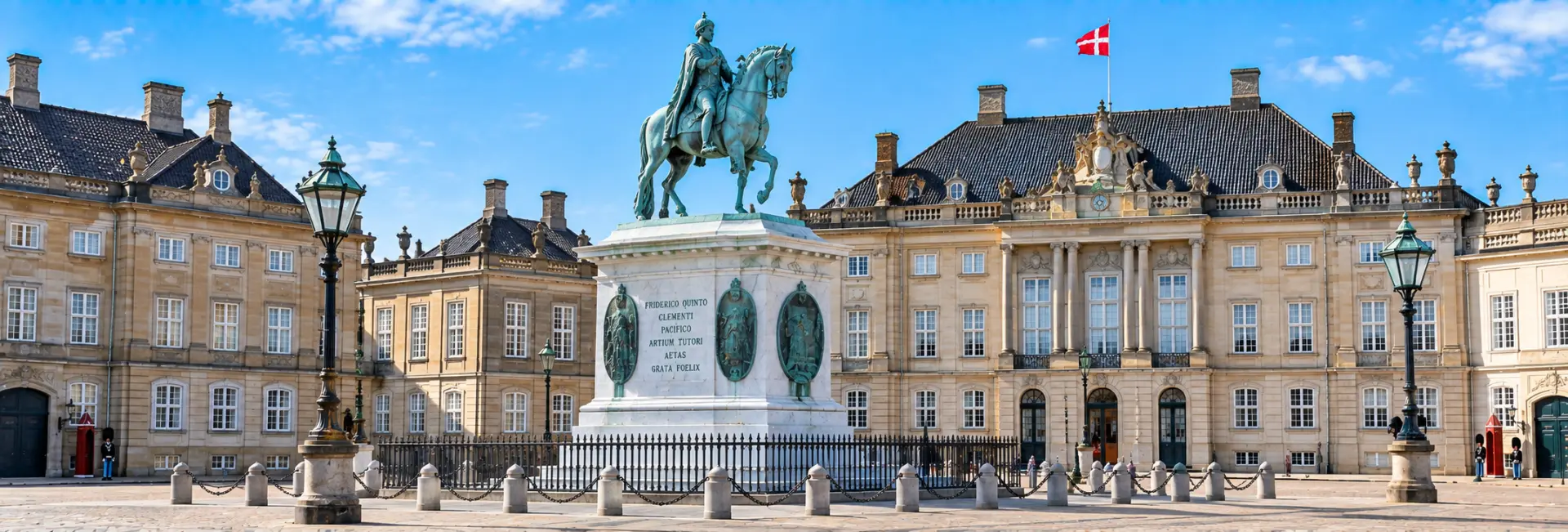
Amalienborg is the winter home of the Danish royal family and one of Copenhagen's most recognizable landmarks. The complex is made up of four matching rococo palaces arranged around a wide octagonal square, with a bronze statue of King Frederik V on horseback standing at its center. Unlike many royal residences that have been turned entirely into museums, Amalienborg still functions as a working home, which gives a visit here a different feel from a typical palace tour.
Visitors can walk freely across the open square at any hour, watch the daily changing of the guard, and step inside one of the palaces that has been converted into a museum covering more than a century of Danish royal history. Its location on the Copenhagen waterfront, close to Nyhavn and the Marble Church, makes it an easy stop to combine with a wider walk through the city's historic core.
History
Origins in Frederiksstaden
Amalienborg was not built as a royal palace at all. In the mid-18th century, King Frederik V ordered the creation of a new district called Frederiksstaden to mark the 300th anniversary of the House of Oldenburg's rule over Denmark. Architect Nicolai Eigtved designed four grand townhouses around a shared octagonal square, each intended as a residence for a wealthy noble family rather than for the crown. Construction ran from 1750 to 1760, and the four buildings, later known as the Moltke, Schack, Brockdorff, and Levetzau palaces after their original owners, still form the complex seen today.
The Royal Family Moves In
The turning point came on the night of 26 to 27 February 1794, when a fire destroyed Christiansborg Palace, the seat of the Danish monarchy at the time. With nowhere else suitable to live, the royal family purchased the four noble houses at Amalienborg and moved in as a temporary solution. That arrangement became permanent, and the palaces were gradually adapted for royal use over the following decades, gaining the names of the monarchs who lived in them, Christian VII, Christian VIII, Christian IX, and Frederik VIII.
Amalienborg in Modern Times
The complex has continued to evolve since then. A public park called Amalie Garden opened in 1983 on the harbor side of the palaces, giving both residents and visitors a green space with views across the water. Amalienborg also saw real conflict during the Second World War, when a firefight broke out on the square between German and Danish forces. Today the palaces remain in active royal use while also welcoming the public into one of them as a museum.
The Four Palaces
Each of the four palaces looks nearly identical from the outside, but they have separate histories, names, and roles that have shifted over time as different generations of the royal family have moved between them.
- Christian VII's Palace (originally Moltke's Palace) has the most elaborate interior of the four and is used for state occasions, official receptions, and the New Year reception. It is occasionally open for guided tours, though reservations are required.
- Christian VIII's Palace (originally Levetzau's Palace) houses the Amalienborg Museum, the one part of the complex that is regularly open to the public without a booking.
- Frederik VIII's Palace (originally Brockdorff's Palace) is the home of King Frederik X, Queen Mary, and their children, and is not open to visitors.
- Christian IX's Palace (originally Schack's Palace) serves as the residence of former Queen Margrethe II following her abdication in January 2024, and is likewise closed to the public.
Because two of the four palaces are private family homes, a visit to Amalienborg is really a mix of open public space, one accessible museum, and a working court that continues its official business behind closed doors.
Architecture & Design
Amalienborg is considered one of the finest examples of rococo architecture in Northern Europe, though the exteriors themselves lean toward a restrained, classical style, with the ornamentation concentrated inside. Nicolai Eigtved planned the four palaces as a matched set, giving the square a rare sense of balance and order for a Copenhagen streetscape built up gradually over centuries.
At the heart of the octagonal square stands an equestrian statue of Frederik V, sculpted by the Frenchman Jacques-François-Joseph Saly. The statue took two decades to complete and, according to court records, ended up costing more than the four surrounding palaces combined. A colonnade added in the 1790s by royal architect Caspar Frederik Harsdorff links two of the palaces across the street Amaliegade, framing the square and adding a further layer of formality to the site.
Looking south-west from the square, the domed silhouette of Frederik's Church, better known as the Marble Church, closes the view along the main axis, a piece of deliberate urban planning that ties Frederiksstaden together as a single composition rather than a collection of separate buildings.
Cultural Significance & Royal Life
Amalienborg carries a different kind of weight than palaces that have been fully converted into museums, because it remains a genuine royal residence rather than a preserved relic. The King's New Year address, a tradition dating back to 1941, is delivered from within the complex and broadcast nationwide, and major family events, from birthdays to official welcomes for visiting heads of state, regularly play out on the square.
The site also carries the personal history of the Glücksburg dynasty, which has occupied Amalienborg since the 1860s. Under Christian IX and Queen Louise, whose children went on to sit on the thrones of Britain, Greece, and Russia as well as Denmark, the family earned the nickname the in-laws of Europe, a reputation that the museum inside Christian VIII's Palace explores in detail.
The Amalienborg Museum
The Amalienborg Museum occupies Christian VIII's Palace and focuses on the more recent history of the Danish monarchy, roughly the last 150 years, from Christian IX through to the modern constitutional royal family. Rather than staging elaborate historical rooms, the museum largely preserves the private studies and salons of past monarchs as they were actually used, giving the visit an unusually personal feel.
Highlights include the preserved study of Christian X, kept much as it looked when he used it between 1899 and his death in 1947, and Queen Louise's private salon, furnished in the style of the 1890s. The museum also holds a small but striking collection of Fabergé pieces, including an oversized silver-gilt champagne cooler, in a room dedicated to Russian imperial gifts exchanged through royal marriages. The upper floor includes some of the original neoclassical reception rooms built after the royal family's move into the palace in 1794.
The museum is spread over two floors and does not require a guided tour to visit, though the grander state rooms in the neighboring Christian VII's Palace can only be seen separately, by reservation.
Changing of the Guard
The changing of the guard at Amalienborg is one of Copenhagen's best-known free attractions and happens every single day at noon, regardless of weather or season. The Royal Life Guard marches from its barracks near Rosenborg Castle, through the streets of central Copenhagen, and onto the palace square to relieve the outgoing watch.
On days when the monarch is in residence, the ceremony is accompanied by a full marching band, adding music and extra pageantry to the changeover. Even without the band, the sight of guards in their tall bearskin hats and blue uniforms marching in formation across the cobbled square draws a steady crowd, and it remains one of the few points in the day when the otherwise quiet square fills with both locals and visitors.
Best Time to Visit
Amalienborg's outdoor square is open around the clock and free to enter, so timing mainly comes down to what you want to see and how many people you want to share it with. Arriving before the changing of the guard at noon gives the best chance of a clear view, since the square fills quickly as the ceremony approaches.
For a quieter visit to the museum itself, early morning on a weekday, shortly after opening, tends to be the calmest, especially outside the summer high season when cruise ship crowds and tour groups are at their heaviest. Winter visits offer a different experience, since Amalienborg is specifically the royal family's winter residence, though shorter daylight hours mean the square photographs best around midday.
Visitor Tips
A few practical points make a visit to Amalienborg smoother, particularly since large parts of the complex remain private family homes rather than tourist sites.
- Stay at least a couple of meters back from the palace buildings and the guards themselves, both out of respect and because the guards are instructed not to interact while on duty.
- Only Christian VIII's Palace is open to the public without advance booking; visiting Christian VII's Palace requires a reserved guided tour and is not always available.
- A combined ticket covering the Amalienborg Museum and Rosenborg Castle, valid for 48 hours, is worth considering if you plan to see both royal sites during the same trip.
- The museum has step-free access throughout, including a platform lift down to the museum shop and a standard lift to the upper floors.
- Check the current exhibition schedule before visiting, since the museum periodically rotates special displays alongside its permanent rooms.
Nearby Attractions
Amalienborg sits in one of the most walkable parts of central Copenhagen, making it easy to combine with several other landmarks in a single outing.
- Frederik's Church (the Marble Church), whose dome closes the view from the palace square, is a short walk away and free to enter.
- Amalie Garden runs along the harbor directly behind the palaces, offering waterfront views toward the Copenhagen Opera House across the water.
- Nyhavn, with its rows of colorful townhouses and canal-side cafes, is only a few minutes on foot from the square.
- The Little Mermaid statue and Kastellet, the star-shaped fortress park, both lie within easy walking distance along the waterfront to the north.
FAQs about visiting Amalienborg Palace
Is Amalienborg Palace free to visit? +
The outdoor square is free and open at all times, but entry to the Amalienborg Museum inside Christian VIII's Palace requires a paid ticket.
Can you go inside Amalienborg Palace? +
Yes, the Amalienborg Museum in Christian VIII's Palace is open to the public year-round, and Christian VII's Palace can occasionally be seen on a reserved guided tour, though the other two palaces are private royal residences and not open to visitors.
What time is the changing of the guard at Amalienborg? +
The changing of the guard takes place daily at noon, with the guards marching from their barracks near Rosenborg Castle through the city to the palace square.
How long does a visit to Amalienborg take? +
Seeing the square and watching the changing of the guard takes about 30 to 45 minutes, while adding a visit to the Amalienborg Museum typically brings the total to around 1.5 to 2 hours.
Is Amalienborg suitable for children and visitors with limited mobility? +
The open square and free guard ceremony work well for families and most mobility needs, and the museum itself has step-free access via lifts, though the cobbled square can be uneven for wheelchairs and strollers.
What is the best way to get to Amalienborg? +
Amalienborg sits in central Copenhagen within easy walking distance of Nyhavn and the harbor front, and is also reachable by bus or a short walk from Kongens Nytorv metro station.
What else is nearby that's worth combining with a visit? +
Frederik's Church, Amalie Garden, Nyhavn, and the Little Mermaid statue are all within a short walk, making it easy to build a half-day route around the palace.
Do you need to book tickets in advance for the museum? +
Advance booking is not required for the Amalienborg Museum, though buying tickets online ahead of a visit during peak summer months can help avoid queues at the entrance.