Table of Contents
Overview
Christianshavn is the canal quarter of Copenhagen, a neighborhood of narrow waterways, brick warehouses, and houseboats sitting just across the harbor from the city center. Its name literally means "Christian's Harbour," a nod to the 17th-century king who had it built from scratch on reclaimed land as a fortified trading town of its own.
Today it feels distinct from the rest of Copenhagen: quieter streets, water on almost every corner, and a mix of residents that spans old sailing families, artists, and the self-governing community of Freetown Christiania. For visitors, it offers a slower, more residential counterpart to the palaces and shopping streets on the other side of the harbor.
History
A Planned Merchant Town
Christianshavn was laid out in 1617 on the orders of King Christian IV, who wanted to extend Copenhagen's fortifications while also creating a privileged trading settlement modeled on the Dutch canal towns he admired, particularly Amsterdam. The Danish-Dutch engineer Johan Semp designed the street plan on land reclaimed from the harbor, cutting a grid of canals so that goods could be unloaded directly from ships into warehouses rather than passing through Copenhagen's older harbor.
Absorbed into the City
Despite its original status as an independent town, Christianshavn could not compete commercially with Copenhagen proper and was formally folded into the city by 1674. Over the following centuries it developed into a working district tied to shipping, the navy, and industry, with the naval facilities at Holmen occupying its northern islands for much of that time.
From Working District to Bohemian Neighborhood
Much of the 20th century saw Christianshavn remain a working-class, industrial part of the city. That began to change in 1971, when a group of squatters took over an abandoned military barracks in the northeast of the district and declared it the self-governing Freetown Christiania, giving the area its enduring reputation for alternative culture. From around 1990 onward, Christianshavn's warehouses and townhouses were increasingly renovated into desirable housing, and it is now regarded as one of Copenhagen's more sought-after residential neighborhoods while retaining its bohemian edge.
Architecture & Streetscape
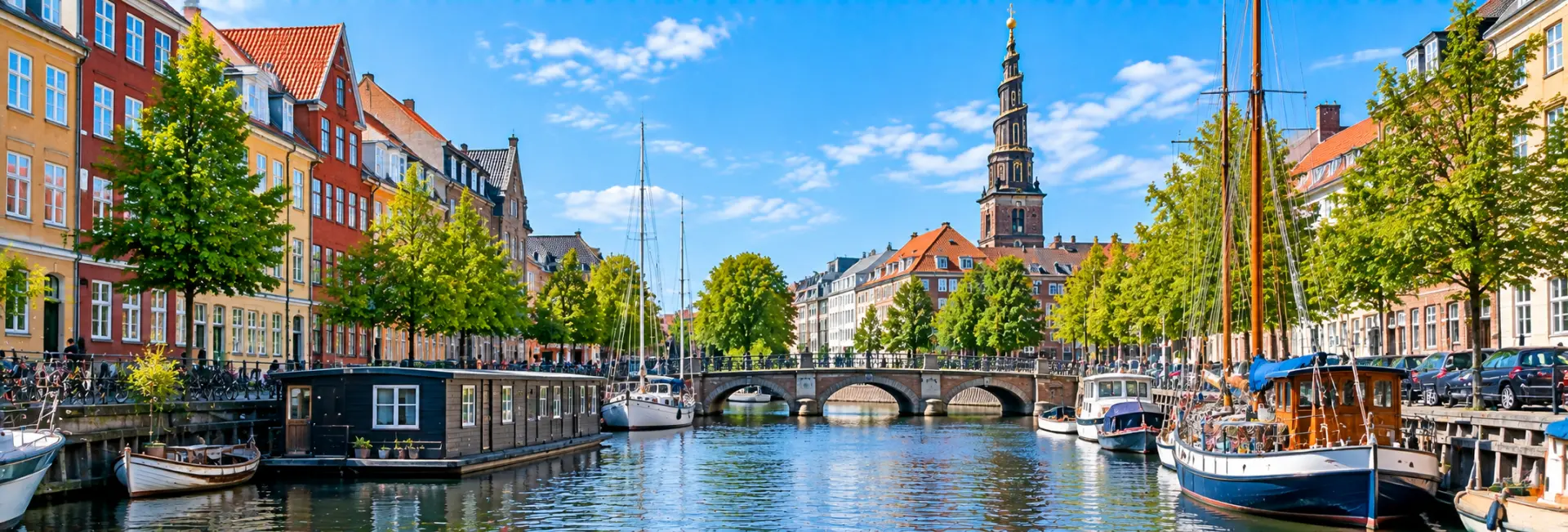
The clearest sign of Christianshavn's Dutch inspiration is its canal, still lined with the narrow, brightly painted townhouses, gabled warehouses, and the occasional houseboat that give the area its distinctly Amsterdam-like atmosphere. The two streets running along the water, Overgaden Oven Vandet and Overgaden Neden Vandet, preserve much of this 17th- and 18th-century character, with converted merchant warehouses now serving as apartments, offices, and small businesses.
Away from the canal, the streetscape shifts between quiet cobbled residential blocks, larger 20th-century developments near Christianshavns Torv, and the improvised, self-built structures inside Christiania, which stand in deliberate contrast to the formal Dutch grid surrounding them. This mix of eras and building styles is part of what makes a walk through the district feel like moving between several different neighborhoods at once.
Key Areas
The Canal and Torvegade
Torvegade is Christianshavn's main street, crossing the canal at Christianshavns Torv, the neighborhood's central square and metro stop. This is the natural starting point for exploring the canal on foot in either direction.
Freetown Christiania
In the northeast corner of the district, Freetown Christiania occupies former military land as a self-governing community with its own informal rules, murals, and workshops. Visitors are welcome to walk through most of the area, though photography is discouraged on Pusher Street, where cannabis is sold openly.
Holmen and Refshaleøen
North of the historic core, the former naval islands of Holmen and the shipyard island of Refshaleøen have been repurposed for culture and leisure, including the Copenhagen Opera House and a cluster of restaurants and event spaces built into old industrial buildings.
Notable Landmarks
A handful of sights anchor most visits to the district, each reflecting a different chapter of its history.
- The Church of Our Saviour, famous for its external spiral staircase winding around a golden spire roughly 90 meters above the street
- Freetown Christiania, with its hand-built houses, communal spaces, and long-running alternative way of life
- The Copenhagen Opera House on Holmen, a modern glass-and-stone landmark facing Amalienborg Palace across the water
- Christianshavns Torv, the neighborhood's historic market square and transit hub
- Noma, the internationally influential restaurant based on Refshaleøen, which reopened in 2026 after several years operating as an experimental food lab
Ways to Experience It
Christianshavn rewards unhurried exploration more than a checklist of sights, and most of it is best covered on foot or by bike.
- Walk the length of the canal along Overgaden Oven Vandet and Overgaden Neden Vandet, crossing back and forth over the small bridges
- Climb the external spiral staircase of the Church of Our Saviour for panoramic views over the harbor and city, weather permitting
- Take a respectful, unhurried walk through Freetown Christiania, sticking to photography guidelines around Pusher Street
- Rent a kayak or join a canal boat tour to see the neighborhood's warehouses and houseboats from the water
- Cycle or take the harbor bus out to Holmen and Refshaleøen for a change of pace along the old naval waterfront
Best Time to Visit
Christianshavn is pleasant throughout the year, but late spring through early autumn brings the canal to life, with outdoor seating, boats on the water, and the seasonal street food market at Reffen on Refshaleøen typically running from April to October.
The Church of Our Saviour's spire climb is weather-dependent and generally closes during high winds, rain, or the depths of winter, so travelers hoping to go up should build in flexibility and check conditions on the day. Weekday mornings offer the quietest canal walks, while weekends bring a livelier mix of locals and visitors.
Visitor Tips
A few practical notes make a visit to Christianshavn easier to plan.
- Christianshavn Metro station, served by the M1 and M2 lines, sits at the district's central square and is the easiest way in from central Copenhagen
- Inside Freetown Christiania, avoid photographing Pusher Street and follow any posted signage, since rules there differ from the rest of the city
- Book Church of Our Saviour spire tickets or arrive early in peak season, since the narrow internal and external stairs limit how many people can climb at once
- Wear comfortable shoes for cobblestones and uneven paths, especially inside Christiania
- If visiting Reffen or Noma on Refshaleøen, allow extra time, since they sit a further walk or short bus ride beyond the historic canal core
Nearby Attractions
Christianshavn's position just across the water from central Copenhagen makes it easy to combine with several other well-known sights.
- Nyhavn's colorful harbor front, a short walk across Inderhavnsbroen, the pedestrian and cycle bridge over the harbor
- Christiansborg Palace and Slotsholmen, home to the Danish Parliament and several museums, just over Knippelsbro bridge
- The National Museum of Denmark, a short walk further into the city center
- Amalienborg Palace, visible across the water from the Opera House on Holmen
- CopenHill, the waste-to-energy plant with a rooftop ski slope and climbing wall on nearby Amager
FAQs about visiting Christianshavn
What is Christianshavn known for? +
It is Copenhagen's historic canal district, recognized for its Dutch-style waterways, colorful houses and houseboats, the spiraling Church of Our Saviour, and the self-governing community of Freetown Christiania.
Is Christianshavn the same place as Christiania? +
No, Christianshavn is the larger historic neighborhood, while Christiania is a smaller self-governing community located within its northeast corner; the two are closely linked but not the same.
How do I get to Christianshavn? +
Christianshavn Metro station, on the M1 and M2 lines, sits right at the district's central square, and it is also an easy walk from Nyhavn across the Inderhavnsbroen bridge.
Is it safe to visit Freetown Christiania? +
Christiania is generally safe for a daytime walk and welcomes visitors, but it is best to avoid photographing Pusher Street and to be mindful that some local rules differ from the rest of the city.
Can I climb the Church of Our Saviour's spire? +
Yes, visitors can climb the roughly 400 steps to the top for city views, though the climb is weather-dependent and can close during wind, rain, or the winter months.
How much time should I set aside for Christianshavn? +
A couple of hours covers a walk along the canal and a visit to Christiania, while a half day allows time to also climb the church spire and explore Holmen or Refshaleøen.
What's the best way to see the canal itself? +
Walking along Overgaden Oven Vandet and Overgaden Neden Vandet gives close-up views of the houseboats and old warehouses, while a canal boat tour or kayak rental offers a different perspective from the water.
What's nearby if I want to keep exploring? +
Nyhavn, Christiansborg Palace, and the National Museum of Denmark are all within easy walking distance, making Christianshavn simple to pair with a broader day in central Copenhagen.