Table of Contents
Overview
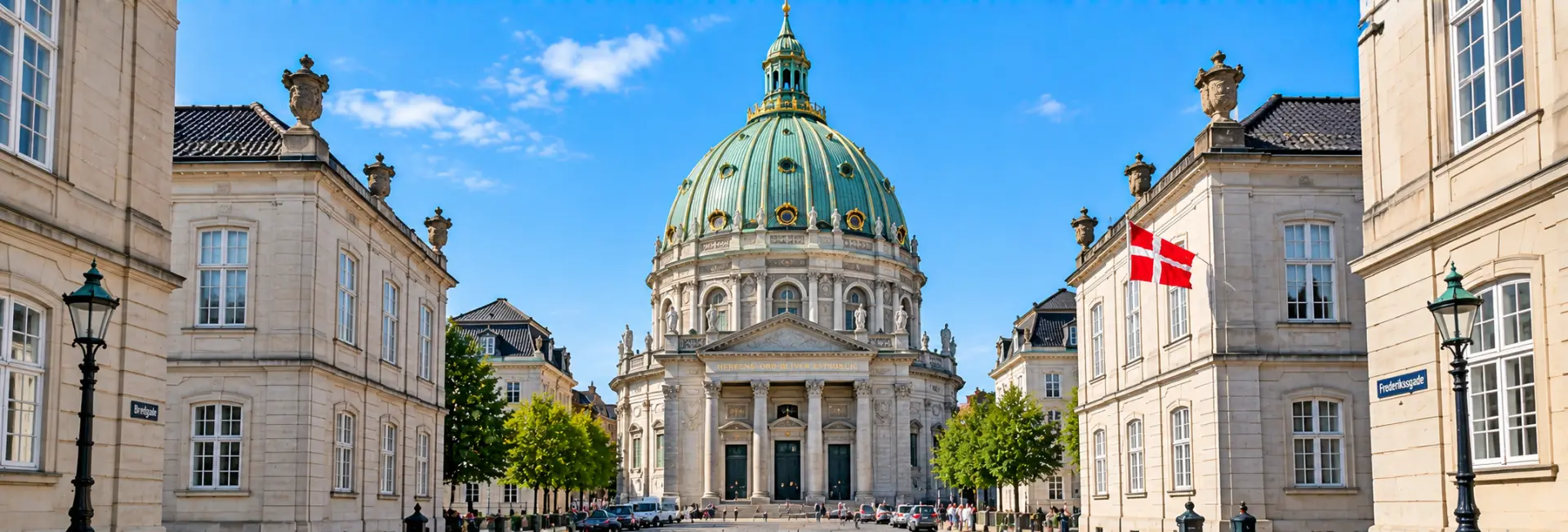
Frederik's Church, known to almost everyone in Copenhagen simply as the Marble Church, is one of the city's most recognizable landmarks, its enormous green dome visible from streets away and framing the view down Frederiksgade from Amalienborg Palace. Officially an Evangelical Lutheran parish church, it sits at the heart of the Frederiksstaden district and remains an active place of worship alongside its role as one of Copenhagen's most photographed buildings.
What makes the church especially interesting is its history rather than just its architecture. Planned as a grand marble monument in the 18th century, it was abandoned half-built for nearly 150 years before a private financier stepped in to finish it in a more economical style, leaving a building whose finished form is quite different from what its original architect had in mind.
History
A Royal Monument, Cut Short
Frederik's Church was conceived in the 1740s as part of Frederiksstaden, the grand new royal district King Frederik V commissioned to mark the 300th anniversary of the House of Oldenburg's rule over Denmark. Architect Nicolai Eigtved drew up the original designs, and King Frederik V laid the foundation stone on 31 October 1749, envisioning a church built almost entirely from imported Norwegian marble as the district's crowning centerpiece.
Decades as a Ruin
The project proved enormously expensive from the start, since the plan called for the church to be built almost entirely from costly imported stone rather than the brick used for most Danish buildings of the period. Progress slowed further after Eigtved's death in 1754, and later architects, including Nicolas-Henri Jardin, revised the plans in an attempt to keep the project moving forward. Spiraling costs eventually caught up with the project entirely, and in 1770, chief minister Johann Friedrich Struensee halted construction altogether, leaving a roofless shell that stood as an unfinished ruin in the middle of the city for close to a century, a strange and somewhat embarrassing landmark at the heart of an otherwise grand royal district.
Rescued by a Financier
Salvation came from an unlikely source. In 1874, Denmark's leading 19th-century industrialist and financier, Carl Frederik Tietgen, purchased the ruined site from the state on the condition that he complete a church broadly following the original plans. The deal was politically controversial at the time, and the government official who negotiated it later faced impeachment proceedings over the arrangement, though he was eventually acquitted. Tietgen commissioned architect Ferdinand Meldahl to finish the design, and construction resumed in 1877. The finished church was finally consecrated on 19 August 1894, a full 145 years after the first stone was laid, closing out one of the longest building projects in Danish history.
Architecture & Design
The church's exterior blends its two very different building phases in a way that is not immediately obvious to most visitors. The lower walls, dating from the original 18th-century campaign, are built from imported Norwegian marble, while the upper sections added under Meldahl in the 1880s use Faxe limestone, a hard coral stone quarried south of Copenhagen that can be polished to resemble true marble. The result is a building that looks strikingly uniform from street level despite being constructed more than a century apart in two different materials by architects working in noticeably different styles.
Meldahl also reworked Eigtved's original rococo vision into a more Roman Baroque style for the finished building, drawing heavily on the example of St. Peter's Basilica in Rome for the church's overall silhouette and proportions. Around the base of the dome and along the church's balustrades runs a series of statues depicting biblical figures and major names from Danish and international church history, including a statue of the philosopher Søren Kierkegaard, whose relationship with the established church in his own lifetime was famously uneasy, and one of the reformer Martin Luther, tying the building's iconography to the broader story of the Lutheran church in Denmark.
The Dome
The dome is Frederik's Church's defining feature and remains the largest church dome in Scandinavia, spanning roughly 31 meters and rising to an interior height of around 46 meters above the church floor, a scale that dwarfs most other church interiors in Denmark. It rests on twelve massive supporting columns and is finished on the outside in weathered copper, which has given it the distinctive green patina visible across much of central Copenhagen, especially when viewed from the harbor or from higher vantage points elsewhere in the city.
Inside, the dome is decorated with painted frescoes depicting the twelve apostles, created by artist Chresten Overgaard following preliminary designs by his colleague Henrik Olrik. During the summer months, and on weekends the rest of the year, visitors can climb up into the dome itself for a close-up look at the structure and sweeping views out over the rooftops of Frederiksstaden and the harbor beyond, a perspective that also makes clear just how much of central Copenhagen's skyline the dome dominates.
Interior & Notable Features
Inside, the circular nave beneath the dome creates an unusually open, light-filled worship space compared with the narrower naves typical of older Danish churches, an effect that owes as much to Meldahl's 19th-century adjustments as to Eigtved's original vision. Above the front portico, an inscription in gold lettering reads Herrens ord bliver evindelig, meaning the word of the Lord endures forever, a line drawn from the New Testament book of 1 Peter and chosen to frame the building's purpose for visitors as they step inside.
At the church's main entrance stands a statue of N. F. S. Grundtvig, the influential 19th-century pastor, writer, and reformer whose ideas shaped much of modern Danish religious and cultural life. Tietgen, who financed the church's completion, intended the building to serve as a monument to Grundtvig's legacy as much as to the royal family that originally commissioned it.
Cultural & Religious Significance
As a working parish church within the Church of Denmark, Frederik's Church holds regular Sunday services alongside occasional concerts and public lectures, continuing a religious role that long predates the building's eventual completion and that carries on largely unchanged despite the church's popularity as a tourist site. Its location directly on the sightline from Amalienborg Palace also ties it closely to the royal family, both symbolically and in practice, reinforcing the original vision behind Frederiksstaden as a unified royal and religious district built around a single grand axis.
The church has hosted major royal occasions in more recent history, including the wedding of King Frederik X and Queen Mary in 2004, cementing its place as one of the more significant ceremonial sites in modern Danish royal life alongside its everyday role as a neighborhood church.
Visiting Etiquette & Tips
A few practical points help visitors get the most out of a stop at Frederik's Church, particularly if a dome climb is part of the plan.
- Entry to the church itself is free, but the dome climb carries a small admission fee that is typically cash-only, so bring some kroner along.
- The dome is open at 1 pm daily during the summer high season, and at the same time on weekends and public holidays for the rest of the year, so check the current schedule before planning a visit around it.
- As an active place of worship, visitors should keep noise to a minimum and dress modestly, particularly if a service or concert is taking place.
- The dome staircase is narrow and involves a real physical climb, so it may not suit visitors with mobility concerns.
- Photography is generally welcome inside the church, though flash photography is best avoided out of respect for other visitors and ongoing services.
Best Time to Visit
Visiting around midday works well for most travelers, since the dome's limited opening window at 1 pm is the main scheduling constraint for anyone hoping to climb up inside it. Arriving a little before opening time helps avoid the small queue that tends to form during the busy summer months.
The church and its square are also worth a look at different times of day, since the dome's copper exterior and marble facade catch the light differently depending on the hour, with early morning and late afternoon generally offering the softest light for photographs of the building from Amalienborg's colonnade.
Nearby Attractions
Frederik's Church sits at the center of Frederiksstaden, putting several other major Copenhagen landmarks within a short and pleasant walk.
- Amalienborg Palace and its royal square lie directly along the sightline from the church's front steps.
- Amalie Garden and the Copenhagen harbor front are a short walk beyond Amalienborg toward the water.
- Nyhavn's canal and colorful townhouses are within easy walking distance to the south.
- The Little Mermaid statue and Kastellet fortress park lie a bit farther north along the waterfront, reachable on the same walk.
FAQs about visiting Frederik's Church
Is Frederik's Church actually made of marble? +
Only partly, the lower walls were built from imported Norwegian marble in the 18th century, while the upper sections added later use Faxe limestone, which resembles marble but is technically a different material.
Is it free to enter Frederik's Church? +
Yes, entry to the main church is free, though climbing up into the dome requires a small paid ticket, typically payable only in cash.
Why did it take so long to build the Marble Church? +
Construction began in 1749 but was halted in 1770 due to spiraling costs, leaving the church as an unfinished ruin for nearly a century until financier Carl Frederik Tietgen funded its completion, with the church finally consecrated in 1894.
When can you climb the dome? +
The dome is generally open daily at 1 pm during the summer high season, and on weekends and public holidays at the same time for the rest of the year, though schedules can vary and are worth checking in advance.
Is Frederik's Church still an active church? +
Yes, it functions as a working Evangelical Lutheran parish church with regular Sunday services, alongside concerts and lectures held throughout the year.
How long does a visit to Frederik's Church take? +
Seeing the interior alone takes about 20 to 30 minutes, while adding a dome climb typically brings a visit closer to an hour, including any wait for the scheduled opening time.
Has the Danish royal family used the church for major events? +
Yes, King Frederik X and Queen Mary were married at Frederik's Church in 2004, among other notable royal and public occasions held there over the years.
What else is nearby that's worth combining with a visit? +
Amalienborg Palace sits directly in view of the church's entrance, and Nyhavn, Amalie Garden, and the Little Mermaid statue are all within easy walking distance.