Table of Contents
Overview
Rosenborg Castle began as a country summerhouse for King Christian IV and grew into one of Copenhagen's most treasured Renaissance buildings, one that has stayed remarkably close to its original form for over four centuries. Set inside the King's Garden in the middle of the city, it now functions as a museum holding the Danish Crown Jewels along with more than 400 years of royal furnishings, portraits, and personal belongings.
What sets Rosenborg apart from many royal sites is its intimacy. Rather than the vast formal halls of a state palace, several of its rooms remain close to how Christian IV himself used them, giving visitors an unusually direct sense of daily life inside a 17th-century royal household, right down to the king's own writing cabinet and bathroom.
History
A King's Summerhouse
Christian IV commissioned the first version of Rosenborg in 1606 as a modest summer retreat just outside the city walls of the time. He kept adding to it over the following years, and by 1624 the castle had grown into the layered Dutch Renaissance building recognizable today, credited to architects Hans van Steenwinckel the Younger and Bertel Lange working from the king's own ideas.
A Royal Residence, Then a Refuge
Rosenborg served as an active royal residence for much of the 17th century, and Christian IV himself died within its walls in 1648 after a reign that spanned nearly six decades and reshaped much of Copenhagen. Regular royal use continued into the early 18th century, after which the castle's role shifted largely to storage and display of royal treasures rather than day-to-day living. It returned to service twice more in moments of crisis, once when the royal family sought shelter here after the 1794 fire at Christiansborg Palace, and again during the British attack on Copenhagen in 1801, when the castle briefly served as a safe haven while the city came under bombardment.
Opening to the Public
In 1838, Rosenborg opened its doors as a museum, becoming one of the earliest examples in the world of a royal collection displayed inside its original setting rather than moved to a purpose-built gallery. That approach has largely continued ever since, with rooms furnished much as they were during the castle's working life as a residence.
Architecture & Design
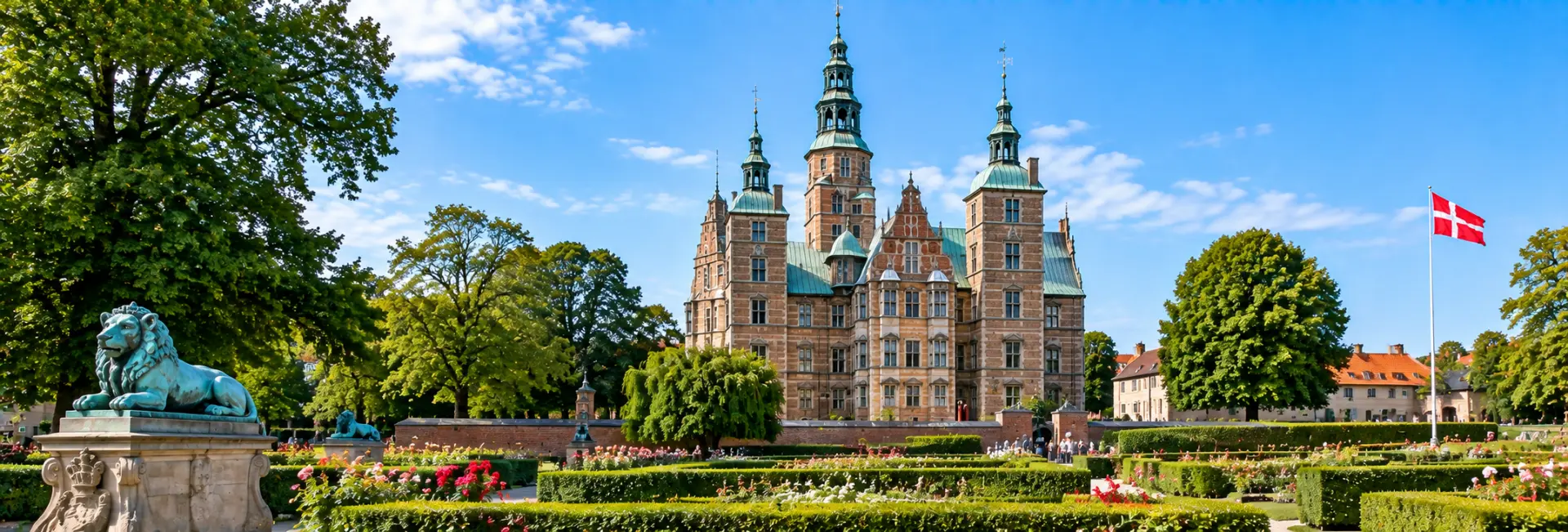
Rosenborg is one of the best-preserved examples of Dutch Renaissance architecture in Denmark, built from red brick with sandstone detailing, stepped gables, and copper-topped towers that give the building its distinctive silhouette against the surrounding garden. Christian IV took a close personal interest in the design, and the castle reflects his broader taste for ambitious building projects across Copenhagen, from the Round Tower to the Exchange building nearby, all built during a reign remembered for its architectural ambition.
Inside, the layout still traces the castle's growth in stages, from the more modest original rooms to grander additions built as the king's ambitions for the building expanded over successive phases of construction. Several interiors, including Christian IV's private writing cabinet and his personal bathroom, remain close to their original 17th-century appearance, offering a rare look at a royal building that was never significantly remodeled in later centuries the way many other European palaces were, having instead been treated as a preserved time capsule almost from the moment royal residents stopped using it day to day.
The Knights' Hall
The Long Hall, better known today as the Knights' Hall, occupies the castle's third floor and is Rosenborg's most celebrated room. Originally built as a ballroom, it later served as a royal reception room before taking on the name it carries now in the 19th century.
At one end stand the coronation chairs of the Danish monarchy, the king's throne made partly from narwhal tusk once believed to be unicorn horn, and the queen's throne flanked by three life-size silver lions standing guard on the floor before it. Twelve tapestries line the walls, commissioned by Christian V to commemorate his victories in the Scanian War of the 1670s, created from sketches made by artists who accompanied the king during the campaigns and later translated into detailed woven scenes of battle. A stucco ceiling above depicts the Danish coat of arms surrounded by the Order of the Elephant and the Order of the Dannebrog, Denmark's two highest orders of chivalry, with side reliefs recording notable events from the early reign of King Frederik IV.
Smaller rooms leading off the Long Hall hold an extensive collection of royal silver furniture and porcelain place settings gathered from Denmark, China, and Italy, reflecting the diplomatic gifts and trading connections of the Danish court over several centuries. Also tucked among these rooms is a curious piece of 17th-century engineering: an early acoustic system that let musicians hidden in a cellar below play music that drifted up through hidden ducts into the hall above, effectively giving the room a form of ambient surround sound more than three hundred years before the term existed.
The Treasury & Crown Jewels
Rosenborg's basement holds the Treasury, where the Danish Crown Jewels and Royal Regalia are kept under heavy security in a set of vaulted rooms with their own separate entrance from outside the castle. The collection includes four sets of jewels along with the crowns, scepter, orb, and sword used historically in Danish coronation ceremonies.
Among the most striking pieces is Christian IV's own crown, made of solid gold for his 1596 coronation and weighing roughly three kilograms, its surface densely set with enamel work and precious stones that took goldsmiths years to complete. Later rooms in the Treasury display more recent royal jewelry, including pieces worn by Queen Margrethe II on state occasions, connecting the collection's earliest 16th-century pieces to items still in active royal use centuries later. A coronation carpet, historically laid out for the anointing ceremony of absolute monarchs, is also preserved here alongside the sword and orb used in the same rites.
The King's Garden
Rosenborg sits inside Kongens Have, the King's Garden, which Christian IV laid out in a formal Renaissance style shortly before construction of the castle itself began. It holds the distinction of being Denmark's oldest royal garden, and today it draws an estimated 2.5 million visitors a year, making it one of the most heavily used green spaces in Copenhagen.
The garden is free to enter regardless of whether you buy a ticket for the castle itself, and its tree-lined paths, rose beds, and open lawns make it a popular spot for picnics, reading, and simply resting during a day of sightseeing. In summer, formal flower beds near the castle's main facade come into full bloom, echoing the Renaissance planting style Christian IV originally favored, while shaded avenues elsewhere in the garden offer a cooler retreat from the surrounding city streets. Just beyond the garden stand barracks belonging to the Royal Life Guard, the regiment traditionally responsible for guarding the castle, and it is not unusual to see guardsmen passing through the grounds on their way to and from duty.
Best Time to Visit
Rosenborg is at its most photogenic in late spring and summer, when the King's Garden is in full bloom and the castle's brick and sandstone facade stands out against the greenery. This is also the busiest period, so arriving close to opening time gives the best chance of moving through the Knights' Hall and Treasury before tour groups fill in behind you.
Visiting outside the summer months brings smaller crowds and still gives full access to the interior collections, though the garden itself will naturally look sparser. Regardless of season, mornings tend to be quieter than afternoons, particularly on weekends when the surrounding garden fills with locals as well as visitors.
Visitor Tips
A few practical details help make the most of a visit to Rosenborg, particularly given how much is packed into a relatively compact building.
- The Treasury has its own separate outdoor entrance from the main castle, so keep an eye out for the signage rather than expecting to reach it directly from inside.
- Children under 18 generally receive free entry, making Rosenborg a reasonably affordable stop for families compared with some of the city's other paid attractions.
- A combined ticket covering both Rosenborg and Amalienborg is available and can be worthwhile if you plan to visit both royal sites in the same trip.
- Photography without flash is typically allowed in most rooms, but flash and tripods are generally restricted, especially near the Crown Jewels.
- The castle is a short walk from Nørreport Station, one of Copenhagen's main transport hubs, making it easy to reach by metro, train, or bus.
Nearby Attractions
Rosenborg's central location puts several other Copenhagen landmarks within easy walking distance, making it simple to build into a longer day of sightseeing.
- The Botanical Garden of the University of Copenhagen lies just across the road from Rosenborg's grounds.
- The National Gallery of Denmark (Statens Museum for Kunst) sits a short walk to the north along the edge of the same park district.
- Nørreport Station and the surrounding shopping streets offer an easy transition from sightseeing to food and transit connections.
- Amalienborg Palace and the harbor front are within a longer but manageable walk for visitors continuing on toward the waterfront.
FAQs about visiting Rosenborg Castle
Is Rosenborg Castle free to visit? +
Entry to the castle and Treasury requires a paid ticket, though the surrounding King's Garden is free to enter at any time.
How long does a visit to Rosenborg Castle take? +
Most visitors spend around 1.5 to 2 hours touring the castle's rooms and Treasury, with additional time if you plan to relax in the King's Garden afterward.
Where are the Danish Crown Jewels kept? +
The Crown Jewels and Royal Regalia are displayed in the Treasury, located in vaulted basement rooms beneath the castle with their own separate outdoor entrance.
Did the Danish royal family used to live at Rosenborg Castle? +
Yes, Rosenborg served as a royal residence through much of the 17th century, and King Christian IV died within the castle in 1648, though the royal family no longer lives there today.
What is the Knights' Hall known for? +
Also called the Long Hall, it holds the coronation thrones of the Danish monarchy, guarded by three life-size silver lions, along with tapestries commemorating Christian V's 17th-century military victories.
Is Rosenborg Castle suitable for children? +
Yes, entry is generally free for those under 18, and the combination of crowns, jewels, and the surrounding garden tends to appeal to younger visitors as well as adults.
How do you get to Rosenborg Castle? +
The castle is a short walk from Nørreport Station, which connects to Copenhagen's metro, S-train, and regional rail lines as well as several bus routes.
What else is nearby that's worth combining with a visit? +
The Botanical Garden and the National Gallery of Denmark are both within easy walking distance, making it simple to pair a Rosenborg visit with more of the city's museum district.