Table of Contents
Overview
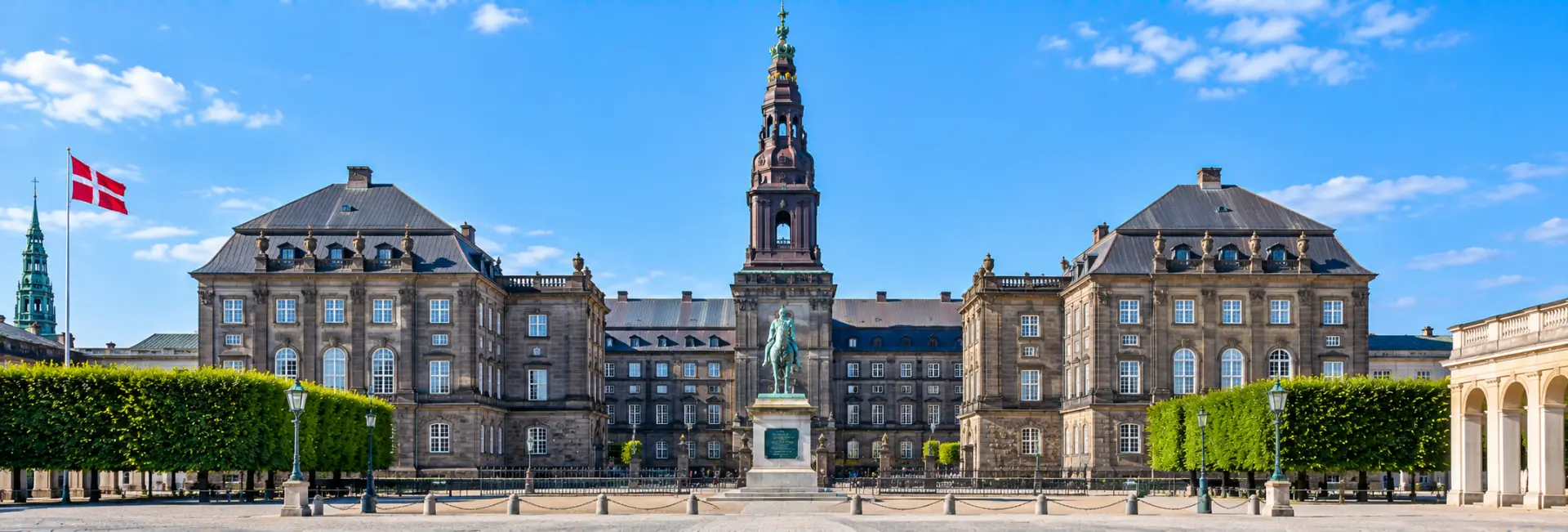
Christiansborg Palace sits on the small islet of Slotsholmen in the middle of Copenhagen and is unlike almost any other building in Europe. It houses Denmark's parliament, the prime minister's office, and the Supreme Court all under one roof, while several rooms are still reserved for the monarch's official use. Locals often refer to it simply as Borgen, the castle, and the name has become shorthand for Danish politics itself.
What makes a visit worthwhile is the layering of history on a single plot of ground. Beneath the current building lie the excavated ruins of a 12th-century fortress, above them sit reception rooms decorated with tapestries chronicling a thousand years of Danish history, and rising over it all is a tower that offers one of the best free views in the city. Few sites let visitors move so directly from medieval stonework to a working seat of modern government in the span of an hour.
History
A Bishop's Fortress
The story of Christiansborg begins in 1167, when Bishop Absalon built a fortified castle on this spot to guard the young trading settlement that would grow into Copenhagen. Over the following centuries the fortress was expanded, torn down by invading forces, and rebuilt more than once as the settlement around it grew into Denmark's capital.
From Royal Residence to Parliament
By the 18th century the site held a proper royal palace, home to the Danish monarchy until a fire tore through it on the night of 26 February 1794. The blaze forced the royal family out with almost no warning, and they relocated to a set of noble townhouses across the city that would become Amalienborg, a move that was meant to be temporary but never reversed. A second Christiansborg was built on the same foundations, completed under architect C. F. Hansen in the 1820s. That palace, too, was destroyed by fire, in 1884, with only the palace chapel and a handful of outer buildings surviving the blaze.
The Current Palace
Construction of the third and current Christiansborg began in 1907, with King Frederik VIII laying the cornerstone, and continued until 1928, when King Christian X presided over its completion. By this point Denmark's system of government had shifted decisively toward parliamentary democracy, so rather than rebuilding purely as a royal residence, the new palace was designed from the outset to house the national parliament and courts alongside the monarchy's remaining ceremonial functions.
The Three Christiansborgs
Visitors sometimes assume the current palace is a single continuous structure, but it is in fact the third building to stand on this site under the Christiansborg name, and each version left its mark on the one that followed.
- The first Christiansborg, completed in 1745 under architect Elias David Häusser, served as the main royal residence until the fire of 1794.
- The second Christiansborg, designed by Christian Frederik Hansen and finished in the 1820s, restored the site as a royal and governmental building until it too burned down in 1884.
- The third and current Christiansborg, largely the work of architect Thorvald Jørgensen, was built between 1907 and 1928 in a Neo-baroque style and now combines the roles of parliament building, courthouse, and partial royal palace.
Salvaged artwork and architectural fragments from the earlier two palaces were incorporated into the current building, so parts of the interior are considerably older than the structure around them suggests.
Seat of the Three Powers
Christiansborg is widely described as the only building in the world that houses a nation's executive, legislative, and judicial branches at the same time. The Folketing, Denmark's parliament, sits in its own chamber within the complex, the prime minister's office occupies a separate wing, and the Supreme Court holds its sessions here as well.
Public access varies by branch. Visitors can watch parliamentary debates from the public galleries when the Folketing is in session, and free guided tours of the parliamentary wing are available on weekends. The Supreme Court and prime minister's office are working government spaces and are not part of the standard visitor route, though the palace's other historic sections remain fully open. This concentration of power in a single building has also made the palace a shorthand for the country's political life; Danes routinely refer to political developments as coming from Borgen, much the way English speakers might say Westminster or Washington.
Royal Reception Rooms & the Tapestries
The Royal Reception Rooms occupy the first floor of the palace's main wing and are still used by the King for New Year receptions, state banquets, and ambassadorial audiences, which makes a visit here feel closer to seeing a functioning court than a museum piece. The rooms were formally inaugurated in January 1928, a date now treated as the official completion of the palace.
The most striking feature inside is a set of seventeen tapestries by Danish artist Bjørn Nørgaard, hung in the Great Hall to mark Queen Margrethe II's 60th birthday in 2000. Commissioned as a gift from the Danish business community for her 50th birthday a decade earlier, the tapestries trace roughly a thousand years of Danish history in a single continuous sequence, from Viking-era scenes through to the 20th century, and reward a slow walk down the length of the hall rather than a quick glance. Nearby rooms hold artwork rescued from the two earlier Christiansborg palaces, including a marble frieze by sculptor Bertel Thorvaldsen originally made for the second building and later remounted in the current one, along with mural paintings of past Danish kings salvaged from the very first Christiansborg.
The Ruins Beneath the Palace
Below the modern palace, visitors can walk through the excavated foundations of Bishop Absalon's original 12th-century castle and the later medieval structures that replaced it. The ruins were uncovered during 20th-century construction work and have been preserved as an underground exhibit, complete with sections of stone wall, wells, and building foundations that predate the current palace by more than seven centuries. Information panels throughout the passages help trace which fragments belong to which era, since the site was rebuilt and expanded so many times over the centuries that different sections of wall can date from wildly different periods.
Because the site sits below the current building rather than in an open field, the ruins give an unusually direct sense of just how much history is compressed into this single small islet, with each rebuilding effectively stacked on top of the last.
The Tower
At around 106 meters, the Christiansborg tower is the tallest in Copenhagen, and its observation deck is one of the few high viewpoints in the city that can be visited completely free of charge. From the top, the view stretches across Slotsholmen's canals, the rooftops of the old city center, and out toward the harbor and the wider Copenhagen skyline.
Because entry to the tower does not require a ticket, it tends to draw a mix of tourists and locals cutting through on a lunch break, making it one of the more relaxed parts of a Christiansborg visit compared with the ticketed sections of the palace.
Best Time to Visit
Christiansborg's various sections keep slightly different hours, and some, like the Royal Kitchen, close on Mondays for part of the year, so it is worth checking the current schedule for whichever rooms matter most before planning a visit. Arriving earlier in the day generally means smaller crowds in the Royal Reception Rooms and an easier time booking a same-day guided tour.
Watching a session of parliament from the public gallery depends entirely on the Folketing's calendar, so travelers hoping to see a debate in progress should check sitting dates in advance rather than assuming access on any given day. The free weekend tours of the parliamentary wing are a reliable alternative when the chamber itself is not sitting.
Visitor Tips
A little planning goes a long way at Christiansborg, since the palace functions as several distinct attractions bundled into one building rather than a single ticketed experience.
- A combination ticket covering the Royal Reception Rooms, the Royal Kitchen, the Royal Stables, and the ruins is generally cheaper than buying separate admission to each.
- Large bags, strollers, and umbrellas are not permitted inside the Royal Reception Rooms, and cloakrooms are available near the ticket office.
- The tower and public galleries are free, so they are worth building into a visit even on a tight budget.
- Wheelchair access is available throughout most of the palace, though visitors with mobility needs should call ahead to arrange a wheelchair or walker.
- Entrance to the Folketing itself, beyond the public galleries, is by guided tour only and cannot be arranged on the spot.
Nearby Attractions
Slotsholmen is packed with historic buildings, so a visit to Christiansborg is easy to extend into a longer walk around the islet and the surrounding old town.
- The Royal Danish Library's Black Diamond building sits on the waterfront a short walk from the palace.
- Thorvaldsens Museum, dedicated to the sculptor whose work appears inside Christiansborg itself, is only a few minutes away on the same islet.
- Strøget, Copenhagen's main pedestrian shopping street, begins close to Slotsholmen's northern edge.
- Nyhavn's colorful harbor front is within easy walking distance for anyone continuing on toward the city center.
FAQs about visiting Christiansborg Palace
Is Christiansborg Palace free to visit? +
The tower and the public galleries of the parliament are free, but the Royal Reception Rooms, the ruins, the Royal Kitchen, and the Royal Stables each require paid admission or a combination ticket.
How long does a visit to Christiansborg Palace take? +
Seeing the tower and one or two ticketed sections generally takes around 1.5 to 2 hours, while covering the full palace, including the ruins and Royal Stables, can take closer to half a day.
Can you watch the Danish parliament in session? +
Yes, the public galleries are open free of charge whenever the Folketing is sitting, though schedules vary and should be checked in advance.
Why has Christiansborg been rebuilt three times? +
Fires destroyed the first two palaces on this site, in 1794 and again in 1884, and the current building, completed in 1928, is the third to stand on the same foundations.
What are the tapestries in the Great Hall? +
They are seventeen tapestries by Danish artist Bjørn Nørgaard, a gift for Queen Margrethe II's 50th birthday and hung in the palace for her 60th, depicting roughly a thousand years of Danish history.
Are the ruins beneath the palace worth visiting? +
Yes, the ruins preserve the foundations of Bishop Absalon's original 12th-century castle and later medieval structures, giving a rare look at Copenhagen's earliest history directly beneath a modern government building.
Is Christiansborg Palace accessible for visitors with mobility needs? +
Most of the palace is wheelchair accessible, though visitors are advised to call ahead to arrange a wheelchair or walker for the visit.
What else is nearby that's worth combining with a visit? +
Thorvaldsens Museum, the Royal Danish Library's Black Diamond building, and the start of the Strøget shopping street are all within easy walking distance on or near Slotsholmen.