Table of Contents
Overview
The National Museum of Denmark, known locally as Nationalmuseet, is the country's largest museum of cultural history and one of Copenhagen's essential stops for anyone curious about how Denmark came to be. Inside a grand former royal residence a short walk from the city's main pedestrian street, the museum traces a continuous line from the tools of early hunter-gatherers to the everyday objects of modern Danish life.
Rather than focusing on a single era or theme, the museum spreads its story across several connected departments, moving from prehistoric Denmark through the Viking Age, the Middle Ages, and the centuries of the Danish monarchy, before opening out into collections gathered from cultures around the world. It is a place built for slow wandering as much as for ticking off famous artifacts.
History of the Museum
Origins in the Royal Kunstkammer
The museum's roots reach back to 1650, when King Frederik III assembled a royal cabinet of curiosities known as the Kunstkammer, gathering art, weapons, natural specimens, and objects brought back from distant lands. For well over a century this royal collection grew as an expression of curiosity and prestige rather than as a public institution, and it was eventually broken apart as its contents were redistributed to newer, more specialized collections in the early 19th century.
A Royal Commission and a New System for the Past
A turning point came in 1807, when King Frederik VI established a royal commission tasked with preserving Denmark's antiquities. In 1816, a young collector named Christian Jürgensen Thomsen was put in charge of organizing this growing store of ancient objects for public display. While sorting artifacts by the materials and techniques used to make them, Thomsen arrived at an idea that would reshape the study of the past worldwide: dividing prehistory into a Stone Age, a Bronze Age, and an Iron Age. This so-called Three-Age System, first laid out in the 1830s, gave archaeologists everywhere a practical way to date objects relative to one another, and it still underpins how prehistoric collections are organized today.
Settling into the Prince's Palace
The institution moved through several homes in Copenhagen before finally taking over the Prince's Palace in 1892, the building it still occupies. Over the following century the museum absorbed and expanded collections covering ethnography, coins and medals, and everyday Danish life, growing into the sprawling, multi-department institution visitors encounter today.
Architecture & Building
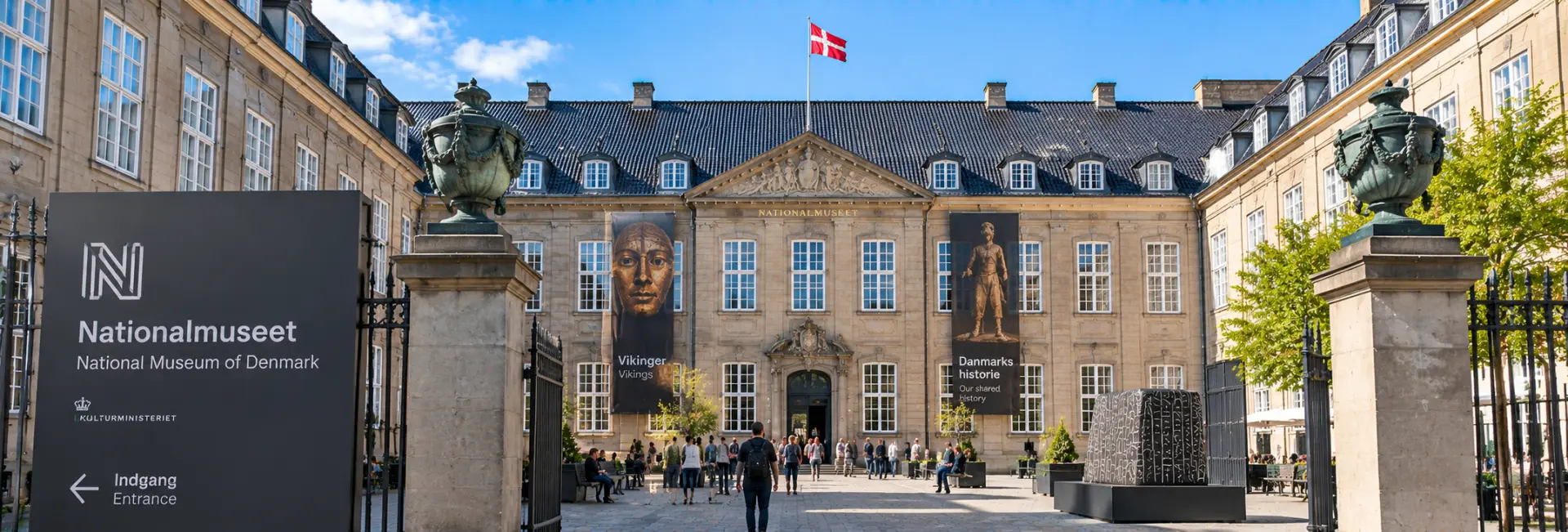
The museum is housed inside Prinsens Palæ, the Prince's Palace, a Rococo mansion built between 1743 and 1744 by Nicolai Eigtved, the court architect also responsible for Copenhagen's Amalienborg Palace complex. A residence had stood on this plot since 1684, making it one of the earliest sites of its kind in the city, and the current building briefly served as home to the future King Frederik V and Crown Princess Louise before the royal family moved on to other residences.
In the decades that followed, the palace passed through the hands of various courtiers, architects, and painters who used its rooms as studios and living quarters, giving the building a layered, lived-in history even before it became a museum. Its stately halls, ornamented ceilings, and grand staircases now form an atmospheric backdrop for the collections, with the scale and formality of the rooms adding a sense of occasion to the galleries they contain.
Collections & Exhibits
Danish Prehistory
This is the museum's core department, following Danish life from the Stone Age through the Bronze and Iron Ages up to around 1050 AD. Cases here hold weapons, jewelry, tools, and burial finds that illustrate how farming, metalworking, and trade gradually transformed early communities across what is now Denmark.
Danish Middle Ages and Renaissance
Covering roughly 1050 to 1660, this section moves into the era of Christian kingship and the growth of towns and churches. Visitors can see an extensive gathering of gilded church altars, carved religious figures, and the furnishings of a wealthy merchant's home, offering a picture of both spiritual life and domestic comfort in medieval and early modern Denmark.
Stories of Denmark, 1660 to the Present
This department picks up with the era of absolute monarchy and carries the story through industrialization, the world wars, and into the modern welfare state. Thousands of objects, from royal court pieces to household items from the 1950s and 1960s, are used to sketch how ordinary Danish life changed across three and a half centuries.
Ethnographic Collections
Beyond Denmark's own history, the museum holds one of the world's largest collections of Greenlandic material culture, including sealskin clothing, kayaks, and carved amulets. Alongside this sit objects gathered from across Asia, Africa, Oceania, and the Americas, among them Japanese samurai armor and sculpted figures of Indian deities, reflecting centuries of Danish trade, exploration, and missionary contact abroad.
Classical and Near Eastern Antiquities
A smaller but rich gallery brings together Egyptian mummies and funerary objects, Greek marble sculpture, Roman household items, and Near Eastern pottery, giving the museum a reach that extends well beyond Scandinavia.
- Royal Collection of Coins and Medals, tracing Danish currency and royal commemorations
- The Victorian Home (Klunkehjemmet), a preserved 1890s merchant's apartment nearby, viewable only on a guided tour
- The Children's Museum, a hands-on wing built specifically for younger visitors
Must-See Highlights
With roughly two million objects in its holdings and around 42,000 on display at any time, the museum can feel vast on a first visit. A handful of objects consistently draw the most attention and make a useful anchor for a first-time route through the galleries.
- The Sun Chariot, a Bronze Age bronze-and-gold sculpture of a horse pulling the sun across the sky, unique in the archaeological record
- The Egtved Girl, a remarkably preserved Bronze Age burial complete with her original corded skirt and belongings
- The Gundestrup Cauldron, an elaborately decorated Iron Age silver vessel found in a Danish bog
- Replicas of the Golden Horns of Gallehus, celebrated Iron Age gold horns whose originals were stolen and melted down in 1802
- The world's largest surviving collection of medieval golden altars, on display in the Middle Ages and Renaissance galleries
- The Huldremose Woman, a naturally preserved bog body dating to around the first century AD
Ways to Experience It
Most visitors explore the permanent galleries independently, following whichever era or theme catches their interest, and a free audio guide is available to add context along the way. Because the museum spans several floors and departments, picking one or two themed routes tends to work better than trying to see everything in a single visit.
- Self-guided routes such as a Danish history walk-through, a family-friendly trail, or a themed world-cultures tour
- Seasonal guided tours in English, typically offered during the summer months
- A separate guided visit to the Victorian Home, booked in advance and limited to small groups due to the fragility of the interior
- Open-ended play and exploration in the Children's Museum, where hands-on activities include boarding a Viking ship replica and cooking in a mock medieval kitchen
Best Time to Visit
Because the collections are entirely indoors, the museum works well regardless of Copenhagen's weather, making it a natural choice on a rainy or cold day. Mornings shortly after opening and the first hour after lunch tend to be quieter, particularly outside the summer peak season.
July and August bring the largest crowds, along with the widest range of English-language guided tours and family activities, so visitors chasing a livelier atmosphere may prefer that window, while those wanting a calmer pace are better served visiting in the shoulder seasons of spring or autumn.
Visitor Tips
A little planning goes a long way given the size of the collections and the museum's central, easily walkable location.
- Confirm current opening hours, ticket prices, and any temporary exhibition details on the museum's official website before visiting, since these can change seasonally
- Entry for visitors under 18 is generally free, making the museum a budget-friendly stop for families
- The building is wheelchair accessible throughout, and wheelchairs and walking frames can be borrowed on site
- Strollers are not permitted inside the galleries, but pushchairs can be borrowed after locking up your own at the entrance
- Set aside at least two hours to see the highlights comfortably, or a half day to explore multiple departments in depth
- The on-site restaurant and museum shop are convenient for a break partway through a longer visit
Nearby Attractions
The museum's central location puts several other major sights within easy walking distance, making it simple to combine with a broader day exploring this part of Copenhagen.
- Christiansborg Palace, home to the Danish Parliament and royal reception rooms, just a few minutes away on foot
- Thorvaldsens Museum, dedicated to the sculptor Bertel Thorvaldsen, roughly a five-minute walk
- Tivoli Gardens, the historic amusement park and pleasure garden, about a ten-minute walk along Vester Voldgade
- Strøget, Copenhagen's main pedestrian shopping street, a short stroll to the northeast
- Ny Carlsberg Glyptotek, an art museum known for its classical sculpture and Impressionist paintings, nearby toward Tivoli
FAQs about visiting the National Museum of Denmark
What is the National Museum of Denmark known for? +
It is Denmark's largest museum of cultural history, best known for holding the country's most important archaeological finds, including the Bronze Age Sun Chariot and the Egtved Girl, alongside centuries of Danish and world history under one roof.
How much time should I plan for a visit? +
Around two hours covers the main highlights, but history enthusiasts can easily spend half a day or more moving through the prehistoric, medieval, and ethnographic collections at a slower pace.
Is the museum free to enter? +
Entry for visitors under 18 is typically free, while adults pay an admission fee; exact current pricing should be checked on the official museum website before your visit, as it can change.
Is the museum suitable for children? +
Yes, the dedicated Children's Museum lets younger visitors touch, climb on, and interact with recreated historical settings, including a Viking ship and a medieval kitchen, making it one of the more child-friendly museums in central Copenhagen.
How do I get to the museum? +
It sits centrally near Strøget and Christiansborg Palace, within easy walking distance of Copenhagen Central Station and Nørreport Station, and is also served by several city bus routes and a nearby metro stop.
Is the museum accessible for visitors with mobility needs? +
The main building is wheelchair accessible, and wheelchairs and walking frames can be borrowed on site, though it is worth confirming accessibility details for specific temporary exhibitions in advance.
What should I combine with a visit to the museum? +
Its location makes it easy to pair with Christiansborg Palace, Thorvaldsens Museum, or Tivoli Gardens, all within a short walk, for a fuller day exploring central Copenhagen's history and culture.
Can I visit the Victorian Home as part of the same trip? +
The Victorian Home is a separate nearby apartment managed by the museum and can only be seen on a limited, pre-booked guided tour, so it is best arranged ahead of time rather than as a walk-in addition to your main visit.