
Table of Contents
Overview
The Antalya Archaeological Museum is one of Türkiye's largest and most important museums, built to house the archaeological wealth of the Mediterranean and Pamphylia regions of Anatolia. Its collection spans from the Palaeolithic era through the Neolithic, Bronze Age, Hellenistic, Roman, Byzantine, Seljuk, and Ottoman periods, drawing heavily on excavations at nearby ancient sites such as Perge, Karain Cave, and Hacılar.
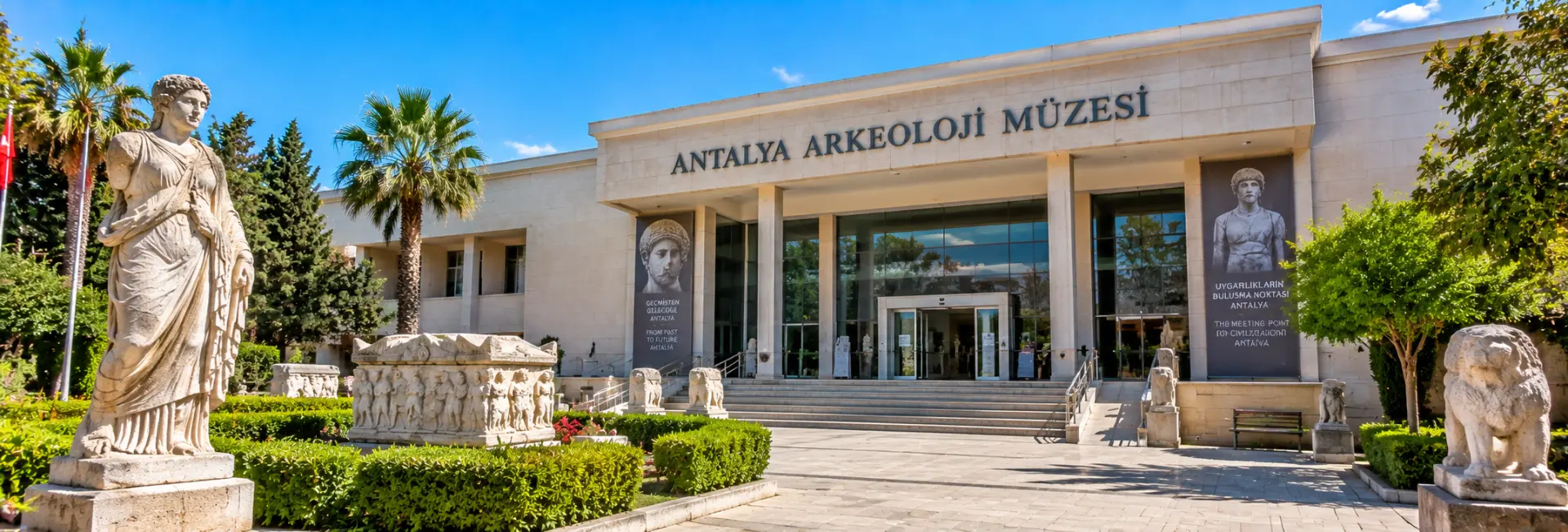
Beyond its holdings, the museum building itself is a significant piece of modern Turkish architecture, the first in the country to be selected through a national design competition. As of this writing, however, the museum is closed to the public and undergoing a major, and contested, redevelopment, so anyone planning a visit should check its current status before making it part of a trip.
For decades before its closure, the museum was regularly ranked among the most complete archaeology collections on Türkiye's Mediterranean coast, serving both as a research institution for scholars working on Pamphylian and Lycian sites and as one of Antalya's standard stops for visitors interested in the region's deeper history.
History of the Museum
The museum's origins trace back to 1919, when a schoolteacher named Süleyman Fikri Erten began gathering archaeological pieces to keep them from being removed from the region during the Italian military occupation that followed the First World War. Those early collections were first displayed inside the Yivli Minaret mosque complex in Kaleiçi, Antalya's old town, in a building that later became the city's Ethnographic Museum.
As the collection grew far beyond what the mosque complex could hold, the Turkish Ministry of Public Works ran a national architectural competition in 1964 for a purpose-built museum, the first time such a competition had been used for a museum project in the country. The winning design, by architects Doğan Tekeli, Sami Sisa, and Metin Hepgüler, was constructed between 1968 and 1971 on a new site on the western side of the city, and the museum opened there in 1972. Its design was recognised in 1988 with the Council of Europe's Museum of the Year Special Award, a rare international honour for a Turkish museum at the time.
For more than fifty years, the building served as one of Antalya's central cultural institutions, expanding its exhibition halls and adding a large extension in the 2000s to accommodate a growing collection. In March 2025, Türkiye's Ministry of Culture and Tourism announced that the building would be demolished and replaced, citing a 2020 seismic assessment that found the structure to be at high earthquake risk.
The building had, by that point, become closely tied to the identity of the city itself, having stood in roughly the same form for over half a century and having hosted generations of school trips, researchers, and tourists during that time.
Architecture and Design
The museum building that opened in 1972 was designed around a modular, low-rise layout of interconnected exhibition halls arranged around courtyards and an open-air gallery, a style architectural historians have described as blending fragmented massing with strong connections between indoor and outdoor exhibition space. The approach reflected mid-twentieth-century Turkish and Mediterranean architectural ideas, using the building's own layout to echo the archaeological sites its collections came from.
At its fullest extent, the complex covered around 7,000 square metres across thirteen exhibition halls plus the open-air gallery, with a further large extension added in the 2000s to handle the museum's expanding storage and display needs. The building's architectural significance, independent of its contents, is central to the debate now surrounding its planned demolition: heritage organisations both in Türkiye and internationally have argued that the structure itself is a protected-worthy example of modern Turkish public architecture, not simply a container for older artefacts.
The same design team behind the museum, led by Doğan Tekeli and Sami Sisa, went on to become one of Türkiye's most prominent architectural practices over the following decades, which has added further weight to arguments that the building deserves recognition as an early, formative work in that career rather than an ordinary municipal structure to be replaced without debate.
Collections and Highlights
At its full operation, the museum displayed around 5,000 objects at any one time, drawn from a wider holding of 25,000 to 30,000 artefacts, most of which remain in storage rather than on public view. The collection is especially strong in material from Pamphylia, the ancient region surrounding Antalya, and from sites within Antalya Province more broadly.
- Finds from Karain Cave, one of the longest continuously inhabited prehistoric sites in Anatolia, spanning tools, bones, and fossils from the Palaeolithic period
- Neolithic, Chalcolithic, and Early Bronze Age material from excavations at Hacılar and Semahöyük
- An extensive Roman-era sculpture collection, much of it excavated from the ancient city of Perge, including large-scale statuary and sarcophagi
- A Hellenistic-era gallery featuring earthenware figurines, wine vessels, and a notable statuette of Apollo
- Mosaics, coins, and icons spanning the Byzantine through Ottoman periods
The Perge material in particular has made the museum an important reference point for the study of Roman-era sculpture in Asia Minor, since many of the pieces recovered from that site's theatre and colonnaded streets were brought here rather than left on site.
The museum also holds a dedicated natural history section covering the region's fossils and geological history, alongside an ethnography wing focused on Ottoman and early Republican-era daily life, giving the collection a broader scope than archaeology alone. Its scale and depth are part of why the current closure has drawn attention well beyond Antalya: very little of the roughly 30,000-object holding can be seen anywhere else while the main building is inaccessible.
Current Status: Closure and Redevelopment
The Antalya Archaeological Museum has been closed to visitors since mid-2025. The Ministry of Culture and Tourism announced in March 2025 that the existing building would be demolished and rebuilt on the same site, citing a seismic performance assessment that found the 1972 structure to be at high risk in an earthquake, along with a stated need for more modern storage and display space. Packing of the collection into on-site temporary storage began over the following months, and demolition preparations were underway by the second half of 2025.
The decision has been strongly contested. Heritage and professional bodies, including Turkish architecture and archaeology associations along with international groups such as ICOMOS Türkiye, DOCOMOMO Türkiye, and the Society of Architectural Historians, have called for the seismic report to be made public and for retrofit or partial preservation to be properly evaluated as an alternative to full demolition. Some of these groups have pursued formal heritage-protection applications and legal challenges, which were still unresolved as of late 2025.
Ministry officials have stated that the new museum will be built on the same site rather than relocated elsewhere in the city, that the surrounding green space and mature trees will be preserved, and that the collection will remain safely stored in Antalya throughout construction under specialist supervision. Early reporting on the project pointed to a design influenced by the ancient city of Perge and a completion target around the end of 2026, though as with any large public construction project, that timeline may shift.
Planning a Visit
Because the museum is currently closed for reconstruction, there is no admission, ticketing, or visiting information to plan around at present. Anyone hoping to see the collection in person should check the museum's official channels or the Ministry of Culture and Tourism's museum website for the latest word on reopening before including it in a trip itinerary.
In the meantime, the museum's specialist teams have continued restoration and conservation work behind the scenes, including on artefacts brought in from abroad, so research and conservation activity tied to the collection has not stopped even though the exhibition halls are inaccessible. Visitors to Antalya in the period before reopening will need to look elsewhere in the city, such as Kaleiçi's smaller museums, for an in-person look at the region's history.
Travellers building an itinerary around the region's archaeology should also bear in mind that many of the artefacts on the museum's usual walking route, including much of the Perge material, will remain in storage rather than on any public display until the new building opens, so this is not a case of a temporary relocation to another venue in the city.
Nearby Attractions
The museum sits on Konyaaltı Caddesi at the western edge of central Antalya, close to several of the city's other well-known sights even while its own doors remain closed.
- Konyaaltı Beach, Antalya's long pebble shoreline, directly below the museum along the coast
- Kaleiçi, Antalya's old walled town, a short tram or bus ride to the east
- Hadrian's Gate, the Roman triumphal arch marking Kaleiçi's historic entrance
- The Suna and İnan Kıraç Kaleiçi Museum, a smaller ethnography museum housed in a restored Ottoman-era mansion in the old town
Visitors keen on archaeology while the main museum is closed often combine a walk through Kaleiçi's old streets with a visit to the smaller Kaleiçi museum, which remains open and covers some of the same regional history on a much smaller scale. The museum's location also makes it a convenient stop on the way to or from Konyaaltı, since a tram line connects the area directly to both the beach and the old town.
FAQs about visiting Antalya Archaeological Museum
Is the Antalya Archaeological Museum open? +
No, the museum has been closed to visitors since mid-2025 while its building is demolished and replaced; check the Ministry of Culture and Tourism's museum website for the latest status before planning a visit.
Why is the Antalya Archaeological Museum closed? +
Türkiye's Ministry of Culture and Tourism cited a 2020 seismic assessment that found the 1972 building to be at high earthquake risk, along with a need for more modern exhibition and storage space, as the reasons for demolishing and rebuilding it.
When will the Antalya Archaeological Museum reopen? +
Early reporting pointed to a completion target around the end of 2026, though timelines for large public construction projects often shift, so it's worth checking current sources closer to any planned visit.
Is the museum's collection safe during the closure? +
Officials have stated that the collection is being kept in secure temporary storage on the museum grounds under specialist supervision, and that restoration and conservation work on the collection has continued throughout the closure.
Why is there controversy around the museum's demolition? +
The 1972 building was Türkiye's first museum designed through a national architectural competition and won a Council of Europe award in 1988, so heritage and architecture organisations have argued for retrofitting or partially preserving it rather than full demolition, and have asked for the seismic report behind the decision to be made public.
What is the Antalya Archaeological Museum known for? +
It holds one of Türkiye's largest archaeological collections, particularly strong in Roman-era sculpture from the nearby ancient city of Perge, alongside prehistoric finds from Karain Cave and material spanning the Byzantine, Seljuk, and Ottoman periods.
Where is the Antalya Archaeological Museum located? +
It sits on Konyaaltı Caddesi on the western edge of central Antalya, close to Konyaaltı Beach and a short tram or bus ride from the old town of Kaleiçi.
Can I see any of the collection while the museum is closed? +
Not currently in Antalya itself; visitors interested in the region's archaeology in the meantime can instead visit the smaller Suna and İnan Kıraç Kaleiçi Museum in the old town, which remains open.
