
Table of Contents
Overview
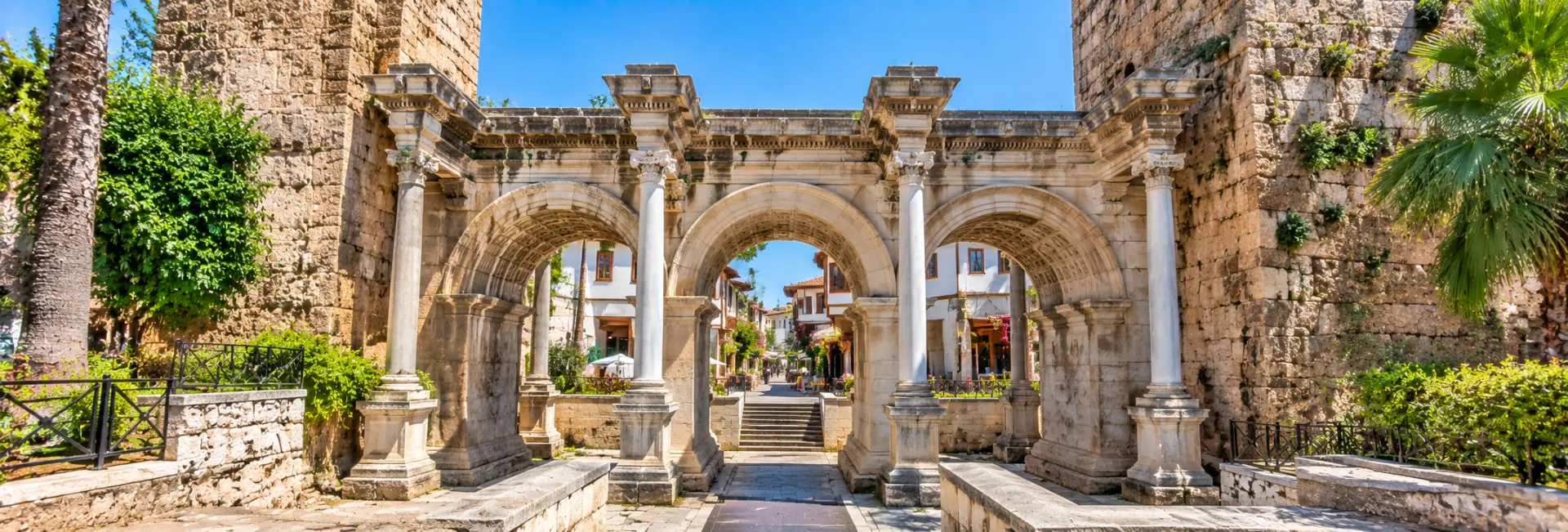
Hadrian's Gate is a triple-arched Roman monument standing at the eastern edge of Kaleiçi, Antalya's old walled town. Built around 130 CE, it is the only surviving entrance gate from the ancient city walls that once ringed Attaleia, the Roman-era name for Antalya, and it still marks the boundary where the modern city gives way to narrow cobbled lanes and Ottoman-era houses.
Locally known as Üçkapılar, or "the three gates," the monument is built almost entirely of white marble and remains remarkably intact for its age, in part because it spent centuries buried and hemmed in by later buildings before being rediscovered in the nineteenth century. Today it functions less as a ruin behind a rope barrier and more as a working piece of the city: pedestrians still pass through its central arch on their way into the old town, much as travelers did nearly two thousand years ago.
Of the many gates and towers that once punctuated Attaleia's defensive walls, Hadrian's Gate is the only one to have survived intact into the present day, which gives it an outsized role in how the city presents its own ancient history. Set against the busy modern traffic of Atatürk Caddesi on one side and the quiet lanes of Kaleiçi on the other, it acts as a physical hinge between the two versions of Antalya that exist side by side.
History
The gate was erected around 130 CE to mark the visit of the Roman emperor Hadrian to Attaleia, a prosperous port city founded roughly three centuries earlier by King Attalus II of Pergamon. Hadrian was known for touring the provinces of his empire more extensively than most of his predecessors, and grand ceremonial gates built to commemorate an imperial visit were a common form of civic honor across Roman cities of the period.
The gate was later folded into the city's defensive walls, and at some point during the Byzantine period it was deliberately sealed on both sides with additional stonework, likely for defensive reasons, which had the unintended effect of protecting it from further damage. It sat largely hidden behind later construction for centuries, unmentioned by earlier travelers through the region, until the Irish hydrographer Francis Beaufort documented its existence in 1817 while surveying the southern coast of Asia Minor. Beaufort's account also described a second storey above the three arches, which had disappeared by the time later nineteenth-century visitors, including the Polish scholar Karol Lanckoroński, recorded the site in detail.
Excavation and restoration work through the twentieth century gradually exposed the lower portion of the gate that had been buried under accumulated street level, and by the 1950s it stood fully uncovered as it does today. Kaleiçi itself, the old town surrounding the gate, was formally declared an archaeological site in 1973, and its historic core has since been the subject of long-running restoration and conservation efforts.
Architecture and Design
The gate consists of three arched passageways set within a single monumental facade, built largely from white marble with granite elements, a combination that set it apart from the plainer stonework of the surrounding city walls. The central arch was traditionally reserved for wheeled traffic and dignitaries, while the two smaller flanking arches handled everyday foot traffic, a layout typical of Roman triumphal gates elsewhere in the empire.
Columns and Ceiling Detail
Decorative marble columns separate the arches on both the interior and exterior faces of the gate, and the underside of the arches carries a coffered ceiling pattern, a common device in Roman monumental architecture used to add depth and rhythm to an otherwise flat stone surface. Some of the columns supporting the structure today are later replacements, pyramid-shaped stone buttresses added during restoration after the originals were damaged in the course of excavating the buried lower section.
The Flanking Towers
Two towers flank the gate on either side, and they come from distinctly different periods. The southern tower dates to the Roman era, built independently of the gate itself using plain stone blocks, while the northern tower was rebuilt during the reign of the Seljuk sultan Alaeddin Keykubad I in the first half of the thirteenth century. An inscription in Old Turkish, written in Arabic script, survives on the Seljuk-era tower, giving the gate a visible record of two very different periods of the city's history side by side.
Legends and Cultural Significance
Beyond its documented Roman history, Hadrian's Gate carries a long-told local legend connecting it to the Queen of Sheba. According to the story, Sultan Belkis, identified with the biblical Queen of Sheba, passed through the gate on her way to a palace at Aspendos, further along the coast, before continuing on to visit King Solomon. The tale is not historically verifiable and predates the gate's actual construction by many centuries, but it has become a well-known piece of local folklore repeated by guides and residents alike, and it reflects how thoroughly the gate has been woven into Antalya's sense of its own past.
The gate also serves a more practical cultural role today: it is a natural stage for the city's public life. During the annual Kaleiçi Old Town Festival, the area around the gate hosts performances, including recreations of Roman-style processions, dance, and music, turning a nearly two-thousand-year-old monument into an active gathering point rather than a purely static ruin.
What to See There
The gate itself is compact, so a visit tends to focus on close details rather than sweeping views. Worth pausing over are the coffered ceilings inside each archway, the surviving marble columns, and the contrast between the plain Roman stonework of the southern tower and the inscribed Seljuk brickwork of the northern one.
- The central archway, now protected by a raised modern walkway that keeps foot traffic from wearing directly on the ancient stone
- The Seljuk-era inscription on the northern tower, written in Old Turkish using Arabic script
- The transition itself: stepping from Antalya's modern Atatürk Caddesi through the gate into Kaleiçi's narrow lanes
- The small landscaped area just outside the gate, with grass, flowers, and benches used for resting between the old and new parts of the city
Looking closely at the stonework also reveals the gate's patchwork history: sections of plain, undecorated Roman masonry sit alongside later restoration work, and the pyramid-shaped stone buttresses added during twentieth-century excavation stand out from the original marble columns around them if you know to look for the difference.
Ways to Experience It
Hadrian's Gate is best experienced as a starting point rather than a standalone stop. Most visitors pass through it on foot as the natural entrance into a longer walk through Kaleiçi, taking in the old harbor, Ottoman-era houses, and narrow shopping streets that begin just beyond it.
- Walk through the central arch to begin a self-guided tour of Kaleiçi's old town and harbor
- Pause at the small park just outside the gate, a popular meeting and resting point along Atatürk Caddesi
- Photograph the gate from the modern street side, where the contrast between the marble arches and contemporary Antalya is most visible
- Visit during the Kaleiçi Old Town Festival, when the area around the gate hosts music, dance, and processions
The gate is unstaffed and freely accessible at any time, with no ticket or opening hours to plan around, which makes it easy to fit into a broader day of exploring the old town rather than treating it as a scheduled attraction on its own. In the evening, when the surrounding buildings are lit and the daytime crowds have thinned, the gate takes on a quieter, more atmospheric character than during the busy midday hours, and it's worth a second look if your visit to Kaleiçi runs into the evening.
Visitor Tips
- The gate is open to the public at all hours and free to visit, with no entrance fee
- Only the central arch is open for walking through today; the two side arches have been closed off to protect the structure
- Wear comfortable shoes, since a visit naturally leads into Kaleiçi's cobbled lanes just beyond the gate
- Visit in the early morning or later afternoon in summer to avoid both the midday heat and the busiest foot traffic through the arch
- The gate sits directly on Atatürk Caddesi, one of central Antalya's main streets, making it easy to find without a guide or map
- Look up while passing through the central arch to see the coffered ceiling detail, which is easy to miss when focused on the columns and towers
- Traffic and pedestrians share the street directly in front of the gate, so take care when stepping back to photograph the full facade
Nearby Attractions
Standing at the boundary between modern Antalya and its old town, Hadrian's Gate puts several other landmarks within easy walking distance.
- Kaleiçi's old harbor and yacht marina, a short walk downhill through the old town
- Yivli Minaret, a distinctive fluted Seljuk-era minaret and one of the symbols of Antalya
- The Antalya Clock Tower, the last surviving tower from the old city walls
- Karaalioğlu Park, a clifftop garden with sea views a short walk to the south
- The Suna and İnan Kıraç Kaleiçi Museum, housed in a restored Ottoman-era mansion just inside the old town
Because Kaleiçi is compact and largely pedestrian, all of these sights can comfortably be combined into a single walking route starting or ending at the gate, with most of them no more than a ten to fifteen minute walk away. The Antalya Archaeological Museum, one of Türkiye's largest, sits a little further out toward Konyaaltı Beach and is generally reached by a short tram or bus ride rather than on foot.
FAQs about visiting Hadrian's Gate
Is Hadrian's Gate free to visit? +
Yes, the gate is freely accessible at all hours with no ticket or entrance fee, since it sits on an open public street rather than inside a fenced site.
Why is Hadrian's Gate called the Three Gates? +
Its Turkish name, Üçkapılar, refers to its three arched passageways: a larger central arch originally meant for dignitaries and wheeled traffic, flanked by two smaller arches for pedestrians.
How old is Hadrian's Gate? +
It was built around 130 CE to mark a visit by the Roman emperor Hadrian, making it nearly 1,900 years old, and it is the only surviving gate from Antalya's ancient city walls.
Can you still walk through Hadrian's Gate? +
Yes, the central arch remains open to pedestrians and forms one of the main entrances into Kaleiçi, Antalya's old town, though the two smaller side arches have been closed off to protect the structure.
How long does it take to see Hadrian's Gate? +
The gate itself takes only a few minutes to see closely, but most visitors combine it with a longer walk through the surrounding Kaleiçi old town, which can easily fill an hour or more.
What is the legend associated with Hadrian's Gate? +
Local folklore holds that the Queen of Sheba passed through the gate on her way to a palace at Aspendos, though the story is a piece of folk legend rather than a historical account, since it predates the gate's actual construction.
Is Hadrian's Gate suitable for visitors with limited mobility? +
The gate itself sits at street level and is easy to reach, but the lanes of Kaleiçi just beyond it are cobbled and sometimes sloped, so onward exploration of the old town may be more challenging for wheelchair users or those with limited mobility.
What's the best time of day to visit Hadrian's Gate? +
Early morning or late afternoon tends to be quieter and cooler, especially in summer, while visiting during the Kaleiçi Old Town Festival offers a livelier atmosphere with music and performances around the gate.
