
Table of Contents
Overview
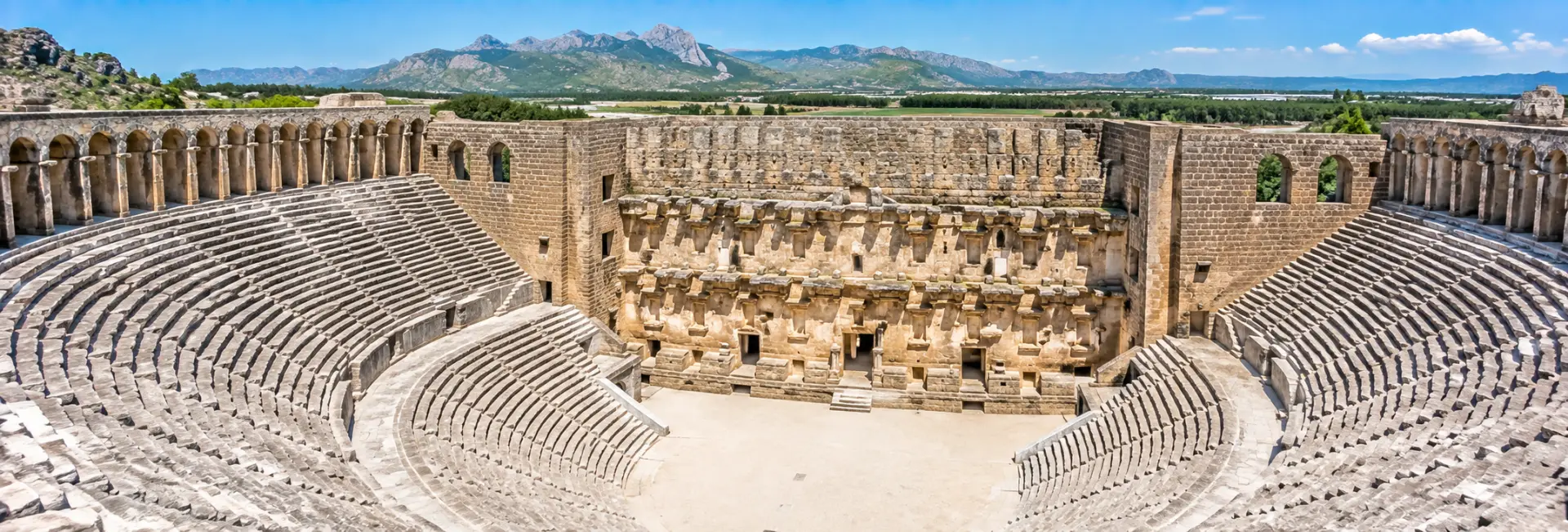
The Aspendos Ancient Theatre sits on the southern slope of a hill near the village of Belkis, in the Serik district roughly 45 kilometres east of Antalya. Built in the 2nd century AD under Roman rule, it is widely regarded as the best-preserved Roman theatre anywhere in the world, with its stage wall, seating tiers, and upper galleries still largely intact. Unlike many ancient theatres that survive only as fragments, Aspendos remains a working performance venue, hosting an international opera and ballet festival every year.
What sets Aspendos apart from other Roman ruins in the region is how little imagination visitors need to bring with them. The scale, the stonework, and the acoustics all still function close to their original design, so a visit feels less like touring a ruin and more like stepping into a building that simply happens to be nineteen centuries old. For many travelers exploring the Antalya coast, it ends up being the single most memorable stop of the trip.
History
Origins and Construction
The theatre was commissioned during the reign of Emperor Marcus Aurelius, in the second half of the 2nd century AD, at a time when Aspendos was a prosperous city in the Roman province of Pamphylia. An inscription found at the site credits the design to a local architect named Zenon and records that it was financed by two brothers from a wealthy Aspendian family, Curtius Crispinus and Curtius Auspicatus, who dedicated the building to the imperial family and to their home city.
Aspendos itself was already an old settlement long before the theatre was built, with a reputation stretching back centuries as a trading hub and horse-breeding centre on the fertile Pamphylian plain, and coins minted there in earlier periods still survive as evidence of that early prosperity. Builders set the theatre into the natural slope of the acropolis hill rather than raising it entirely from ground level, a technique that reduced the amount of stone required for the seating structure and gave the finished building extra stability. Construction on this scale would have required significant civic wealth, which lines up with what historians know about Aspendos as one of the more affluent cities in the region during the Roman era.
Later Uses and Survival
Long after the Roman period ended, the theatre kept being used rather than left to fall apart, which is a large part of why it survived in such good condition. During the era of Seljuk rule it was repurposed as a caravanserai, and builders reinforced parts of the structure with brickwork, including a covered passage added behind the stage wall. That continuous use, instead of centuries of neglect, is often cited as the main reason Aspendos avoided the slow collapse that broke apart so many other ancient theatres around the Mediterranean.
Architecture & Design
The Cavea and Seating
The seating area, known as the cavea, is built directly into the hillside and split into two tiers separated by a walkway, with room for an estimated 12,000 to 15,000 spectators depending on how the standing areas are counted. A colonnaded gallery runs along the very top of the upper tier, which originally gave the whole building an enclosed, unified feel rather than the more open horseshoe shape typical of Greek theatres.
The Stage Building
Behind the orchestra stands the scaenae frons, a two-story stage wall decorated with columns, niches, and Corinthian-style ornamentation, much of which is still standing today. Statues and reliefs would originally have filled many of the wall's niches, adding another layer of decoration above the performers, though most of that sculptural detail has since been lost or moved to museum collections. This stage building is one of the theatre's rarest surviving features, since the stage walls of most other Roman theatres have either collapsed over time or were dismantled long ago for use as building material elsewhere.
- Estimated seating capacity of 12,000 to 15,000
- Two-tiered cavea carved directly into a natural hillside
- Two-story stage wall (scaenae frons) that remains largely intact
- Colonnaded gallery crowning the upper seating tier
The Renowned Acoustics
Aspendos is nearly as famous for how it sounds as for how it looks. The curve of the seating, the height of the stage wall, and the theatre's overall proportions combine to carry sound from the orchestra up to the topmost rows without any electronic amplification, a result ancient builders clearly understood and modern acoustic engineers still study today.
Visitors who stand at the center of the orchestra and speak or clap can often be heard clearly by someone sitting in the highest seats, a small demonstration that local guides frequently use to show just how deliberately the space was engineered. This same acoustic quality is exactly what allows the theatre to be used for live opera and ballet performances today with little need for modern sound equipment.
Part of the effect comes from the semicircular shape of the cavea itself, which focuses and reflects sound back toward the audience instead of letting it scatter outward, while the tall stage wall behind the performers acts as a kind of natural sounding board. Modern researchers who have studied the site point out that ancient builders likely arrived at these proportions through generations of trial and error across many theatres, rather than through any formal understanding of acoustic physics as we know it today.
Aspendos Opera and Ballet Festival
Since 1994, the theatre has hosted the Aspendos International Opera and Ballet Festival, organized with Turkey's State Opera and Ballet directorate. The festival typically runs across several weeks in September, bringing international opera and ballet companies to perform on the very stage where Roman audiences once watched their own entertainment nearly two thousand years earlier.
The festival has grown into one of the Antalya region's best-known cultural events, drawing visitors from across Europe for the chance to watch a live performance inside a nearly two-thousand-year-old building. Because the theatre remains an active performance venue, some areas or seating sections may be closed to general daytime visitors while performances are being staged or rehearsed, so anyone hoping to combine sightseeing with a show should confirm the current festival schedule before planning a trip.
- Held annually, generally across September (exact dates shift each year)
- Features international opera and ballet companies
- Relies on the theatre's natural acoustics rather than heavy amplification
- Festival tickets are sold separately from general daytime admission
Beyond the Theatre: The Ancient City of Aspendos
The theatre is only the most complete part of a much larger ancient city that once stood on and around the surrounding hill. Aspendos was already a significant Pamphylian city well before Roman rule, and the wider archaeological site still holds the remains of a basilica, an agora, a nymphaeum (a monumental fountain), and a stadium, though these structures survive in far rougher condition than the theatre itself. Walking up to the acropolis on top of the hill also gives a wider view over the Pamphylian plain, which helps explain why the original city was built on this spot in the first place.
The Aspendos Aqueduct
A short distance from the theatre, out on the surrounding plain, stand the remains of an aqueduct system that once carried water into the city from nearby hills using a series of tall siphon towers rather than a single continuous elevated channel. It is considered one of the more sophisticated pieces of Roman water engineering in the region and is often visited as an easy add-on stop by travelers who have rented a car or joined a guided tour.
- Basilica and agora ruins on the acropolis hill
- Remains of a nymphaeum, or monumental fountain
- A stadium built into the hillside near the theatre
- The Aspendos Aqueduct, with its distinctive siphon towers, out on the plain
Best Time to Visit
Spring, from April to June, and autumn, from September to October, bring milder temperatures than the height of summer, when the open, largely shadeless site can get uncomfortably hot by midday. Early morning visits, shortly after the site opens, tend to be noticeably quieter and cooler than a midday visit, especially during the busier summer months.
Visiting during the September opera and ballet festival adds a different kind of experience, but it comes with trade-offs: daytime visiting hours or access to certain areas may be adjusted around performance schedules, and festival tickets need to be booked separately and well in advance.
Visitor Tips
- Wear comfortable, closed-toe shoes, since the stone steps and paths are uneven and can be slippery in places
- Bring sunscreen, a hat, and plenty of water, as there is very little shade across the site
- Arrive early or late in the day during summer to avoid both the heat and the largest tour groups
- Combine the visit with the nearby aqueduct ruins if you have your own transport, since they sit only a short drive away
- Check the festival schedule in advance if visiting in September, since some areas may be restricted during rehearsals or performances
- Pack snacks if you plan to spend more than an hour or two, since food and drink options on site are limited
Nearby Attractions
- Perge Ancient City - another well-preserved Pamphylian city with a colonnaded main street and stadium
- Side Ancient City - a coastal town built around Roman ruins, including a well-known temple of Apollo
- Köprüçay River - a popular spot for rafting trips not far from Aspendos
- Antalya's old town (Kaleiçi) and the Antalya Archaeological Museum, both a drive back toward the city centre
FAQs about visiting Aspendos Ancient Theatre
What is Aspendos Ancient Theatre famous for? +
It's known as the best-preserved Roman theatre in the world, with its original stage wall, seating tiers, and acoustics still largely intact nearly two thousand years after it was built.
How do I get to Aspendos from Antalya? +
The site sits about 45 kilometres east of Antalya, and the easiest ways to reach it are by rental car, taxi, or an organized day tour, since public transport only gets you as far as nearby Serik.
How much time should I plan for a visit? +
Most visitors spend around one to two hours exploring the theatre itself, or closer to half a day if combining it with the nearby aqueduct ruins or a stop at Perge or Side.
Is Aspendos Theatre still used today? +
Yes, it hosts the Aspendos International Opera and Ballet Festival each September, using the theatre's original acoustics for live performances rather than a modern venue.
Do I need to book tickets in advance? +
General daytime admission tickets can usually be bought at the entrance, but tickets for opera and ballet festival performances should be booked ahead separately, since seats are limited.
Is Aspendos suitable for kids or visitors with mobility issues? +
Children generally enjoy the scale of the theatre, but the stone steps are steep and uneven in places, so the site is not easy going for visitors who use wheelchairs or have limited mobility.
What else is worth seeing near the theatre? +
The Aspendos Aqueduct is a short drive away, and many visitors pair the theatre with a trip to Perge or Side, both other well-preserved ancient sites in the Antalya region.
What time of year is best to visit? +
Spring and autumn offer milder weather for exploring the mostly shadeless site, while a September visit lets you combine sightseeing with the opera and ballet festival if the schedule allows.
