
Table of Contents
Overview
Termessos is an ancient Pisidian city perched around 1,000 metres up on Güllük Dağı, a rugged peak in the Taurus Mountains roughly 30 kilometres northwest of Antalya. Founded by the Solymi, an indigenous Anatolian people, the city grew into a fortified Hellenistic and Roman settlement so difficult to reach that Alexander the Great abandoned his siege of it in 333 BC rather than fight his way up the mountain.
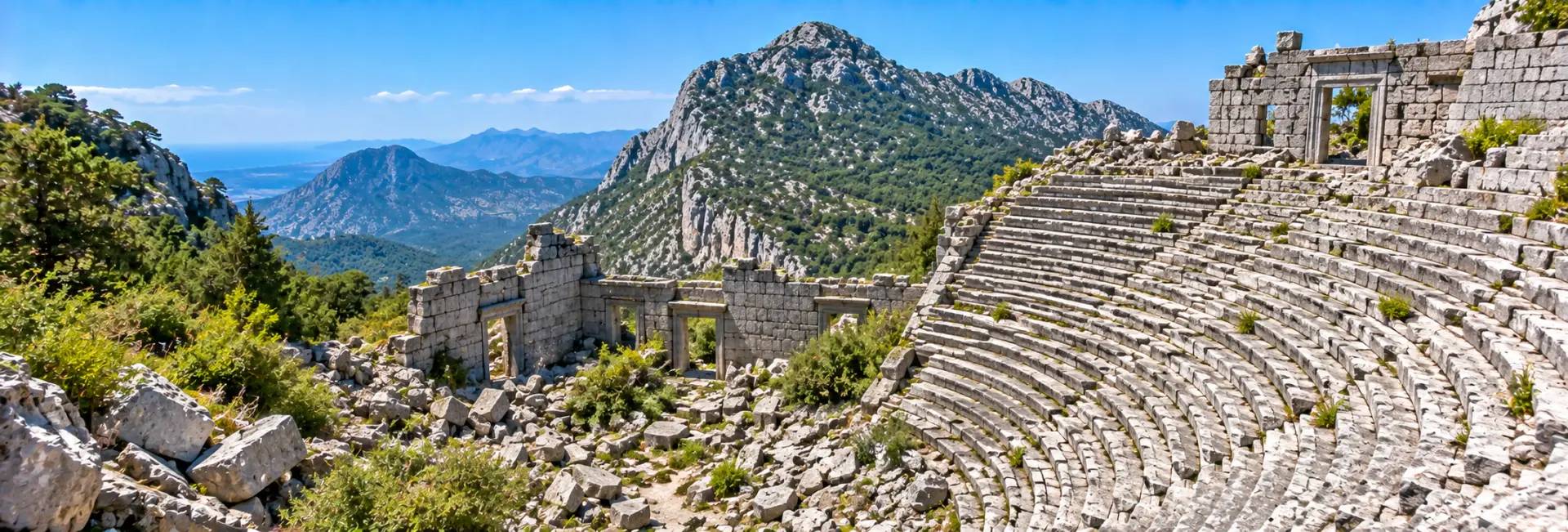
Today the ruins sit inside Güllük Dağı-Termessos National Park, largely unrestored and partly reclaimed by pine forest, which gives the site a wilder, less curated feel than better-known ancient cities on the Antalya coast. Visitors need to hike uphill to reach most of the ruins, but the reward is a theatre, temples, tombs, and city walls scattered across a mountainside with sweeping views over the surrounding valleys. Some visitors even nickname it Turkey's own version of a mountaintop citadel, since so little of the surrounding land has been touched by modern building.
History
Origins and the Siege of Alexander
Termessos traces its origins to the Solymi, a people descended from the Luwians and among the oldest known communities in Anatolia, with some form of settlement on the mountain likely dating back to the fourth or fifth century BC. The city's fortunes are most closely tied to 333 BC, when Alexander the Great marched on Termessos during his campaign through Pisidia. Faced with steep cliffs, narrow approaches, and a defended gorge, Alexander judged the position too costly to storm and moved on to besiege other cities instead, leaving Termessos as one of the few settlements in the region never to fall to his army.
Alcetas and the Hellenistic Period
After Alexander's death in 323 BC, his empire fractured into rival factions, and in 319 BC the Macedonian commander Alcetas took refuge inside Termessos while fleeing his enemies. According to ancient accounts, the city's older leaders eventually agreed to hand him over to preserve peace with the wider region, while younger citizens objected; Alcetas took his own life rather than be captured, and Termessos's youth later recovered his body and gave him an honorary burial, a tomb still pointed out on the site today.
Roman Rule and Abandonment
Termessos later came under Roman influence and was granted a degree of autonomy rare for cities in the province, which allowed it to keep minting its own coins and maintaining its own institutions well into the imperial period. Construction continued under Roman rule, including a triumphal arch dedicated to Emperor Hadrian, but the city's fortunes declined in late antiquity. Most researchers believe Termessos was largely abandoned after an earthquake damaged the aqueduct that supplied its water, cutting off a settlement that already depended on carefully managed cisterns rather than any natural spring.
The Mountaintop Setting
Termessos owes much of its character to where it was built. Rather than choosing an easy, low-lying site, its founders settled on a narrow shelf of rock high on Güllük Dağı, protected on several sides by cliffs and reachable only along a handful of defensible approaches. That choice explains both the city's military resilience and the physical demands it places on modern visitors, since almost every part of the site requires walking uphill along uneven stone paths.
Because there was no reliable natural water source at this altitude, the city's engineers cut a network of large rock cisterns to capture and store rainwater, some of them deep and wide enough that visitors sometimes mistake them for tombs or foundations on first glance. That dependence on stored rainwater rather than a spring or river is also thought to explain why the city was eventually abandoned, since a single earthquake damaging the aqueduct could cut off the water supply for the entire hilltop community. The same rugged terrain that kept invaders out has also kept large-scale modern development away, leaving the ruins in a notably undisturbed setting compared with more accessible ancient sites nearer the coast.
Theatre, Agora, and Temples
The Theatre
The best-known structure at Termessos is its theatre, built into the natural slope of the mountain with a Hellenistic-style cavea that once seated around 4,000 to 5,000 spectators. Unlike coastal theatres framed by cities or plains, this one opens onto a dramatic view of jagged peaks and, on clear days, the distant coastline near Antalya, which is part of why it's often singled out as one of the most scenically located ancient theatres in Turkey. Beyond staging performances, the building is also thought to have doubled as a meeting place for civic gatherings, a common arrangement in Hellenistic cities where theatres served both entertainment and political functions.
Agora and Public Buildings
Below the theatre, the ruins of the agora mark what was once the city's civic and commercial heart, framed by the remains of colonnaded stoas, including one associated with the Hellenistic ruler Attalus II. Nearby stand the remains of a gymnasium, a large training complex for young citizens that once included a bathhouse and dining hall, along with an odeon that likely doubled as a meeting place for the city council.
Temples
Termessos had at least six temples, several clustered near the agora and dedicated to deities such as Zeus Solymeus and Artemis, reflecting the mix of local and Greek religious traditions the city maintained over the centuries. A monumental gateway built in the Ionic order during the reign of Emperor Hadrian marks one of the more architecturally polished additions from the Roman period.
The Necropolis and the Tomb of Alcetas
Termessos is unusually rich in tombs, spread across several necropolis areas to the north, south, and west of the city walls. The northern and southern necropolises are dominated by freestanding sarcophagi raised on stone pedestals, many carved with shields, weapons, or Medusa heads marking the profession or status of the person buried inside, while the western necropolis is known instead for rock-cut tombs carved directly into the cliff face.
The most famous grave at Termessos is the Tomb of Alcetas, reached by a short trail past one of the site's large cisterns. Carved into the rock is a relief of a mounted Macedonian soldier, widely believed to represent Alcetas himself, making it one of the more evocative funerary monuments surviving from the Hellenistic world. Centuries of looting have damaged many of the site's sarcophagi, and some of the finest surviving examples from Termessos are now displayed in the Antalya Archaeological Museum rather than left in place. Archaeologists only began systematic excavation of the necropolis and its waterworks in 2025, so parts of this area of the site are still actively being studied rather than fully documented.
Ways to Experience It
There is no way to see Termessos without walking, since the national park's access road stops well below the ruins and every structure sits along a network of stone paths climbing the mountainside. Most visitors plan for roughly three to four hours on site to reach the theatre, agora, temples, and at least one of the necropolis areas, though it's possible to see a shortened version of the main ruins in less time if the trail to Alcetas's tomb is skipped.
- Wear sturdy hiking shoes, since paths are uneven, rocky, and occasionally steep
- Expect a genuine hike rather than a paved walking tour, with real elevation gain from the parking area
- Bring your own food and water, as there are no shops or cafes inside the park
- Consider a guide or a detailed map from the entrance, since the site is large and not always clearly signposted
Best Time to Visit
Spring and autumn bring the most comfortable hiking conditions, with cooler temperatures than the peak of summer and less risk of the exposed mountain paths becoming uncomfortably hot. Early morning starts are worth planning for in any season, both to avoid the midday heat on the climb and to have a better chance of quieter trails.
Because the site is entirely outdoors and involves genuine hiking, heavy rain or very hot afternoons can make the visit considerably less pleasant, so checking the forecast before setting out is worth the extra step.
Visitor Tips
- There is no public transport directly to the site, so plan on a rental car, taxi, or organized tour from Antalya
- The park entrance and the ruins themselves are a considerable distance apart, so budget time for the drive up through the national park as well as the hike
- Bring cash for the park entrance fee, and check current opening hours before setting out, since these can change seasonally
- Watch your footing around the cisterns and rock-cut tombs, as some areas lack barriers or clear markings
- Pack layers, since temperatures at 1,000 metres can feel noticeably cooler than down in Antalya, especially in early morning or evening
Nearby Attractions
- Karain Cave - a prehistoric cave site with evidence of human habitation stretching back tens of thousands of years, a short drive from the park entrance
- Antalya Archaeological Museum - home to sarcophagi and artifacts removed from Termessos and other sites in the region
- Antalya's old town (Kaleiçi) - a compact historic quarter with Ottoman-era streets, back down toward the coast
- Düzlerçamı Nature Park - a forested area near the national park, popular for picnics and short walks
FAQs about visiting Termessos Ancient City
Why couldn't Alexander the Great conquer Termessos? +
Its position high on a mountain, protected by cliffs and a narrow, defensible gorge, made a full assault too costly, so Alexander chose to move on rather than force his way up in 333 BC.
How difficult is the hike at Termessos? +
It's a genuine uphill hike over uneven stone paths with real elevation gain, so comfortable walking shoes and a reasonable level of fitness are recommended rather than treating it as a casual stroll.
How long should I plan for a visit? +
Most visitors need around three to four hours to reach the main ruins, including the theatre, agora, and at least one necropolis area, longer if you also hike out to the Tomb of Alcetas.
How do I get to Termessos from Antalya? +
There's no direct public transport, so most visitors arrive by rental car, taxi, or an organized day tour, driving up through Güllük Dağı-Termessos National Park to the parking area below the ruins.
Is Termessos suitable for children or visitors with limited mobility? +
The uneven terrain, steep paths, and lack of barriers around cisterns and tombs make it a challenging visit for young children or anyone with mobility issues, more so than lowland ancient sites.
What is the Tomb of Alcetas? +
It's a rock-cut monument honoring Alcetas, a Macedonian commander under Alexander the Great who took refuge at Termessos and died there, with a striking carved relief of a mounted soldier believed to represent him.
Why is Termessos so well preserved compared to other ancient cities? +
Its remote, mountainous location kept away both later builders looking for stone and modern development, so the ruins survived largely undisturbed rather than being reused or built over.
What should I bring for a visit? +
Sturdy shoes, water, snacks, sun protection, and cash for the entrance fee are all worth packing, since there are no shops inside the park and services near the site are limited.
