
Table of Contents
Overview
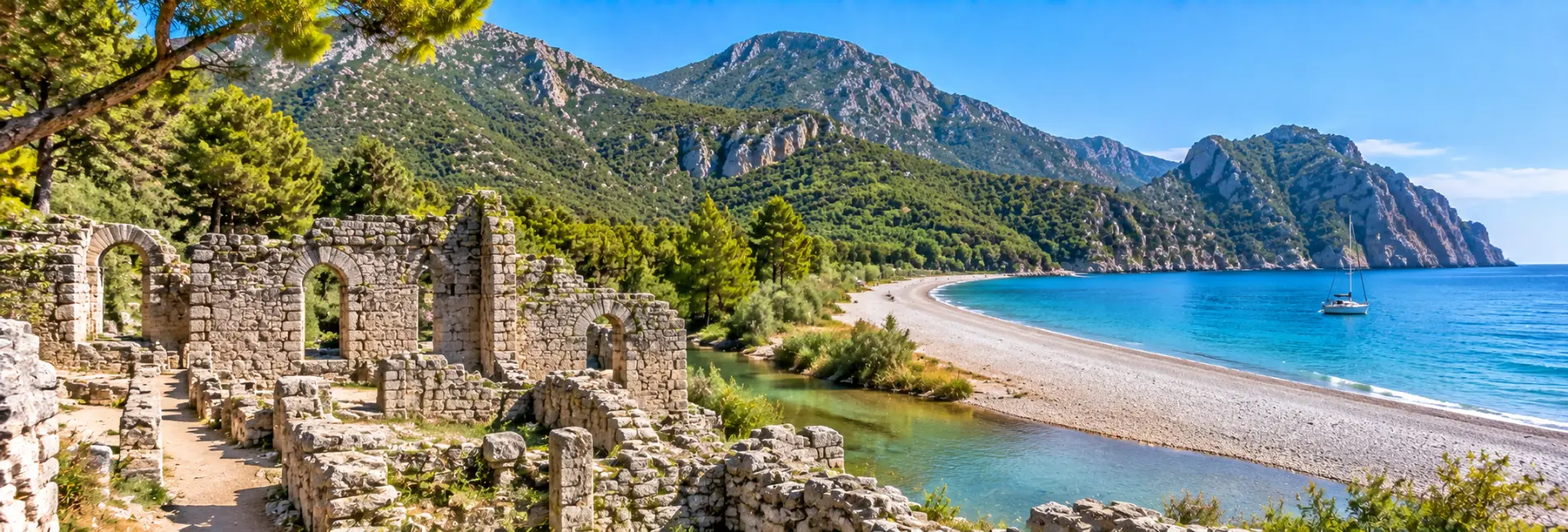
Olympos, Çıralı, and Yanartaş sit close together on Antalya's southwestern coast, but they're three distinct things worth telling apart. Olympos is a ruined Lycian city scattered through a wooded river valley that opens onto the sea. Çıralı is the small, low-rise beach village just next to it. Yanartaş, better known as the Chimaera, is a hillside above both where natural gas has burned continuously out of bare rock since antiquity.
Together they form one of the more unusual stops on the Turkish Riviera: a genuine ancient city that visitors walk through rather than view from behind a rope, a beach protected for nesting sea turtles rather than lined with resorts, and a mythological fire that still burns exactly where ancient writers said it did. Few places on this coast combine archaeology, myth, and nature quite so directly, which is why many travelers end up staying a night or two rather than treating it as a quick stop between other destinations.
History
A Lycian League City
The exact founding date of Olympos isn't known, but the city's name appears on coins from the late second century BC, and ancient sources list it among the six leading cities of the Lycian League, a status that came with three votes in the league's council rather than the one or two votes granted to smaller members. That standing points to a wealthy, well-connected port city with control over productive farmland and a natural harbor at the mouth of its river valley.
The Pirate City
Olympos's fortunes took a darker turn in the first century BC, when the pirate leader Zeniketes seized control of the city along with nearby Phaselis, using its sheltered position to raid Mediterranean shipping and hold travelers for ransom. Rome eventually intervened in 78 BC, when the governor of Cilicia, Publius Servilius Vatia, laid siege to Olympos with a young Julius Caesar reportedly among his forces. Rather than be captured, Zeniketes is said to have set fire to his own household and died inside it, bringing Olympos's pirate era to a violent end.
Roman and Byzantine Olympos
Under Roman rule Olympos was rebuilt and continued as a functioning port city, with the emperor Marcus Aurelius honored by a statue near one of its temples. The city later became a bishopric during the Byzantine period, and the ruins of an early church still stand near the site's entrance. Like much of the Lycian coast, Olympos gradually declined through the medieval period, and a fortified tower built on the hill above the harbor points to a period of Genoese or Venetian presence before the settlement was finally abandoned. By the time European travelers and later archaeologists rediscovered the site, the valley had been left largely undisturbed for centuries, which is part of why the ruins today feel more overgrown and atmospheric than heavily restored.
Exploring the Ancient City
Unlike more manicured archaeological parks, Olympos is deliberately left half-wild: a stream splits the ruins in two, stone paths wind between fig and laurel trees, and many structures are still partly wrapped in undergrowth. A Roman-era bridge once crossed this stream near the site's Çıralı-side entrance, and following the water downstream leads past bath ruins, a basilica, house foundations, and a scatter of sarcophagi belonging to the city's wealthier residents, some carved with markings tied to the seafaring and pirate history of the city.
On the northern side of the valley, a defensive tower on the hill above the old harbor is often described locally as a Genoese or medieval fortification, built long after the classical city itself was founded, and gives a good vantage point over the river mouth and beach below. Because Koç University archaeologists continue active excavation work at Olympos, some paths or structures are periodically closed off, and visitors are asked to respect any barriers they come across.
- Roman bridge and bath ruins near the Çıralı-side entrance
- An early Byzantine church and basilica remains
- Rock-cut and freestanding sarcophagi scattered along the valley
- A hilltop defensive tower overlooking the harbor and beach
The Chimaera (Yanartaş) Eternal Flames
A short drive and a 20 to 30 minute uphill walk above Çıralı, dozens of small flames burn directly out of bare rock on a hillside known in Turkish as Yanartaş, or "burning rock." The flames come from methane and other gases seeping through fissures in the rock and igniting on contact with air, a phenomenon that has been documented at this spot since antiquity and, according to some accounts, has never gone out.
Ancient writers connected the site to the myth of the Chimaera, a fire-breathing creature described as part lion, part goat, and part snake, which the hero Bellerophon was said to have killed while riding the winged horse Pegasus. The ruins of a small temple dedicated to Hephaestus, the Greek god associated with fire, sit near the base of the flames, underscoring how directly this natural phenomenon shaped the mythology and religious life of ancient Olympos. Later Greek and Roman writers, including the historian Ctesias and the naturalist Pliny the Elder, are credited with tying the myth to this exact hillside, giving the site an unusually well-documented link between legend and a still-visible natural feature.
Çıralı: Beach, Village, and Sea Turtles
Çıralı is a small, low-key village that sits right beside the ancient city, stretched along a roughly 3.5-kilometre beach backed by citrus groves and pine forest rather than hotel towers. Building height restrictions and its status as a protected nesting beach for loggerhead (Caretta caretta) sea turtles have kept large-scale development out, so most accommodation here is small guesthouses, pensions, and family-run properties rather than resorts.
Because Çıralı is one of the Mediterranean's protected turtle-nesting sites, sections of the beach are marked off and monitored during nesting season, and visitors are generally asked to avoid using bright lights on the sand at night or disturbing marked nests. That same quiet, low-impact character is a big part of the area's appeal for travelers looking for a slower pace than the busier resort towns further along the coast, and it's common to see the village described as one of the few remaining stretches of undeveloped coastline on this part of the Turquoise Coast.
Ways to Experience It
A typical day starts at the ancient city, entering either from the main gate near the parking area or, for a quieter approach, walking the beach from Çıralı and reaching Olympos through the ruins near the shoreline. Most visitors spend one to two hours if focusing on the main path along the stream, or longer if exploring the hillside tower and outlying sarcophagi as well.
Many travelers pair the ruins with an afternoon on Çıralı or Olympos beach, then drive or hike up to Yanartaş in the early evening, since the flames are far more striking after dark. The trailhead for the Chimaera also lies directly on the Lycian Way, a long-distance coastal hiking route, so some visitors arrive on foot as part of a multi-day trek rather than a day trip.
- Walk the ancient city at your own pace along the stream-side paths
- Combine a beach afternoon in Çıralı with sightseeing at Olympos
- Time a visit to Yanartaş for sunset or after dark, when the flames are most visible
- Consider joining a guided turtle walk during nesting season through a local conservation group
Best Time to Visit
Spring and early autumn bring warm but manageable temperatures for walking around the ruins and hiking up to Yanartaş, while midsummer afternoons can be hot and humid in the sheltered river valley. Sea turtle nesting and hatching generally run through the warmer months, so travelers interested in turtle activity should time a visit accordingly and follow any posted guidance on the beach.
Because Yanartaş is best experienced after dark, an overnight stay in Çıralı makes it easier to see the flames properly rather than rushing back to Antalya or Kemer the same evening.
Visitor Tips
- Wear sturdy sandals or shoes, since both the ancient city paths and the Yanartaş trail involve uneven, rocky ground
- Bring a flashlight or headlamp if visiting Yanartaş after sunset, since the trail itself isn't lit
- Respect any barriers or closed-off areas within the ancient city, since archaeological work is still ongoing in places
- Avoid walking on marked turtle nesting areas of the beach and keep bright lights off the sand at night during nesting season
- There's no direct road between Çıralı beach and Olympos beach, so plan your route accordingly if you want to see both
- Book accommodation in Çıralı ahead in peak summer months, since options are limited by design
Nearby Attractions
- Phaselis - another Lycian coastal ruin with three small bays, a short drive north
- Tahtalı Dağı (Mount Olympos) - reachable by cable car from Tekirova, with panoramic views over the coast
- The Lycian Way - a long-distance coastal trail that passes directly through Olympos and the Yanartaş trailhead
- Adrasan - a quieter neighboring beach village popular with hikers finishing sections of the Lycian Way
FAQs about visiting Olympos Ancient City & Çıralı
Are Olympos, Çıralı, and Yanartaş the same place? +
No, they're three related but separate spots: Olympos is the ancient city ruins, Çıralı is the modern beach village next to it, and Yanartaş (the Chimaera) is a separate hillside site a short drive and hike above them.
Do I need to pay separate entrance fees? +
Yes, the ancient city of Olympos and the Yanartaş flame site each have their own entrance fees or Museum Pass access, and Çıralı beach itself is generally free to walk, though sunbeds and umbrellas are paid extras.
Why is Çıralı so undeveloped compared to other beach towns nearby? +
Its status as a protected loggerhead turtle nesting beach and local building restrictions have kept large hotels out, favoring small guesthouses and pensions instead.
What time of day is best to see the Chimaera flames? +
After dark, since the flames are far more dramatic against a night sky, though the site can be visited during daylight as well if evening timing doesn't work for your schedule.
How long does it take to see the Olympos ruins? +
Most visitors spend one to two hours following the main path along the stream, longer if they also climb to the hilltop tower or explore the outlying tombs and sarcophagi.
Is Olympos suitable for children? +
Yes, the relatively flat main path along the stream is manageable for families, though some side paths and the tower area involve rougher, uneven terrain.
Can I combine a visit with other ancient sites nearby? +
Yes, Phaselis is a short drive north and makes a natural pairing with Olympos for travelers interested in Lycian coastal ruins.
Is there public transport to Olympos and Çıralı? +
Buses run from Antalya's main bus station toward Kumluca and Kaş, with connections by dolmuş or taxi from the Olympos junction, though having a rental car makes getting around the area considerably easier.
