
Table of Contents
Overview
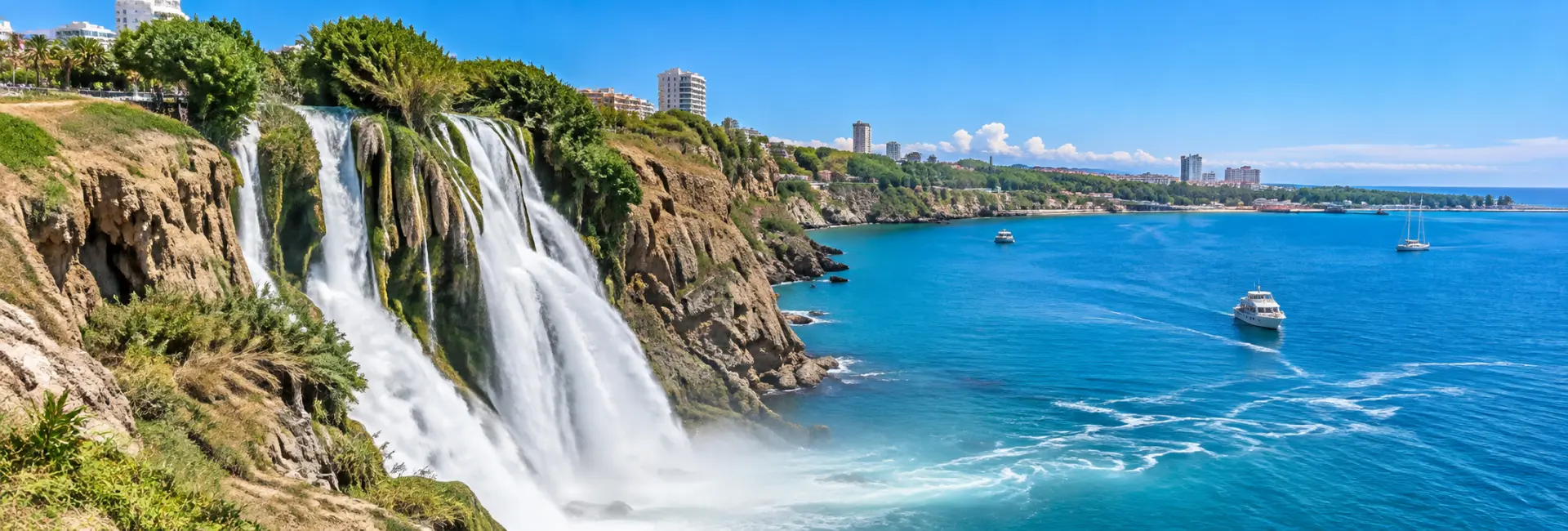
The Düden Waterfalls are actually two separate cascades on the same river, sitting roughly 13 kilometres apart on opposite sides of Antalya. Upper Düden tumbles through a green, tree-lined park inland, while Lower Düden ends the river's journey by pouring straight off a limestone cliff into the Mediterranean Sea.
Together they're among the most visited natural sights around Antalya, popular with day-trippers from the city and with travelers combining a waterfall stop with a beach day or a boat tour along the Lara coastline. Despite sharing a name and a river, the two falls have distinct characters: one is a shaded park built for lingering, the other a coastal landmark best taken in from a viewing terrace or the deck of a boat.
Because they're so close to the city center and to Antalya's main hotel districts, both waterfalls are easy to fit into a short visit, whether as a standalone half-day trip or as one stop on a longer tour of the coastline.
Formation & Natural History
Where the River Reappears
The Düden River's story starts underground. Its water originates from springs in the Kırkgözler and Pınarbaşı area before disappearing into the Bıyıklı Sinkhole and travelling underground for around 18 kilometres through the region's limestone bedrock. It resurfaces at Upper Düden through a karstic spring, a common feature of the porous, water-carved terrain that runs along much of Antalya's hinterland.
A regulator built at this resurgence point diverts part of the flow toward the Kepez hydroelectric plant, where the water passes through a pressure system and turbine before rejoining the river's course. What emerges afterward at Düdenbaşı is effectively a man-managed cascade layered onto a natural spring, which is part of why Upper Düden's flow looks so channelled and consistent compared to a typical mountain waterfall.
Two Falls, One System
From the resurgence at Upper Düden, the river crosses the plain northeast of the city, splitting into irrigation ditches that water agricultural land before the main channel continues toward the coast. At Lara, the accumulated flow reaches a line of limestone cliffs shaped by centuries of erosion and drops roughly 40 metres directly into the Mediterranean, forming Lower Düden. The two waterfalls are best understood as bookends of a single river system — a managed inland spring at one end, and an unaltered plunge into open sea at the other — rather than as two versions of the same sight.
Upper Düden Waterfall
A Park Built Around a Spring
Upper Düden sits in the Kepez district, about 12 kilometres northeast of central Antalya, where the river's karstic source spills into a rocky basin surrounded by pine and eucalyptus trees. Turkey's State Hydraulic Works (DSİ) landscaped the site into a picnic and recreation park between 1970 and 1972, and it still functions largely that way today, drawing a steady mix of local families and visiting tour groups rather than just passers-by taking a quick photo.
What's on Site
- Walking paths loop around the basin and along the top of parts of the cascade
- Shaded picnic tables, tea gardens, and cafés are spread throughout the park grounds
- Wildlife such as songbirds and freshwater turtles is a regular sight near the water
- Fenced entry points mean the site operates on set hours and an admission charge, unlike its coastal counterpart
Compared with Lower Düden, Upper Düden is smaller in scale but calmer in atmosphere, making it a favorite for locals looking for a shaded, unhurried escape from the city rather than a single dramatic photo opportunity.
Lower Düden Waterfall
Where the River Meets the Sea
Lower Düden marks the point where the Düden River finally reaches the sea, dropping about 40 metres from a limestone cliff on the eastern edge of Antalya near the Lara district, in the Muratpaşa area. Locally it's also called Karpuzkaldıran — literally "the watermelon lifter" — a name tied to the district it sits in rather than to any single documented story, and it's often used interchangeably with Lower Düden in casual conversation. Together the falls produce one of the more recognizable images of the city: fresh river water breaking directly into the Mediterranean with Antalya's coastline stretching behind it.
Viewing the Falls
- Clifftop viewing terraces inside Düden Park give a free, direct view straight down onto the drop
- Mist thrown up by the falls frequently forms a visible rainbow, especially in the afternoon light
- Boat tours pass in front of and beneath the cliff for a head-on, sea-level view that isn't possible from land
- Nearby cafés and restaurants perched along the clifftop let visitors watch the falls over a meal
Unlike Upper Düden, the park around the Lower falls is open to the public at all hours and free to enter, though there's no path down to the waterline — viewing is done from above on the terraces or from the water on a boat.
Legend & Cultural Significance
Upper Düden carries an old association with Alexander the Great, who is said to have watered his horses at the site while campaigning through the region of Pamphylia around 334–333 BC. Whether or not the story is strictly accurate, it's repeated widely enough locally that Upper Düden is sometimes referred to as Alexander's Waterfall, and it's one of the details guides frequently point out to visitors.
The falls also appear in classical geography under an older name, Katarrhaktes, with ancient writers noting how far the sound of the water carried along the coast — a detail that still holds true today, especially at Lower Düden, where the falls are often heard before they come into view. Lower Düden's local name, Karpuzkaldıran, reflects a more everyday layer of the same landscape: a district name that has become attached to the waterfall itself, alongside its more formal Düden identity.
Ways to Experience It
There's no single "right" way to see the Düden Waterfalls — the two sites suit different paces and interests, and many visitors combine several of the options below into one outing.
- Walk the park paths and viewing points at Upper Düden for a slower, green visit, with time to picnic or sit at a tea garden
- Watch Lower Düden from the clifftop terraces of Düden Park, free of charge and open at any hour
- Take a boat tour from the old harbour near Kaleiçi or Antalya's marina for a sea-level view of Lower Düden, with several tours running specifically along this stretch of coast
- Book a half- or full-day organized tour that pairs both Düden falls with other regional sights, such as Kaleiçi's old town or the waterfalls at Kurşunlu and Manavgat
- Reach Upper Düden by public bus from central Antalya, or Lower Düden via bus routes serving the Lara road, if traveling independently
Best Time to Visit
Spring and early summer tend to bring the fullest flow to both waterfalls, before the driest months of high summer can thin the river down somewhat. Since part of Upper Düden's flow is shared with the Kepez hydroelectric plant, its volume can also vary depending on how the water is being managed at any given time, which is worth keeping in mind if a full, powerful cascade is the goal.
For Lower Düden specifically, afternoon light is worth timing a visit around, since that's when the rainbow effect in the spray is most likely to appear against the sun. Early mornings are quieter at both sites, particularly at Upper Düden, which can fill with local family groups and tour buses by midday. Outside the peak summer season, both waterfalls are noticeably less crowded and just as scenic, with the added benefit of more comfortable walking temperatures around the park at Upper Düden.
Visitor Tips
- Upper Düden charges an entrance fee and has set opening hours — check current times and pricing before visiting, as these can change seasonally
- Lower Düden Park is free and open around the clock, with no ticket needed for the clifftop terraces, though parking for private vehicles usually carries its own charge
- There's no safe access down to the water at Lower Düden — admire the drop from the designated terraces rather than approaching the cliff edge
- Bring swimwear, a change of clothes, and sun protection if spending time at Upper Düden's picnic and basin area
- Expect spray if you take a boat tour near Lower Düden, and pack cameras and phones accordingly
- Wear comfortable, non-slip shoes, since paths near both falls can be uneven, shaded, or damp underfoot
- If visiting both falls in one day, plan for the travel time between them — they're roughly 13 kilometres apart, on opposite sides of the city
Nearby Attractions
Both waterfalls sit close to other well-known Antalya sights, making them easy to fold into a broader day out rather than a stand-alone trip.
- Kaleiçi, Antalya's historic old town, with its harbour, city walls, and Hadrian's Gate, and the usual departure point for Lower Düden boat tours
- Lara Beach, only a couple of kilometres from Lower Düden along the coast
- Antalya Aquarium, a popular family stop along the Lara road near Lower Düden
- Kurşunlu Waterfalls and Manavgat Waterfall, both further along the coast and often combined with the Düden falls on a single organized waterfall tour
FAQs about visiting Düden Waterfalls
Are Upper Düden and Lower Düden the same waterfall? +
No — they're two separate falls on the same river, about 13 kilometres apart, with Upper Düden inland in a forest park and Lower Düden on the coast where the river meets the sea.
Which one should I visit if I only have time for one? +
Lower Düden is the more dramatic and photogenic of the two thanks to its cliffside drop into the Mediterranean, while Upper Düden suits visitors who want a quieter, greener setting to walk around and picnic in.
Do I have to pay to see the waterfalls? +
Upper Düden charges an entrance fee for its park, while Lower Düden's clifftop viewing area is free and open at all times; it's worth confirming current Upper Düden pricing and hours before you go, since these can change.
Can I swim at Düden Waterfalls? +
Swimming isn't a feature of either site in the way it might be at a countryside waterfall — Upper Düden's basin is more for picnicking and walking, and Lower Düden ends in a sheer drop into the sea with no safe access to the water's edge.
How do I get to the waterfalls from central Antalya? +
Public buses serve both falls from the city center — several routes run to Upper Düden in Kepez, while Lower Düden is reached via buses along the Lara road, and both are easy stops on an organized day tour as well.
What's the best way to see Lower Düden up close? +
A boat tour departing from the harbour area near Kaleiçi or Antalya's marina brings you right in front of the falls at sea level, which shows the full height of the drop in a way the clifftop terraces can't.
How much time should I set aside for a visit? +
A stop at either waterfall alone can be done in under an hour, but allow half a day if you want to see both, and longer still if you're adding a boat tour or pairing the visit with nearby Kaleiçi or Lara Beach.
Is there a good spot to see a rainbow at the falls? +
Yes — the spray thrown up by Lower Düden frequently catches the sun in the afternoon, producing a rainbow that's visible from the clifftop terraces in Düden Park.
