
Table of Contents
Overview
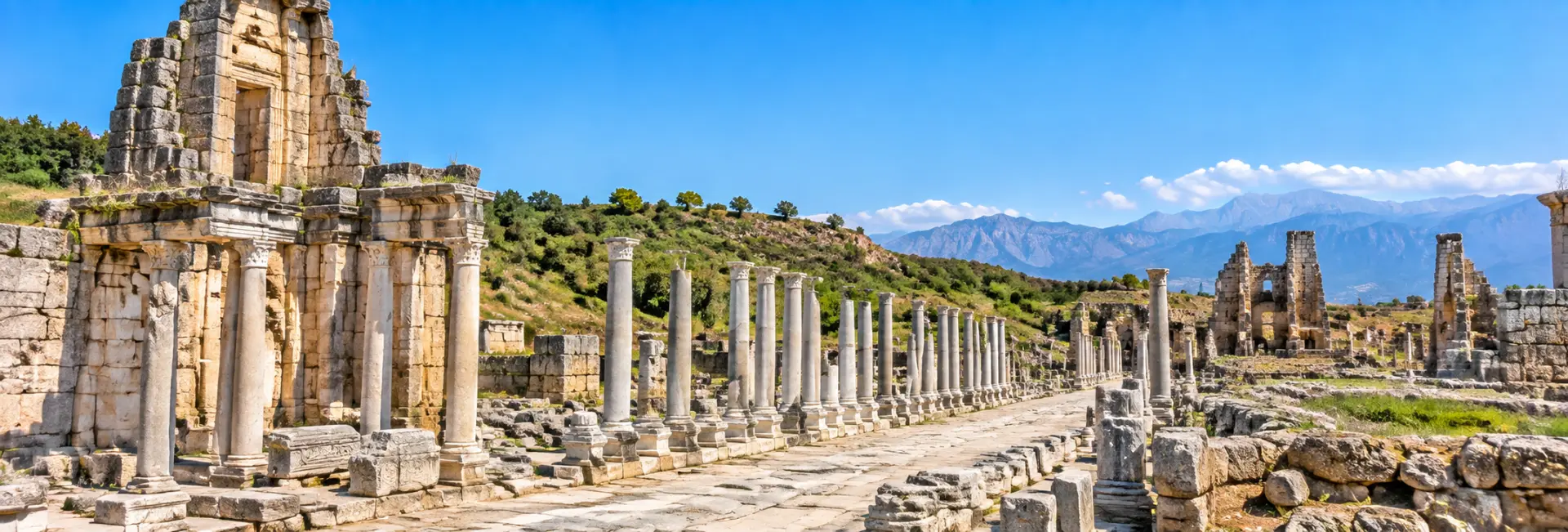
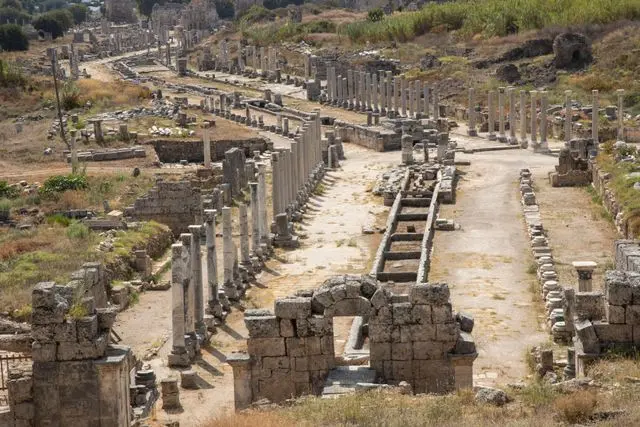
Perge is one of the largest and best-preserved ancient cities in the Antalya region, sitting on the coastal plain east of the city near the modern town of Aksu. Unlike sites reduced to a single standing structure, Perge still reads as a city — a colonnaded main street, a monumental gate, a theatre, and a stadium all survive together, laid out much as they would have appeared under Roman rule.
Visitors walk the same paved streets that once carried Roman traffic, past the remains of baths, fountains, and shopfronts, with the scale of the site making clear just how substantial Perge once was. Excavation has been ongoing since 1946, and the site continues to be uncovered gradually, so what's visible today already represents only part of the ancient city's full footprint.
It's usually visited as part of a day combining several ancient sites east of Antalya, most often Aspendos, though it easily holds its own as a stand-alone destination for anyone with an interest in Roman urban planning or archaeology more broadly.
History
Early and Hellenistic Perge
The site has been occupied since at least the early Bronze Age, with excavations on its acropolis hill dating settlement to around 4000–3000 BC. The city is believed to correspond to Parha, a name recorded in a Hittite treaty tablet, and later tradition held that Perge was founded by Greek heroes returning from the Trojan War. The city entered recorded Greek history around 333 BC, when it opened its gates to Alexander the Great without resistance as his forces advanced through the region, and it subsequently became part of the Seleucid Kingdom.
Roman Perge
Rome absorbed the city around 188 BC, and it was under Roman rule that Perge reached its peak, developing into the capital of the province of Pamphylia Secunda. Most of what visitors see today — the colonnaded streets, the agora, the baths, the enlarged theatre, and the stadium — dates from this Roman building boom during the first three centuries CE. The city's most celebrated resident from this era was the mathematician and astronomer Apollonius of Perga, known for his work on conic sections and for giving the ellipse, parabola, and hyperbola the names still used today.
Byzantine Decline
Perge remained an important Byzantine city into later centuries, adding large basilicas in the 4th and 5th centuries as Christianity spread through the region. Its decline is generally linked to the silting up of the river that once connected the city to the sea, which undercut the trade that had sustained it; occupation eventually contracted back to the fortified acropolis before the site was abandoned. Systematic excavation began in 1946 under Istanbul University and continues today, steadily uncovering more of the ancient street plan.
Recognition & Status
The Archaeological Site of Perge was added to Turkey's UNESCO World Heritage Tentative List in 2009, in recognition of how much of the ancient city plan has survived and of the depth of its excavated record, spanning the Bronze Age through the Byzantine period. It has not yet received full UNESCO inscription, but the tentative listing reflects its standing as one of the more complete ancient cities in the region.
Many of the marble statues and architectural fragments recovered from Perge, including sculpture that has made Antalya's archaeological collection one of the richest of its kind, are now held at the Antalya Archaeology Museum rather than displayed on site.
Fortifications & the Hellenistic Gate
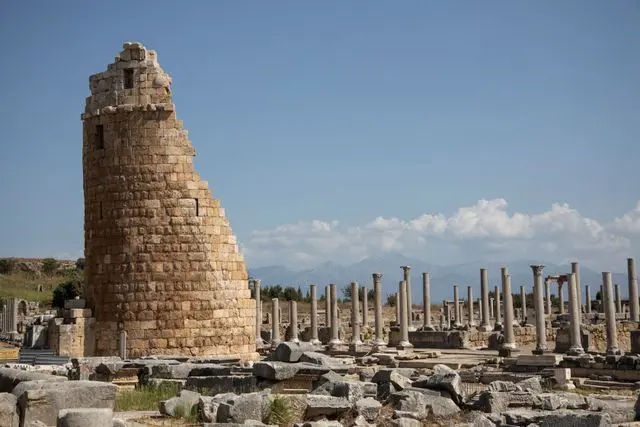
Perge's city walls, dating from the 3rd century BC, are unusually well preserved for a site of this age, especially along the eastern side, where many of the original towers still stand close to their full height. The most memorable entry point is the Hellenistic gate, flanked by two round towers that once anchored the fortification line.
Just inside the towers, a horseshoe-shaped courtyard was added in the Roman period, giving the utilitarian defensive gate a more theatrical, ceremonial character with marble paneling and niches that likely once held statues. Passing through this sequence — practical fortification giving way to decorative civic architecture — is one of the clearest illustrations at Perge of how a working Hellenistic city was reshaped for Roman public life.
Colonnaded Street, Agora & Baths
Beyond the gate, a long colonnaded street forms the spine of the ancient city, running north from the towers with the remains of a central water channel down its length that once fed a series of cascading pools — a striking feature for a Roman street and one still visible in the paving today.
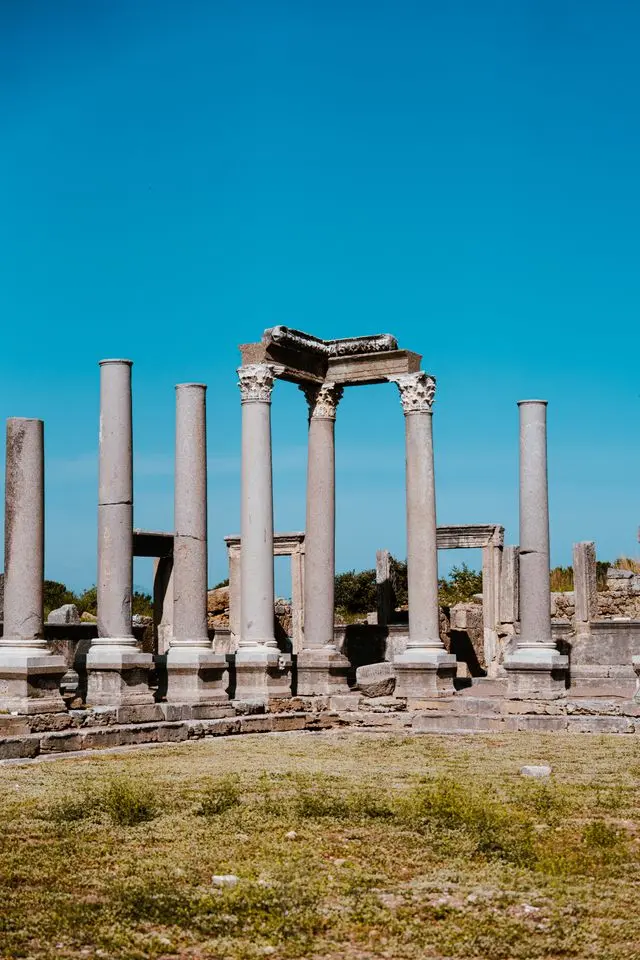
- The agora, a rectangular market square once ringed by shops, some with surviving mosaic floors
- Roman bath complexes, including a well-preserved southern bath with visible heating channels beneath the floors
- A 2nd-century AD nymphaeum, a monumental fountain structure dedicated to the water nymphs
- Remnants of basilicas added during the city's Byzantine Christian period
Together these structures give a sense of Perge as a fully functioning Roman city rather than a scattering of isolated monuments — a place with a market, plumbing, public bathing, and religious life all visible within a short walk of one another.
Theatre & Stadium
The Theatre
Built into the side of a hill with initial construction dating to around 120 CE, Perge's theatre could seat somewhere between 12,000 and 15,000 spectators, depending on the estimate used. Its stage building rose at least two stories and was decorated with marble reliefs depicting scenes associated with the god Dionysus; some of these panels are now displayed at the Antalya Archaeology Museum rather than left in place.
The Stadium
Perge's stadium, built in the 2nd century AD, is considered one of the best-preserved Roman stadiums in western Turkey. At roughly 234 metres long and 34 metres wide, it could hold around 12,000 spectators across rows of seating supported on barrel-vaulted arches — vaults that also appear to have doubled as small shops or storage spaces beneath the stands, based on evidence uncovered during excavation.
Cultural & Religious Significance
Perge holds a notable place in early Christian history. The New Testament book of Acts describes the apostle Paul and his companion Barnabas passing through Perga twice during Paul's first missionary journey, preaching there on their return before sailing on from the coast (Acts 14:25). The city is accordingly one of two starting points, alongside Aspendos, for the modern St. Paul Trail, a long-distance walking route that follows the general course of his travels north into the Anatolian plateau.
In antiquity, Perge was also known as a centre of worship for the goddess Artemis, whose temple was said to have stood on a hill outside the city; despite extensive searching, archaeologists have not yet located its remains.
Ways to Experience It
Perge's flat, open layout makes it easy to explore at a self-directed pace, though a little context goes a long way in a site this large.
- Walk the full length of the colonnaded street from the Hellenistic gate north through the ancient city centre
- Climb into the theatre's seating for a wide view over the site and the surrounding plain
- Explore the stadium's vaulted understructure as well as its seating tiers
- Join a guided day tour that pairs Perge with nearby Aspendos, and often a stop at the Antalya Archaeology Museum to see the site's finest finds
- Reach Perge independently by tram to Aksu from central Antalya, followed by a short minibus, taxi, or walk to the site entrance
- Bring a guidebook or use posted signage, since on-site information panels help make sense of the agora, baths, and other structures whose original function isn't always obvious from the ruins alone
Best Time to Visit
Spring, from April to May, and autumn, from October into early November, offer the most comfortable conditions for exploring Perge, with moderate temperatures and softer light across the open, largely unshaded site. Visiting early in the day is worth planning for at any time of year, since organized tour groups typically begin arriving by mid-morning and the main colonnaded street can get crowded shortly after.
Midsummer visits are workable but demanding — by early afternoon in July and August, the heat across the site's exposed stone surfaces can make extended walking uncomfortable, so an early start and plenty of water are worth planning around if that's the only option. Winter is generally quiet at Perge, and while the weather can be cooler and occasionally wet, the reduced crowds make it an underrated time to see the site's main structures without the summer rush.
Visitor Tips
- Wear sturdy, closed shoes, since much of the site involves walking on uneven ancient paving and loose stone
- Bring sun protection and water — Perge has very little shade across most of the open site
- Set aside at least two to three hours to see the main structures without rushing, more if combining the visit with the on-site museum area or a wider day tour
- Opening hours generally run longer in the April–October high season than in the winter months — check current times and ticket pricing before visiting, since these can change
- Consider visiting the Antalya Archaeology Museum before or after Perge, since many of the statues and reliefs originally found on site are displayed there rather than left in place
FAQs about visiting Perge Ancient City
How old is Perge? +
Occupation of the site goes back to the early Bronze Age, around 4000–3000 BC, though most of the standing ruins visitors see today date from the Roman period between the 1st and 3rd centuries CE.
Is Perge a UNESCO World Heritage Site? +
Not yet — it was added to Turkey's UNESCO World Heritage Tentative List in 2009, which recognizes its significance but is a step short of full inscription.
How does Perge compare to other ancient sites near Antalya, like Aspendos? +
Perge gives a fuller sense of an entire ancient city, with its colonnaded street, agora, and baths all still visible together, while Aspendos is best known for a single, exceptionally well-preserved Roman theatre; many visitors combine both in one day.
How much time should I plan for a visit? +
Two to three hours covers the main structures at a comfortable pace, though history-minded visitors or those combining Perge with the Antalya Archaeology Museum's finds from the site often spend longer.
Is there shade or shelter on site? +
Very little — Perge is a large, open, largely unshaded site, so sun protection, water, and a hat are worth bringing, especially in summer.
How do I get to Perge from central Antalya? +
The most common independent route is the AntRay tram to its eastern terminus, followed by a minibus or short taxi ride to Aksu and on to the site entrance; many visitors instead join an organized day tour that includes transport.
Why is Perge significant for Christian history? +
The New Testament describes the apostle Paul and Barnabas passing through the city during Paul's first missionary journey, preaching there on their return, which is why Perge is one of the starting points for the modern St. Paul Trail.
Where are the statues and artifacts found at Perge now? +
Most of the notable sculpture and architectural fragments excavated at Perge, including marble reliefs from the theatre, are on display at the Antalya Archaeology Museum rather than left at the site.
