
Table of Contents
Overview
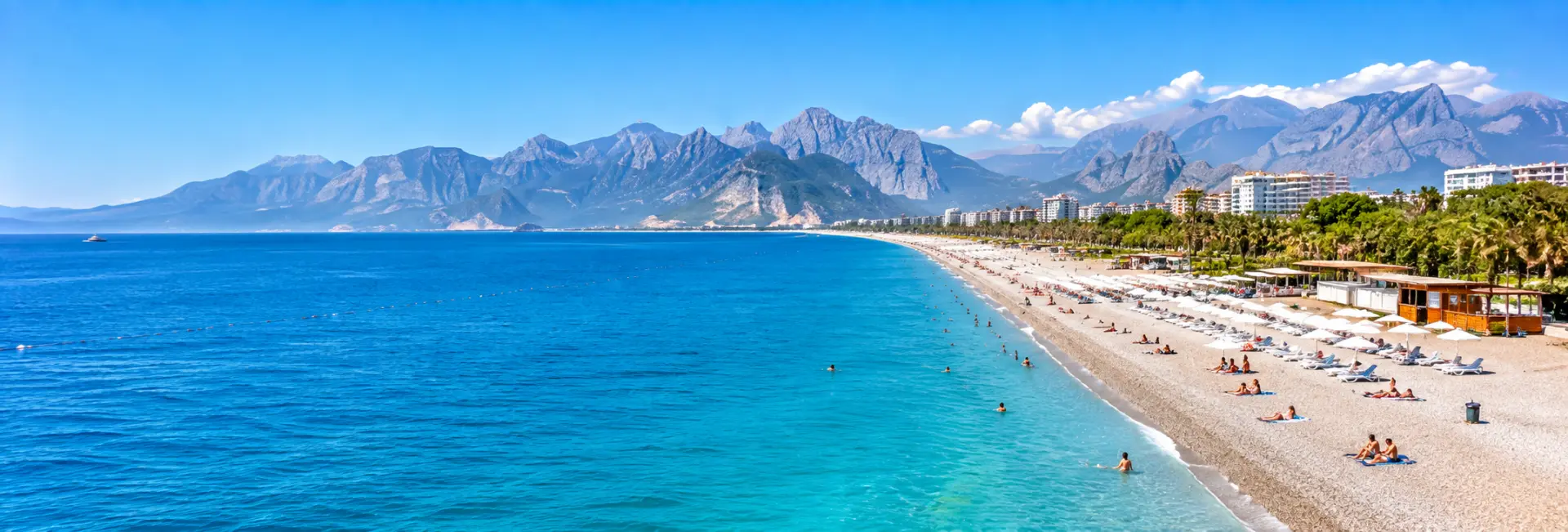
Konyaaltı Beach is the long pebble shoreline that runs along the western edge of Antalya, on Türkiye's Mediterranean coast. Stretching for roughly seven kilometres between the city's sea cliffs and the foothills of the Beydağları mountains, it is one of two beaches most associated with Antalya, the other being sandy Lara Beach to the east. Where Lara is soft and warm, Konyaaltı is known for cooler, clearer water and a dramatic backdrop of mountain peaks that often still carry snow well into spring.
The beach sits directly against the city rather than apart from it, so a day here can move easily between swimming, a walk along the seafront park, and an afternoon at a nearby museum or aquarium. It carries Blue Flag status for water quality and cleanliness, and its scale, running for kilometres along the coast rather than tucked into a single cove, means it rarely feels as packed as smaller resort beaches even during the busy summer months.
What sets Konyaaltı apart from many purpose-built resort beaches is that it functions as a genuine city beach: the neighbourhoods behind it are home to residents going about ordinary life, not just holiday accommodation, and the beach itself is used as much for an evening walk or a bike ride as for a full day of sunbathing.
History and the Meaning of the Name
Long before it became a public beach, the shoreline below Antalya's cliffs was used as a working coastline. Sections of it are linked to Olbia, an ancient port associated with the mountain people of Termessos, and scattered traces of that older settlement have been noted along the coast between the Boğaçayı stream and the Arapsuyu district. The area's role shifted over the twentieth century as Antalya grew from a walled trading port into one of Türkiye's largest cities, with the beach gradually built up with a promenade, parks, and facilities rather than left as open shoreline.
The name "Konyaaltı" has two commonly told explanations, and neither is fully settled. One traces it to "koy altı," meaning roughly "beneath the bay" or "beneath the cliffs," describing the beach's position under Antalya's coastal bluffs. The other connects it to Konya: in the Ottoman period, travellers and traders arriving from Konya are said to have referred to the area below the city as being "under Konya," a phrase that was eventually shortened into the name used today. Locals tend to repeat both stories, and either way the name has stuck to describe the low shoreline beneath the older, higher city.
In more recent decades, the beach has been reshaped from an informal stretch of shoreline into a managed public space. A modern promenade running the length of the coast, complete with cycling and jogging lanes, was completed in the late 2010s, and it replaced what had previously been a looser mix of small beach shelters and undeveloped shore. That redevelopment is a large part of why Konyaaltı now functions as much as a city park as a beach.
Geography and Natural Setting
Konyaaltı runs west from the base of Antalya's travertine cliffs toward the rising slopes of the Beydağları range, part of the wider Taurus Mountains. The coastline is composed mainly of fine, rounded pebbles, with patches of sand in some stretches, and the seabed shelves relatively quickly not far from shore. That depth, combined with several small freshwater streams and underground springs that feed into the sea along the beach, keeps the water noticeably cooler than at Lara Beach on the city's other side.
- Length: approximately 7 kilometres of continuous shoreline, with additional coves and public beach sections extending further along the coast
- Surface: mostly smooth pebbles, with some sandy patches near the eastern end
- Backdrop: the Beydağları mountains rise directly behind the beach to the west
- Water: clear and cool, fed in part by small streams and coastal springs
The cliffs at the beach's eastern end mark the edge of the old city and give some of the best views along the coast, particularly toward sunset when the light catches both the sea and the mountains at once. These bluffs are part of the same limestone plateau that Antalya's old town sits on, and a narrow, winding road descends from the clifftop near the museum down to beach level, giving pedestrians a scenic if occasionally steep route down to the water.
Key Areas Along the Beach
Konyaaltı is not a single uniform strip; different sections of it have developed their own character over the years, largely centred around the seafront park that runs behind the sand and pebbles.
Beach Park and the Eastern End
The eastern section, closest to the cliffs and Antalya's old town, is the busiest and most developed part of the beach. It sits alongside Beach Park, a landscaped green strip with cafes, restaurants, playgrounds, and the promenade's main pedestrian and cycling paths. This is also where most of the beach's paid sunbed areas and water-sport operators are concentrated, and where the tram line and museum are within easy walking distance.
The Western Stretch
Further west, toward the mountains, the beach becomes noticeably quieter and less built up. This part is favoured by residents and longer-term visitors looking for open space rather than facilities, and it offers a more direct, unbroken view of the Beydağları range.
Public and Private Sections
Alongside free public access points along the entire length, more than thirty privately run beach clubs and cafes operate along the coastline, offering sunbeds, umbrellas, and food service for a fee. Visitors can move freely between the free and paid sections depending on whether they want facilities or simply space to lay out a towel.
Specialised Sections
A few stretches along the coast serve specific purposes: a women-only public beach operates further west near Sarısu, and a small yacht harbour sits toward the western end of the coastline, offering a quieter contrast to the open beach further east. Together, these pockets add some variety to what is otherwise a long, continuous shoreline.
Ways to Experience It
Most visits to Konyaaltı centre on the water itself, but the beach and its park support a wider range of activities than swimming alone.
- Swimming and sunbathing along both the free public sections and the paid beach clubs
- Water sports including jet skiing, parasailing, banana boat rides, and stand-up paddleboarding, concentrated mainly on the eastern half of the beach
- Cycling and jogging along the dedicated paths that run the length of the promenade, with bike rental kiosks available at several points
- Evening walks through Beach Park, especially popular in the cooler hours around sunset
- Beach volleyball at courts set up in a few spots along the shore
Because the beach borders ordinary Antalya neighbourhoods rather than a resort strip, restaurants and cafes along it tend to serve residents as much as tourists, which makes for a wider and often better-value choice of food than at a typical hotel beachfront.
A city-run bike-share system has kiosks at several points along the promenade, making it simple to pick up a bicycle at one end of the beach and drop it off near another. For those who'd rather not carry their own gear, sunbeds and umbrellas at the paid sections are typically rented in pairs for a set daily rate, while the free public stretches require nothing more than a towel or mat.
Best Time to Visit
Konyaaltı is swimmable from late spring through early autumn, with June to September the most reliable stretch for warm sea temperatures and consistent sun. July and August bring the largest crowds and the hottest weather, so visitors who prefer more space often choose May, June, or September instead, when the water is still comfortable but the beach is calmer.
Outside the main swimming season, the beach and its promenade remain worth visiting for walking, cycling, and the mountain views, since Antalya's mild winters keep the area pleasant even when the sea is too cool for swimming. Even in the cooler months, clear days are common enough that a walk along the seafront, with snow occasionally visible on the Beydağları peaks behind the city, remains a worthwhile detour for visitors passing through outside of summer.
Sunset is a particularly good time to visit year-round, when the light over the Beydağları mountains draws both locals and visitors to the park benches along the shore.
Visitor Tips
- Bring water shoes or sandals: the pebbles can get uncomfortably hot underfoot on summer afternoons
- The eastern end near Beach Park and the museum tends to be busiest; the western stretch offers more open space
- Public access is free; only the sunbeds and umbrellas at private beach clubs carry a charge
- Lifeguards are typically on duty during the main swimming season, but conditions can still shift quickly near the deeper drop-offs
- The beach is reachable by tram, bus, or dolmuş minibus from central Antalya, making a car unnecessary for most visitors staying in the city
- Pack a light layer for the evening promenade, since sea breezes can make it noticeably cooler after sunset even in summer
Nearby Attractions
Konyaaltı's location on the edge of central Antalya puts several of the city's best-known sights within a short trip.
- Antalya Archaeological Museum, one of Türkiye's largest museums, sits just above the beach and is reachable on foot from the eastern end
- Antalya Aquarium and the adjoining Aqualand water park and Dolphinland, a short drive or bus ride from the beach
- The Tünektepe cable car, offering panoramic views over the coastline and mountains from a nearby hilltop
- Kaleiçi, Antalya's old walled town and marina, a short tram ride or walk east along the coast
- Karaalioğlu Park, a clifftop garden overlooking the harbour, a short walk beyond Kaleiçi's eastern edge
Because these sights sit close together, many visitors combine a morning or afternoon at Konyaaltı with a museum visit or a walk through the old town on the same day, without needing more than local transport to move between them.
FAQs about visiting Konyaaltı Beach
Is Konyaaltı Beach free to visit? +
Yes, public access to the beach is free. Only the sunbeds, umbrellas, and facilities at the privately run beach clubs along the coast come with a charge.
Is Konyaaltı Beach sandy or pebbly? +
It's mostly fine, smooth pebbles, with some sandy patches in a few areas, particularly toward the eastern end near the marina.
How do I get to Konyaaltı Beach from central Antalya? +
The beach is easily reached by tram, city bus, or dolmuş minibus from central Antalya, and it's about 15 to 20 kilometres, or roughly 20 to 25 minutes by car, from Antalya Airport.
Is the water at Konyaaltı Beach cold? +
It's cooler than Lara Beach on the other side of the city, largely because of small streams and underground springs that feed into the sea along the shoreline, though it's still comfortable for swimming through the summer months.
When is the best time to visit Konyaaltı Beach? +
June through September offers the warmest, most reliable swimming weather, while May and late September bring milder crowds with a still-comfortable sea; the promenade and park are worth a visit year-round.
Is Konyaaltı Beach good for families with young children? +
The pebble surface and the seabed's relatively quick drop-off make it better suited to confident swimmers than to toddlers, though the park behind the beach, with its playgrounds and paths, works well for family time outside the water.
What's within walking distance of Konyaaltı Beach? +
The Antalya Archaeological Museum sits right above the beach, and Beach Park's cafes, restaurants, and playgrounds line the eastern stretch, making it easy to spend a full day without needing transport.
Does Konyaaltı Beach have lifeguards and facilities? +
Yes, lifeguards are typically on duty during the main swimming season, and the beach has showers, changing areas, and bike rental kiosks along the promenade.
