
Table of Contents
Overview
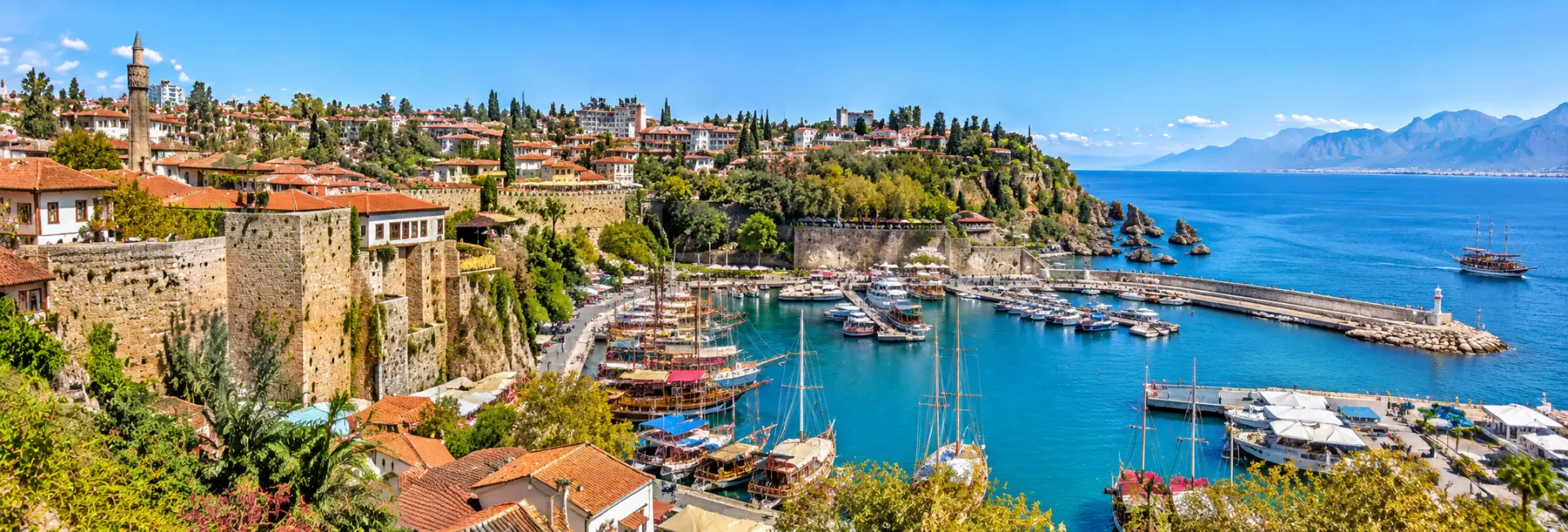
Kaleiçi, meaning "inside the castle," is Antalya's original walled city and still its historic core. Its name comes from the fortifications that once enclosed the settlement, and much of that layout survives in the maze of narrow, cobbled streets that climb gently uphill from the old harbour.
What makes Kaleiçi distinctive isn't any single monument but the way its history is stacked in layers — a Roman gate stands a short walk from a Seljuk minaret, which in turn sits among Ottoman-era houses now converted into boutique hotels, cafés, and small shops. It's a lived-in neighbourhood as much as a sightseeing district, with residents, students, and visitors sharing the same streets.
The district sits right at the centre of modern Antalya, wrapped by newer parts of the city on its landward sides and framed by the sea and its historic harbour on the other. That position has kept it central to city life for thousands of years, even as the buildings themselves changed hands between successive empires.
History
Founding and Roman Growth
The settlement was founded around 150 BC by Attalus II, king of Pergamon, who named it Attaleia — the root of the modern name Antalya. It was built from the start as a working port, with a harbour, defensive walls, and a Hellenistic street layout designed around trade with the wider Mediterranean. Rome absorbed the city in 133 BC, and it grew into a prosperous regional port under imperial rule, benefiting from Antalya's sheltered natural harbour and its position along east-west sea routes. The visit of Emperor Hadrian in 130 CE prompted construction of the triple-arched gate that still bears his name, an event significant enough that the city commemorated it with one of its most enduring monuments.
Byzantine, Seljuk, and Ottoman Layers
Byzantine builders later rebuilt and reinforced much of the city, adding churches and strengthening its fortifications as the settlement adapted to a changing political and religious landscape. The Seljuk Turks captured Antalya in 1207 and largely built on top of what they found rather than clearing it away, raising the Yivli Minaret in the early 13th century under Sultan Alaeddin Keykubad I as part of a wider mosque complex. Venetian merchants were active in the harbour for a period during this era, and the rock-cut steps down to the marina still in use today are attributed to them. The Ottomans took the city in 1391 and held it continuously afterward, gradually transforming Kaleiçi from a fortified port into a residential quarter, adding the mansions, hans, and neighbourhood structures that give the district much of its present-day character.
Into the Modern Era
Hadrian's Gate itself underwent a significant restoration in 1959, part of a longer pattern of preservation work that has continued into the 21st century as archaeologists and conservators keep uncovering and stabilizing the layers beneath the modern streets. Today Kaleiçi carries all of these periods at once — a compact record of roughly two thousand years of continuous settlement in a district you can walk across in well under an hour.
Recognition & Protected Status
Kaleiçi is designated as a protected historic and archaeological zone under Turkish preservation rules, which is why so much of its street pattern and building stock has survived intact rather than being redeveloped like much of the rest of central Antalya. Within the district, the Yivli Minaret Mosque has been included on Turkey's UNESCO World Heritage Tentative List since 2000, recognized as a distinctive example of Anatolian Seljuk religious architecture and one of the candidates the country has put forward for future World Heritage nomination.
Restoration work has continued for decades, most visibly in the traditional Ottoman houses that line the district's alleys, many of which have been converted into hotels, guesthouses, and cafés while keeping their original wooden bay windows and stone ground floors. Local authorities have also worked to protect the old harbour area and the surviving stretches of city wall, since both are considered central to Kaleiçi's identity as a functioning historic district rather than a reconstructed one.
Architecture & Streetscape
Kaleiçi's streetscape is defined by roughly 3,000 traditional houses with red-tiled roofs, packed along a network of narrow, winding, cobblestone lanes that make it easy — and part of the fun — to get lost. Most of the houses visible today date to the Ottoman period, built with stone foundations, timber upper floors, and projecting wooden bay windows overlooking the street, a design that maximized shade and airflow in the narrow lanes below.
- Roman-era remains, including Hadrian's Gate and fragments of the old city walls
- Byzantine traces, such as remnants of early churches tucked into back alleys
- Seljuk-era religious architecture, centred on the fluted Yivli Minaret
- Ottoman residential architecture, with courtyard houses now serving as hotels and cafés
The district's terrain slopes gradually from the higher inland streets down toward the sea, with the old harbour anchoring the lower end. It's reached either by a set of stone steps carved into the hillside — long attributed to the Venetian merchants who once worked the port — or, for a more comfortable descent, a glass panoramic elevator overlooking the marina and the cliffs around it.
Notable Landmarks
Hadrian's Gate (Üçkapılar)
This triple-arched Roman triumphal arch was built in 130 CE to mark Emperor Hadrian's visit and has served as one of the main entrances to the old city ever since. Deep grooves worn into the paving stones under the central arch are a visible record of centuries of cart and foot traffic passing through, and the ornate carvings on its coffered ceilings and cornices are still remarkably well preserved for a monument nearly nineteen centuries old.
Yivli Minare (Fluted Minaret)
Raised in the early 13th century, this brick minaret with its distinctive fluted shaft is one of the defining symbols of Antalya's skyline and appears on the crest of the city's football club. It stands beside a mosque complex that has been altered and expanded over the centuries, and the surrounding square is one of the district's natural gathering points.
Hıdırlık Tower and Kesik Minare
Hıdırlık Tower, a squat Roman-era structure near the harbour where Kaleiçi meets Karaalioğlu Park, is thought to have served as either a lighthouse or a watchtower guarding the approach to the port. Kesik Minare, the "Broken Minaret," has an unusually layered history of its own, having functioned in turn as a Roman temple, a Byzantine church, and later an Ottoman mosque, making it a kind of microcosm of Kaleiçi's wider architectural story.
The Old Harbour and Clock Tower
Once the city's main commercial harbour, the marina is now filled with yachts and traditional wooden boats used for coastal tours, ringed by cafés and restaurants built into the cliffside above. The Clock Tower, a late 19th-century Ottoman addition near the district's edge, sits atop an older Byzantine bastion and remains a common meeting point and orientation landmark for visitors today.
Ways to Experience It
Kaleiçi rewards an unhurried pace more than a strict checklist of sights, and most of what makes it worth visiting can be experienced without any advance planning at all.
- Walk the narrow lanes without a fixed route — getting pleasantly lost is part of the normal way to see Kaleiçi
- Take a guided walking tour that links Hadrian's Gate, the Yivli Minaret, and the old harbour with historical context along the way
- Descend to the marina by the old stone steps or the glass panoramic elevator, then browse the boats offering short coastal cruises
- Visit the Suna & İnan Kıraç Kaleiçi Museum, housed in a restored mansion, for a closer look at Ottoman-era domestic life
- Sit at a café or restaurant built into a converted historic house, several of which look directly onto the harbour or a landmark square
- Browse the small shops and markets scattered through the district for ceramics, textiles, and other traditional crafts
Best Time to Visit
April through June and September through October generally offer the most comfortable conditions for walking Kaleiçi's streets, with milder temperatures than the height of summer and noticeably fewer crowds around the main landmarks. Early morning is also a good window during the busier summer months, before day-trip groups and tour buses arrive in numbers, and again in the late afternoon as the heat eases and the light softens over the harbour.
In summer, Kaleiçi's alleys and squares host open-air concerts and cultural events in the evenings, when the old stone courtyards make an atmospheric backdrop for jazz and Turkish folk music performances. Evenings generally suit the district well year-round, since many of its restaurants and cafés are at their liveliest after dark, with the illuminated old walls and Hadrian's Gate adding a different atmosphere to a nighttime walk.
Visitor Tips
- Wear comfortable, flat shoes — the streets are cobbled and often uneven, and parts of the old town are built on a slope down to the harbour
- Phone signal can be patchy in the narrower alleys, so it's worth downloading an offline map of the district in advance
- The walk from Hadrian's Gate down to the harbour takes around 15 minutes at a relaxed pace, passing the Yivli Minaret square and Kesik Minare along the way
- Many boutique hotels and restaurants occupy converted historic houses, so booking ahead is worthwhile in peak season
- Markets within Kaleiçi are a good spot for traditional crafts and textiles, but prices are often open to polite negotiation
- Keep an eye out for restaurant menus and prices posted outside, since some streets closer to the main tourist routes charge more than others just a block or two away
- If arriving by car, note that much of Kaleiçi's core is pedestrianized or narrow enough to make driving impractical — parking on the district's edge and walking in is usually easier
Nearby Attractions
Kaleiçi's compact size and central position make it an easy base for exploring the rest of Antalya on foot or with a short taxi ride.
- Karaalioğlu Park, a clifftop green space with Mediterranean views, directly adjacent to the old town
- Antalya Archaeology Museum, a short distance away, with an extensive collection drawn from the region's ancient sites
- Konyaaltı and Lara beaches, both reachable from central Antalya within a short bus or taxi ride
- Düden Waterfalls, on the eastern and northeastern edges of the city, often paired with a Kaleiçi visit on organized day tours
- Antalya Marina and the modern city centre around Cumhuriyet Meydanı, just beyond the old town's boundaries
FAQs about visiting Kaleiçi
What does Kaleiçi mean, and is it the same as Antalya Old Town? +
Kaleiçi translates roughly as "inside the castle," referring to the old city walls that once enclosed it, and it's the same area commonly called Antalya's Old Town in English.
How old is Kaleiçi? +
The site was founded around 150 BC, and its surviving streets and buildings layer together Roman, Byzantine, Seljuk, and Ottoman-era construction spanning well over two thousand years.
Is Kaleiçi a UNESCO World Heritage Site? +
Not the district as a whole, but the Yivli Minaret Mosque within Kaleiçi has been on Turkey's UNESCO World Heritage Tentative List since 2000.
How much time should I plan for a visit? +
A couple of hours is enough to see the main landmarks, but a half day or more lets you wander the side streets, visit a museum, and stop at the harbour without rushing.
Is Kaleiçi walkable, and is it accessible for those with mobility issues? +
It's very walkable and best explored on foot, though the cobbled, sloped streets and the steps down to the harbour can be difficult for wheelchair users or those with limited mobility; the glass elevator to the marina is a more accessible alternative to the stone steps.
Is Kaleiçi free to visit? +
Walking through the district and its streets is free, though individual sites such as museums, some historic monuments, and boat tours from the harbour charge their own entrance or ticket fees.
What's the best way to get to Kaleiçi from the rest of Antalya? +
It's within walking distance of much of central Antalya, and also reachable by local buses or taxi from other districts, hotels, and the airport.
Can I combine a Kaleiçi visit with other Antalya sights in one day? +
Yes — many day tours pair Kaleiçi with Hadrian's Gate, a harbour boat trip, and a stop at Düden Waterfalls or the Antalya Archaeology Museum.
