
Table of Contents
Overview
Zoo Berlin sits at the edge of the Tiergarten, one of the city's best-known green spaces, and holds the distinction of being the oldest zoo in Germany still in operation. Since its opening gates first swung open in the 1840s, it has grown from a modest royal menagerie into a sprawling 35-hectare park that shelters well over a thousand species, from tiny insects to elephants and giant pandas.
What sets it apart from many big-city zoos is sheer density of species rather than sheer size: within a footprint that visitors can comfortably walk in half a day, the collection spans nearly every continent's wildlife, housed in a mix of open-air enclosures and ornately designed historic animal houses. Two architecturally striking gates, a century-old aquarium next door, and a location a short walk from central Berlin's shopping streets make it one of the most-visited attractions in the city.
History
Founding and Early Years
The idea for a Berlin zoo came from naturalist Alexander von Humboldt, zoologist Martin Hinrich Lichtenstein, and landscape architect Peter Joseph Lenné, who together persuaded Prussian King Friedrich Wilhelm IV to support the project. The king donated animals from his menagerie on Pfaueninsel and from the royal pheasantry in the Tiergarten, along with a plot of land for the new garden, and Lenné was commissioned to design the grounds.
After several years of preparation, the zoo opened to the public on 1 August 1844 with Lichtenstein serving as its first director. It is widely regarded as the oldest zoo in Germany still operating today, predating the country's other major zoological gardens by decades. Over the following decades the collection expanded steadily, and landmark structures such as the Antelope House, built in 1871, began to define its character.
Wartime Destruction and Rebuilding
By the eve of the Second World War, the zoo held roughly four thousand birds and mammals alongside thousands of aquarium specimens, making it one of the largest collections in the world at the time. Allied bombing raids devastated the grounds, destroying most of its buildings and killing all but a handful of animals; only 91 survived the war out of a collection that had numbered in the thousands.
Reconstruction began in the early 1950s, and West Berlin rebuilt the zoo largely in keeping with its prewar character, restoring its historic gates and gradually replacing old barred cages with the open, naturalistic enclosures visible today. The zoo's aquarium, originally opened in 1913 and designed by the animal behaviorist Oskar Heinroth, was similarly rebuilt and remains one of its signature attractions.
Modern Era and Global Recognition
In the postwar decades the zoo built a reputation for pioneering conservation science, establishing one of the world's first studbooks for the European bison in 1923 and later taking responsibility for international breeding records for species including white and black rhinoceroses. It gained further worldwide attention in 2006 with the birth of Knut, a polar bear cub hand-raised by keepers after being rejected by his mother, whose story drew visitors from around the globe.
The zoo's giant pandas, Meng Meng and Jiao Qing, arrived from China in 2017 and have since become one of its biggest draws, particularly after the birth of panda cubs at the zoo. Today the institution is known as the most species-rich zoo in the world, a title reflecting both its historic roots and its continued investment in modern, welfare-focused enclosures.
Key Areas & Iconic Entrances
Lion Gate
The Löwentor, or Lion Gate, faces Hardenbergplatz and functions as the zoo's main entrance, sitting close to the Zoologischer Garten transit station. Like its counterpart on the opposite side of the grounds, it dates from around 1900 and is considered a small work of art in its own right, setting an ornamental tone before visitors even reach the animal enclosures.
Elephant Gate
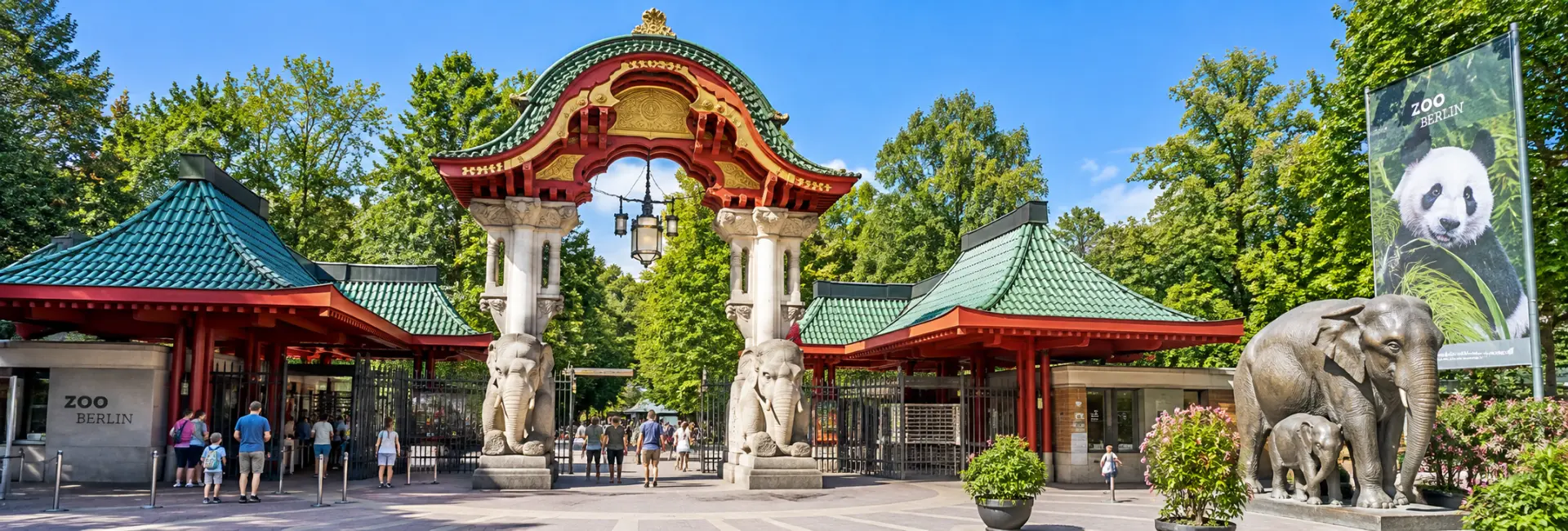
On Budapester Straße, near the entrance to the adjoining aquarium, stands the Elefantentor, or Elephant Gate, built in 1899. Two carved elephants in Elbe sandstone support a curved, pagoda-style roof decorated with gilded ornamentation, a design that reflects the exoticized architectural tastes popular in European zoos of that era.
Layout and the Aquarium
The grounds are organized into a large main section plus a smaller area across the Landwehr Canal, reached by a footbridge, giving the park a layered, exploratory feel rather than a single loop. The Aquarium Berlin sits immediately beside the zoo and can be visited on a combined ticket or separately; it houses sharks, rays, coral-reef fish, and an extensive collection of terrarium animals including snakes, frogs, and insects.
Animal Collection & Signature Exhibits
Zoo Berlin's defining feature is the breadth of its collection: more than a thousand species live on the grounds, from ants to great apes, making it consistently ranked as the most species-rich zoo anywhere in the world. That diversity is organized across a series of themed houses and outdoor habitats rather than a single generic layout.
- Panda Garden — home to giant pandas Meng Meng and Jiao Qing, among the few pairs of breeding giant pandas housed in Europe
- Rhino Pagoda and Antelope House — historic animal houses dating back to the 19th century, still used for hoofed mammals today
- Hippo enclosure — includes underwater viewing where hippos can be watched swimming below the surface
- Nocturnal animal house — a darkened space allowing visitors to observe species that are normally active only at night
- Great ape and big cat habitats — naturalistic outdoor spaces for gorillas, chimpanzees, and lions, replacing the barred cages of the zoo's early decades
Beyond the exhibits themselves, the zoo plays an active role in international conservation. It maintains studbooks that track breeding records for endangered species such as white and black rhinoceroses and gaurs, and it participates in coordinated European breeding and reintroduction programs designed to safeguard species whose wild populations are under threat.
Ways to Experience It
Beyond simply walking the grounds, the zoo runs a program of daily activities designed to bring visitors closer to its animals and the people who care for them.
- Commentated feeding sessions take place several times a day at various enclosures, giving keepers a chance to explain animal behavior as they work
- Themed guided tours cover specific topics, such as the fauna of Africa or South America, for visitors who want a deeper dive than a self-guided walk provides
- Accessible tours are available, including tours in sign language and options tailored for blind and deaf visitors
- A small petting zoo area, Hans im Glück, gives younger children the chance to interact with more approachable animals
- A combined ticket covering both the zoo and the neighboring Aquarium Berlin lets visitors see both collections in a single visit
Large parts of the zoo are step-free, and paths are wide enough to accommodate strollers and wheelchairs comfortably, which makes it a practical outing for families and visitors with mobility needs alike.
Best Time to Visit
The zoo is open year-round, but its hours shift with the seasons: expect shorter days in winter, roughly from 9 a.m. to mid-afternoon, stretching to as late as 6:30 p.m. during the height of summer. Ticket offices and admission close about an hour before the listed closing time, so it pays to check the current schedule before heading out.
Arriving close to opening time is the most reliable way to beat crowds, especially around popular exhibits like the Panda Garden, and it also tends to coincide with more active animal behavior before the midday heat sets in. Weekdays are noticeably quieter than weekends, and outside the busy summer holiday season the zoo is far easier to explore at a relaxed pace.
Visitor Tips
- Set aside at least three to five hours to see the grounds properly, or a full day if combining the visit with the Aquarium
- Reach the zoo via the Zoologischer Garten station, served by U-Bahn lines U2 and U9 and S-Bahn lines S3, S5, S7, and S9, right next to the Lion Gate entrance
- Use the Elephant Gate on Budapester Straße as an alternative, less crowded entrance, particularly useful if arriving from the aquarium side
- Book tickets online in advance where possible, since on-site prices can run higher and queues build quickly on weekends
- Bring a light picnic or budget time for on-site cafés, since the grounds are large enough that a mid-visit break is welcome
FAQs about visiting Berlin Zoo
How old is Berlin Zoo? +
Berlin Zoo opened to the public on 1 August 1844, making it the oldest zoo in Germany that is still in operation today.
What is Berlin Zoo best known for? +
It's known for being the most species-rich zoo in the world, housing well over a thousand species, and for its giant pandas, historic ornamental entrance gates, and its role in international conservation breeding programs.
How much time should I plan for a visit? +
Most visitors need three to five hours to see the grounds at a comfortable pace, or a full day if pairing the zoo with the adjoining Aquarium Berlin.
Do I need to book tickets in advance? +
Advance online booking isn't strictly required, but it's recommended, since it can secure a better price than buying at the gate and helps you skip ticket-office queues, especially on weekends.
How do I get to Berlin Zoo by public transport? +
The zoo sits directly next to the Zoologischer Garten station, reachable by U-Bahn lines U2 and U9 and S-Bahn lines S3, S5, S7, and S9, with the Lion Gate entrance just steps from the platforms.
Is Berlin Zoo suitable for young children? +
Yes — large parts of the grounds are step-free and stroller-friendly, and a small petting zoo area lets younger children interact with more approachable animals.
Can I visit the Aquarium at the same time? +
Yes, the Aquarium Berlin sits right next to the zoo and can be visited on a combined ticket, or separately if you'd rather focus on just one.
What's the best time of day to visit? +
Arriving near opening time gives you the best chance of smaller crowds and more active animals, particularly at popular exhibits like the Panda Garden.
