
Table of Contents
Overview
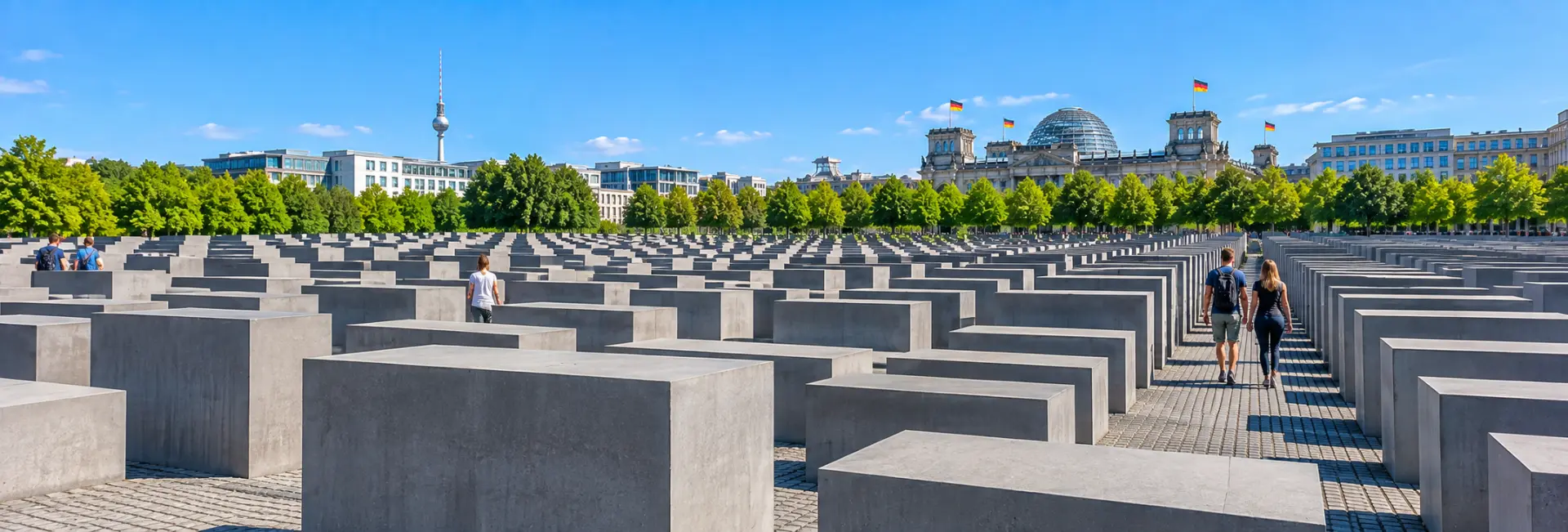
The Memorial to the Murdered Jews of Europe, widely known simply as the Holocaust Memorial, is Germany's central national memorial to the roughly six million Jews murdered under Nazi rule. It occupies a large block just south of the Brandenburg Gate, on ground that once sat inside the Berlin Wall's death strip and, decades earlier, close to the heart of Hitler's government quarter. Above ground, the memorial is an open field of 2,711 concrete slabs of varying height, arranged in a tight grid across sloping, uneven terrain that visitors are free to walk through from any direction. The memorial's formal name deliberately names the victims rather than leaning on a single overarching term. Beneath the field lies the Information Centre, a documentation exhibition that gives names, faces, and personal histories to the statistics associated with the genocide. The two halves work together: the field offers an abstract, physical experience of disorientation, while the exhibition below grounds that experience in specific, researched history.
History
The Site Itself
Before the war, the plot had been part of the so-called Ministergärten, private gardens attached to a row of government ministries along Wilhelmstraße. Wartime destruction and the later division of the city left the land vacant for decades, sitting inside the Berlin Wall's border strip until 1989, not far from where the Reich Chancellery and Adolf Hitler's bunker had once stood.
A Long Debate Before Construction
The idea for a national Holocaust memorial in the reunified German capital was first pushed by the journalist Lea Rosh, who launched a public initiative in 1988. What followed was more than a decade of public argument over the memorial's purpose, size, location, and design, including an earlier design competition whose winning entry was later withdrawn after criticism. The German parliament (Bundestag) finally voted on 25 June 1999 to build the memorial on the chosen site, adopting a revised design by American architect Peter Eisenman, developed with the structural engineering firm Buro Happold.
Construction and Opening
Construction began on 1 April 2003 and was completed in December 2004, on a plot of roughly 1.9 hectares directly south of the Brandenburg Gate. The finished memorial was dedicated on 10 May 2005, sixty years after the end of the Second World War in Europe, and opened to the public two days later.
Two Decades of Public Use
Since opening, the memorial has become one of Berlin's most visited sites, with the Information Centre alone drawing several hundred thousand visitors a year. It has also prompted ongoing public reflection on how the memorial is used and treated day to day, from debates over visitor behavior on the stelae to periodic technical renovations of the exhibition spaces below ground.
Recognition & Significance
The memorial was created by a specific decision of the German Bundestag and is maintained by a dedicated federal foundation, the Stiftung Denkmal für die ermordeten Juden Europas, which also administers Germany's memorials to other groups persecuted under National Socialism, including Sinti and Roma victims and gay men and lesbians. It is widely regarded as Germany's principal, most visible act of national commemoration for the Holocaust, distinguished from the many local and site-specific memorials around Europe by its scale, its central location in the capital, and the fact that it was built through a direct act of national government rather than by a local community or private initiative.
- Created by a formal decision of the German Bundestag in 1999
- Managed by the Stiftung Denkmal für die ermordeten Juden Europas, a federal foundation
- Recognized as Germany's central national memorial to the six million Jewish victims of the Holocaust
Design & the Field of Stelae
The Concrete Field
The memorial's above-ground element consists of 2,711 concrete stelae, arranged in a strict grid of 54 rows running north to south and 87 running east to west, though the rows are set at a slight angle to one another rather than perfectly square. Each stele is about 2.4 meters long and just under a meter wide, but heights vary from barely above ground level to nearly 4.7 meters, and the ground beneath them dips and rises unevenly across the site.
An Intentionally Unsettling Experience
Architect Peter Eisenman designed the field so that visitors walking into it lose sight of the surrounding city and of each other, with narrow corridors between the stelae that can feel disorienting rather than comforting. There are no explanatory signs within the field itself and no single prescribed route through it; Eisenman intended the sense of confusion and instability to be part of the experience rather than something the design explains away.
The Information Centre
Beneath the south-eastern corner of the field, reached by stairs or a lift, the underground Information Centre uses original documents, photographs, and personal accounts to trace the persecution and murder of Jewish communities across Europe.
- Room of Dimensions, which sets the scale of the genocide using excerpts from diaries, letters, and last messages written by victims
- Room of Families, following the fates of individual Jewish families from several different European countries
- Room of Names, where short biographies of murdered or missing individuals are read aloud on a continuous cycle
- Room of Sites, documenting specific locations across Europe where mass murder took place
The exhibition cross-references records held by institutions such as the Yad Vashem museum in Jerusalem, and estimates that around three million individual victims can be named this way, though the vast majority of those murdered left no surviving trace of their identity at all. Admission, like the Field of Stelae above, is free.
Ways to Experience It
The Field of Stelae is open around the clock and can be entered and explored freely at any time, with no set entrance or exit. Because there's no single correct route through it, first-time visitors sometimes find it useful to walk the perimeter first to get a sense of the site's scale before heading into the narrower central corridors. Most people spend anywhere from twenty minutes to an hour walking through the field itself, and closer to an hour more if they also visit the Information Centre underneath. Free guided tours of the field are offered on weekends, and audio guides are available for a self-directed but more detailed visit.
- Free, unstructured walk through the Field of Stelae, open 24 hours a day
- Underground Information Centre exhibition, open Tuesday to Sunday, with last entry 45 minutes before closing
- Free public guided tours of the field on weekends
- Audio guides available for both the field and the underground exhibition
Best Time to Visit
Because the Field of Stelae is outdoors and open at all hours, an early morning or evening visit offers the quietest experience and, for many visitors, the most powerful one, since the narrow corridors between the stelae feel especially isolating with few other people around. Midday, particularly on weekends, draws the largest crowds. The Information Centre is closed on Mondays and on 1 January and 24, 25, and 26 December, and keeps shortened hours on 31 December, so plan any visit to the underground exhibition for another day and check ahead around the winter holidays.
Visitor Tips
- Entry to both the Field of Stelae and the Information Centre is completely free
- The Information Centre is open Tuesday to Sunday, 10 a.m. to 6 p.m., closed Mondays
- The nearest transport is Brandenburger Tor station (U-Bahn and S-Bahn), a short walk north of the memorial
- Visitors are asked to treat the stelae with respect, avoiding activities like climbing, jumping between them, or loud behavior
- The uneven ground within the field can be difficult for wheelchairs and strollers in places, though accessible routes and a lift are available for the Information Centre
- The underground exhibition is text- and image-heavy and deals directly with mass murder, so it may suit older children and teenagers better than very young ones
Nearby Memorials & Attractions
The memorial sits at the center of a cluster of related historical sites, making it easy to spend a half-day exploring Berlin's twentieth-century history on foot.
- Brandenburg Gate, a short walk to the north
- Memorial to the Homosexuals Persecuted Under Nazism, a smaller monument just across the street
- Memorial to the Sinti and Roma Victims of National Socialism, north of the Brandenburg Gate in the Tiergarten
- The Reichstag building, home of the German parliament, a short walk away
- Potsdamer Platz, with shops, museums, and cinemas, a few minutes' walk to the south
FAQs about visiting the Holocaust Memorial
What is the Holocaust Memorial in Berlin? +
It's Germany's national memorial to the roughly six million Jews murdered in the Holocaust, made up of an open-air field of 2,711 concrete stelae and an underground Information Centre exhibition.
Is it free to visit? +
Yes, both the Field of Stelae and the underground Information Centre are free to enter.
How long does a visit take? +
Walking through the field alone takes twenty minutes to an hour; add roughly another hour if you also visit the Information Centre exhibition underneath.
Why does the design use concrete slabs instead of a traditional monument? +
Architect Peter Eisenman designed the grid of varying-height stelae to create a disorienting, uneasy experience rather than a fixed symbol, deliberately leaving the meaning open to each visitor instead of explaining it through an inscription or statue.
What's inside the Information Centre? +
The underground exhibition includes the Room of Dimensions, Room of Families, Room of Names, and Room of Sites, using documents, photographs, and personal accounts to trace individual victims and the locations where mass murder took place.
How do I get to the memorial? +
Brandenburger Tor station, served by both the U-Bahn and S-Bahn, is the closest stop, just a short walk north of the site.
Is it appropriate to bring children? +
The Field of Stelae itself can be visited by families of any age, but the underground exhibition deals directly with mass murder through detailed text and imagery, so it's generally better suited to older children and teenagers.
