
Table of Contents
Overview
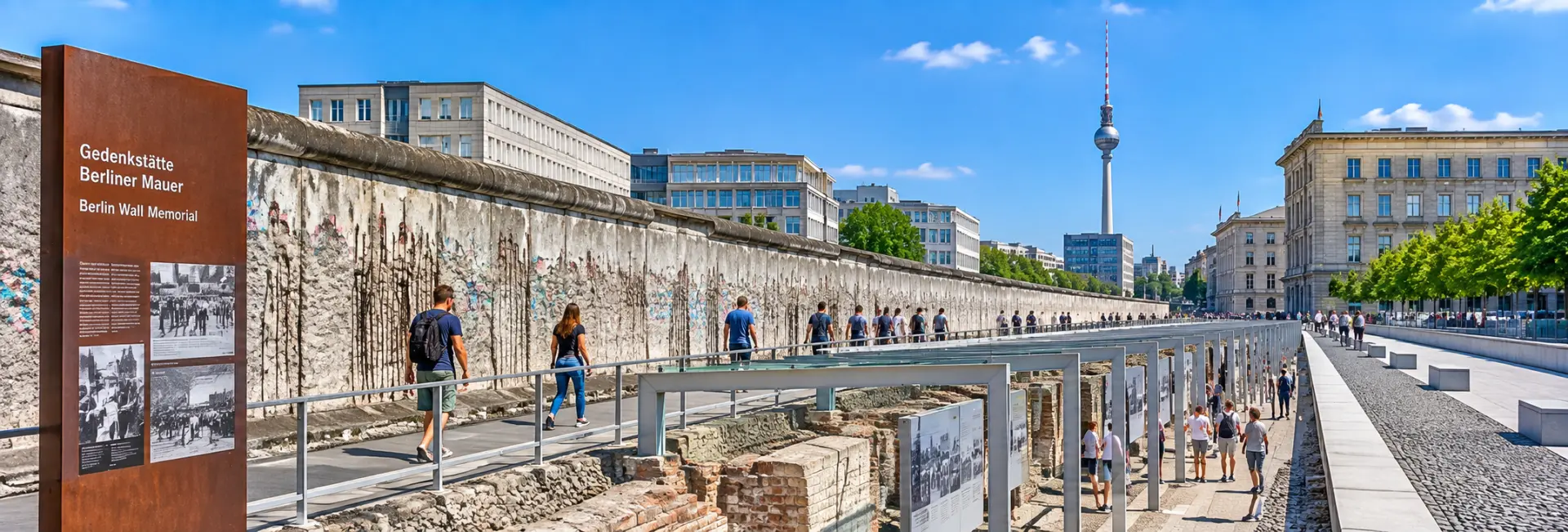
The Berlin Wall Memorial (Gedenkstätte Berliner Mauer) is Germany's central site of remembrance for the wall that divided the city from 1961 to 1989. It runs along Bernauer Straße, a street that became one of the most tragic front lines of the Cold War, where residents leapt from upper-floor windows to escape into the West and where border guards later demolished entire apartment blocks to widen the death strip. Today the memorial stretches roughly 1.4 kilometers, weaving together an outdoor exhibition, a documentation center, a chapel, and the last intact section of the original border fortifications. Because most of the wall elsewhere in Berlin was torn down or sold off as souvenirs after 1990, Bernauer Straße is one of the few places where the full depth and scale of the border system can still be seen standing in place. It exists not to shock but to explain, giving visitors a grounded, physical sense of how a city and its people were split apart for nearly three decades.
History
Before the Wall
Bernauer Straße sat directly on the boundary between the French and Soviet occupation sectors after the Second World War, with building façades on the southern side falling inside East Berlin while the pavement in front of them belonged to the West. When the East German government sealed the border overnight on 13 August 1961, this quirk of geography turned the street into an instant, visible frontier. Ground-floor doors and windows were bricked up within days, while residents on upper floors tried to jump to the western side before those openings, too, were sealed.
Life Along a Divided Street
Over the following years, East German authorities forcibly evicted the remaining residents of Bernauer Straße and tore down the apartment blocks that had marked the border, using the cleared land to widen the death strip. Part of the Sophien parish cemetery, which had extended into the area, was also disturbed, with graves near the new border relocated. The nearby Reconciliation Church, left standing but cut off inside the restricted zone, stood unused for years before East German border troops demolished it with explosives in 1985 to improve sightlines for the guards.
Fall of the Wall and Creation of the Memorial
The wall fell on 9 November 1989, and within roughly a year most of it across the city had been dismantled. A 212-meter stretch of the original fortifications between Ackerstraße and Bergstraße survived largely by circumstance, and it became the anchor for a national memorial. The German federal government and the state of Berlin agreed on a concept in 1994, an international design competition followed, and the resulting memorial was dedicated in 1998. The Documentation Center opened the following year, and the Chapel of Reconciliation, built on the site of the demolished church, was consecrated in 2000.
Recognition & Preservation Status
The surviving 212-meter section of border wall along Bernauer Straße was placed under monument protection by the Berlin state authorities on 2 October 1990, making it one of the earliest pieces of the wall to receive formal heritage status. It was later folded into the wider Berlin Wall Memorial, which the federal government and the Berlin Senate jointly designated as the country's central memorial to the division of Germany. The site does not carry UNESCO World Heritage status, but it functions as Germany's closest equivalent: a single, purpose-built national memorial dedicated specifically to the wall. It is managed today by the Berlin Wall Foundation (Stiftung Berliner Mauer), which also oversees related sites such as the East Side Gallery and the former Marienfelde Refugee Center.
- Protected as a listed historical monument since 1990
- Recognized as Germany's official national memorial to the Berlin Wall and the division of the city
- Administered by the Stiftung Berliner Mauer (Berlin Wall Foundation)
Key Areas of the Memorial
The memorial isn't a single building but a sequence of connected sites strung along Bernauer Straße, each focused on a different part of the story.
- Visitor Center near Nordbahnhof station, the starting point for information, tickets, and an introductory film on the wall's history
- Documentation Center, home to the permanent exhibition "1961 | 1989. The Berlin Wall" and a rooftop viewing platform overlooking the preserved death strip
- The preserved border strip itself, showing the inner wall, patrol path, floodlights, and outer wall as they looked in the late 1980s
- Chapel of Reconciliation, a small wooden chapel built on the site of the church demolished in 1985, used for regular remembrance prayers
- Window of Remembrance, a wall of photographs commemorating people who died trying to cross or living near the border
- The ghost station exhibition at Nordbahnhof, on how some S-Bahn stations under East Berlin were sealed off and used only by trains passing through from the West
Architecture & Design Features
The Preserved Border Strip
Walking along Bernauer Straße, visitors pass the actual inner and outer walls of the border system in their original staggered depth, along with the patrol road, lighting masts, and signal fence that once ran between them. A narrow viewing slot lets people look through the rear wall into the strip exactly as guards would have patrolled it, an experience the memorial deliberately keeps unpolished rather than restoring or prettifying it.
Steel Markers and the Memorial Landscape
Where the original structures no longer stand, the design traces the vanished course of the wall and patrol path using rows of rusted steel rods and plates set into the ground. Multimedia information steles mark the sites of demolished buildings, escape tunnels, and specific events connected to the street's history, so the full 1.4-kilometer stretch reads as one continuous, if partly abstract, memorial landscape rather than a single fenced-off monument.
Visitor Center Building
The Visitor Center itself, designed by the Berlin firm Mola+Winkelmüller Architekten, keeps a low, understated profile so the building doesn't compete visually with the historic street it introduces visitors to.
Window of Remembrance
A freestanding wall of portraits, the Window of Remembrance faces the preserved death strip and lists people known to have died at the wall, giving individual faces to a history that can otherwise feel abstract or purely architectural.
Ways to Experience It
Most visitors start at the Visitor Center, watch the short introductory film, and then walk the outdoor route at their own pace, using the multimedia steles and information panels along the way. The Visitor Center also houses a small bookstore with books and films on the wall and German division, plus terminals with information on other Wall-related sites in Berlin and along the former inner-German border. The outdoor route can be covered in under an hour, but allowing two to three hours lets you also take in the Documentation Center's exhibition and climb to the rooftop viewing platform.
- Self-guided walk along the outdoor memorial grounds, free and open every day
- Permanent exhibition inside the Documentation Center, covering the political background and everyday impact of the wall
- Regularly scheduled guided tours in German and English, conducted with audio guides in small groups
- Remembrance prayers held at the Chapel of Reconciliation several times a week around midday
Best Time to Visit
Because the outdoor grounds are unshaded and largely paved or gravel, spring and autumn mornings tend to be the most comfortable time to walk the full route, while summer afternoons can get hot with little shade along the way. The Documentation Center and Visitor Center are closed on Mondays, so plan any indoor visit for another day of the week between 10 a.m. and 6 p.m. Arriving earlier in the day generally means smaller crowds around the viewing platform and the preserved wall section, which draw the most visitors from mid-morning onward.
Visitor Tips
- Entry to the outdoor memorial and the Documentation Center's permanent exhibition is free; only certain guided tours charge a small fee
- The Documentation Center and Visitor Center close on Mondays, though the outdoor grounds stay open daily from early morning until late evening
- Nordbahnhof (S1, S2, S25) is the closest station to the Visitor Center; Bernauer Straße (U8) sits at the opposite end of the site
- Information panels and the main exhibition are presented in German and English
- The grounds are mostly flat and paved, making the route manageable for wheelchairs and strollers, though some historic surfaces are uneven
- Set aside extra time if you also want to see the Nordbahnhof ghost station exhibition, right next to the Visitor Center
Nearby Attractions
Bernauer Straße connects easily to several other Cold War sites, making it simple to build a half-day or full-day itinerary around the theme of the divided city.
- Mauerpark, a former death-strip section turned public park, a short walk from the northern end of the memorial
- East Side Gallery, the longest surviving stretch of the wall, now covered in murals, a short ride away along the Spree
- Nordbahnhof ghost station exhibition, immediately next to the Visitor Center, on the S-Bahn stations sealed off during division
- Checkpoint Charlie, the former American sector crossing point, reachable by public transport in around 20 minutes
- Museum Island, Berlin's cluster of major museums, a short subway ride to the south
FAQs about visiting the Berlin Wall Memorial
What is the Berlin Wall Memorial? +
It's Germany's official national memorial to the Berlin Wall, running along Bernauer Straße, where a preserved section of the original border fortifications sits alongside a documentation center, a chapel, and an outdoor exhibition.
Is entry to the Berlin Wall Memorial free? +
Yes, the outdoor memorial grounds and the Documentation Center's permanent exhibition are free to enter; only some guided tours carry a small ticket price.
How much time should I plan for a visit? +
A quick walk along the outdoor route takes under an hour, but budgeting two to three hours lets you also see the Documentation Center exhibition and the rooftop viewing platform.
How do I get to the Berlin Wall Memorial? +
Nordbahnhof (S1, S2, S25) is the closest station to the Visitor Center, while Bernauer Straße station (U8) sits at the other end of the memorial grounds; the M10 tram also stops nearby.
Can you still see a real piece of the Berlin Wall here? +
Yes, a 212-meter original section between Ackerstraße and Bergstraße is preserved in place, including the inner wall, patrol path, and outer wall, along with a viewing platform overlooking the former death strip.
Is the memorial suitable for kids? +
Older children and teenagers generally get the most out of it, since the subject matter is serious and much of the content is text-heavy; families with younger children may want to focus on a shorter walk along the outdoor grounds rather than the full exhibition.
What else can I combine with a visit to Bernauer Straße? +
Mauerpark and the Nordbahnhof ghost station exhibition are both within easy walking distance, while the East Side Gallery, Checkpoint Charlie, and Museum Island are all a short ride away for a fuller day exploring Berlin's Cold War history.
