
Table of Contents
Overview
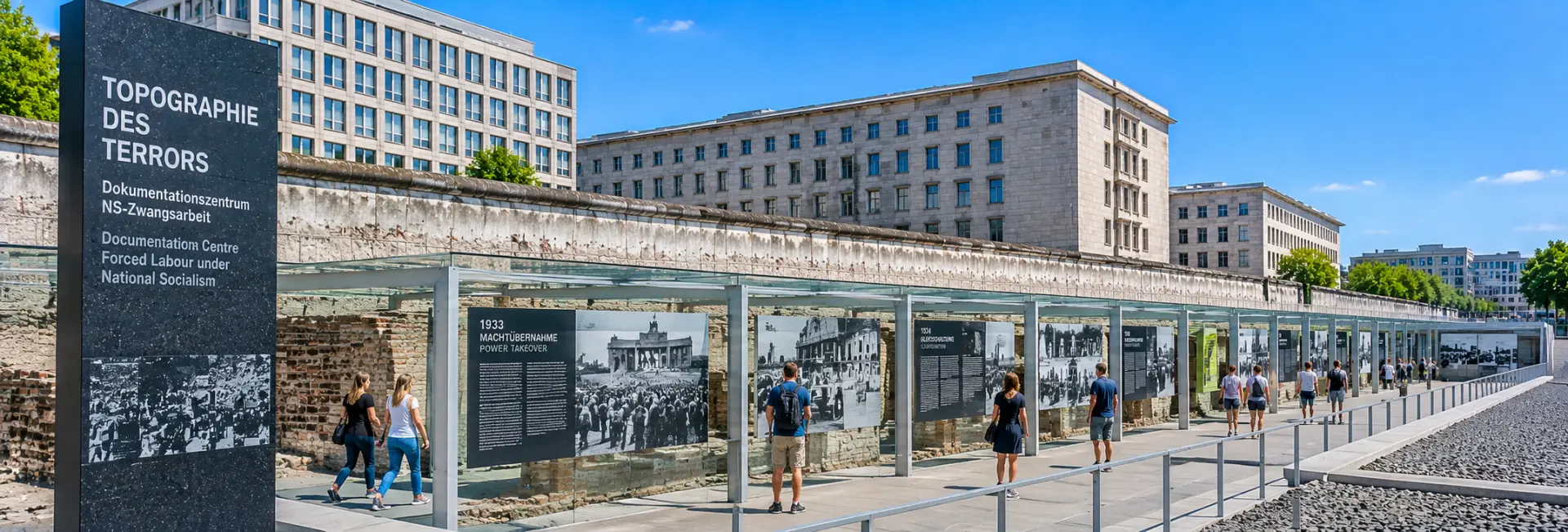
The Topography of Terror stands on the exact ground once occupied by the central institutions of Nazi persecution: the Gestapo headquarters, the leadership of the SS, and the Reich Security Main Office that directed policing and terror across occupied Europe. Rather than recreate the vanished buildings, the site presents their excavated foundations in the open air alongside a documentation center that explains, in detail, how these institutions worked and who they targeted. It sits on Niederkirchnerstraße in central Berlin, a short walk from Potsdamer Platz and Checkpoint Charlie, and a long stretch of the Berlin Wall still runs along its edge. Unlike museums that summarize this history from a distance, the site keeps returning attention to a single question: how ordinary bureaucratic offices, operating from this specific address, organized surveillance, deportation, and murder across an entire continent. Admission is free, and the combination of physical remains, original documents, and the adjoining wall segment makes it one of the most direct places in Berlin to confront how Nazi rule was carried out.
History
Headquarters of Nazi Terror
From 1933, the buildings on this block housed the headquarters of the Gestapo (Secret State Police) at Prinz-Albrecht-Straße 8, a street since renamed Niederkirchnerstraße. The neighboring Hotel Prinz Albrecht became offices for the SS leadership, and from 1939 the newly formed Reich Security Main Office (Reichssicherheitshauptamt), which coordinated the Gestapo, the SS intelligence service, and the criminal police, was based in the same complex. The basement of the Gestapo building served as a prison for political prisoners, where interrogations and torture took place.
Destruction and Decades of Silence
Allied bombing raids badly damaged the buildings in 1944 and 1945, and the ruins that survived the war were largely demolished in the early 1950s as part of a broader effort to clear war damage from the city. For nearly three decades afterward the site sat as an empty lot, at times used to dump rubble and even as a practice track for driving lessons, its history left largely unmarked. From 1961 the Berlin Wall ran along its western edge, since the site lay right against the line dividing the city.
Excavation and a Temporary Exhibition That Lasted Decades
Citizens' groups began pushing in the late 1970s for the site's history to be properly researched and marked. For Berlin's 750th-anniversary celebrations in 1987, archaeologists exposed the cellar foundations of the former Gestapo building, and a temporary open-air exhibition called "Topography of Terror" was installed in a simple hall on the excavated remains. It was meant to last only for the anniversary year but drew such strong public interest that it stayed open, eventually running in temporary form for more than two decades while plans for a permanent building were repeatedly delayed by funding disputes and a stalled construction project in the 1990s.
The Permanent Documentation Center
A new documentation center, designed by architect Ursula Wilms with landscape architect Heinz W. Hallmann, finally opened on the site in 2010, replacing the long-running temporary structure. It houses the permanent exhibition, a library and archive, and space for temporary exhibitions, while the excavated foundations and the adjoining stretch of the Berlin Wall remain outside as part of the site itself.
Recognition & Status
The Topography of Terror is run by an independent, publicly funded foundation, the Stiftung Topographie des Terrors, jointly supported by the German federal government and the State of Berlin. It is recognized as one of Germany's most significant memorial and documentation sites for the Nazi era, valued specifically because the exhibition sits on the authentic historical ground of the institutions it describes rather than in a purpose-built museum elsewhere in the city. The site draws more than a million visitors a year, making it one of the most visited memorials in Berlin.
- Managed by the Stiftung Topographie des Terrors, funded jointly by the German federal government and the State of Berlin
- Considered one of the most important sites documenting the machinery of Nazi persecution, precisely because it occupies the original location
- Free admission, run as a public historical and educational institution rather than a ticketed museum
The Documentation Center & Exhibitions
Inside the documentation center, the permanent exhibition "Topography of Terror. Gestapo, SS and Reich Security Main Office on the 'Prinz-Albrecht-Terrain'" traces the organizations based on this site and their role in persecution and mass murder across Europe, using photographs, original documents, and case studies of victims and perpetrators alike. It is organized chronologically and thematically, moving from the National Socialists' rise to power through the wartime activities of the police and SS across occupied Europe to the limited scale of postwar prosecution many of those responsible actually faced.
- Permanent exhibition covering the structure and crimes of the Gestapo, SS, and Reich Security Main Office
- A separate exhibition, "Berlin 1933–1945: Between Propaganda and Terror," on how National Socialist policy shaped the city and its residents
- Rotating temporary exhibitions on related historical topics
- A specialized library and archive available to researchers and the public
The Outdoor Site & Preserved Wall Section
Running alongside the documentation center is an open-air exhibition set into a long excavation trench, following the exposed foundations of the former Gestapo prison cells and other buildings that once stood here. Information panels along the trench identify specific rooms, including cells where prisoners were held and interrogated, and cite individual accounts from people detained at the site. A self-guided site tour with around 15 stations connects the excavated remains to specific events and individuals tied to the location. Along the northern edge of the grounds, on Niederkirchnerstraße, stands one of the longest sections of the Berlin Wall still in its original position, preserved in large part due to the efforts of the memorial's own staff and supporters in the years after reunification, when other nearby stretches of the wall were being removed.
Ways to Experience It
Most visitors combine the indoor exhibition with a walk along the outdoor trench, using either the free printed guide or the audio guide available at the entrance. Plan on roughly ninety minutes for a focused visit, or up to three hours if you want to read closely, follow the full outdoor tour, and walk the length of the preserved wall section. Free guided tours in German and English run on Sundays, and the documentation center's library is open to anyone wanting to research individual cases in greater depth.
- Self-guided visit through the permanent indoor exhibition, free of charge
- Outdoor site tour along the excavation trench and preserved Berlin Wall section
- Free guided tours in German and English on Sundays
- Research visits to the on-site library and archive by appointment
Best Time to Visit
Because the outdoor exhibition trench and the Berlin Wall section are unshaded, spring and autumn are the most comfortable seasons for spending extended time outside, while the indoor exhibition offers a break from summer heat or winter cold. The site tends to be busiest around midday, so arriving soon after opening at 10 a.m. or later in the afternoon usually means a quieter visit. The indoor exhibitions and outdoor grounds are open every day of the week, including weekends, with 24 and 31 December and 1 January as the only exceptions.
Visitor Tips
- Admission to all exhibitions is free, including the permanent exhibition, temporary shows, and the outdoor site
- Indoor exhibitions are open daily from 10 a.m. to 8 p.m.; outdoor areas stay open until dusk, at the latest 8 p.m.
- The closest stations are Potsdamer Platz or Kochstraße by U-Bahn, and Anhalter Bahnhof or Potsdamer Platz by S-Bahn
- Content is text- and document-heavy and deals directly with the mechanics of persecution and murder, so it suits older teenagers and adults more than young children
- Audio guides and printed materials are available in German and English
- There is no parking on site, so arriving by public transport is the most practical option
Nearby Attractions
The site's central location puts several other major Berlin landmarks within easy walking or short transit distance.
- Checkpoint Charlie, the former Allied-American crossing point, a short walk to the northeast
- Potsdamer Platz, with its cluster of museums, shops, and the Sony Center, just a few minutes away
- The Martin-Gropius-Bau exhibition hall, directly adjacent to the site
- The Berlin Wall Memorial on Bernauer Straße, reachable by public transport for a fuller look at the city's division
- The German Museum of Technology, a short walk to the south
FAQs about visiting the Topography of Terror
What is the Topography of Terror? +
It's a free documentation center and outdoor memorial in Berlin, built on the exact site once occupied by the headquarters of the Gestapo, the SS leadership, and the Reich Security Main Office.
Is admission free? +
Yes, entry to the permanent exhibition, temporary shows, and the outdoor site is free for everyone.
How long should I plan for a visit? +
A focused visit takes around ninety minutes, but set aside up to three hours if you want to read the exhibition closely, follow the full outdoor tour, and walk the preserved section of the Berlin Wall.
What's the connection to the Berlin Wall? +
One of the longest surviving sections of the Berlin Wall still standing in its original position runs along the northern edge of the grounds, largely preserved through the efforts of the site's own staff after reunification.
How do I get to the Topography of Terror? +
The closest U-Bahn stations are Potsdamer Platz and Kochstraße, and the closest S-Bahn stations are Anhalter Bahnhof and Potsdamer Platz; there is no parking on site.
Is it suitable for children? +
The exhibition is text- and document-heavy and addresses the mechanics of persecution and murder directly, so it's better suited to older teenagers and adults than young children.
What's nearby that I can combine with a visit? +
Checkpoint Charlie, Potsdamer Platz, and the Martin-Gropius-Bau exhibition hall are all within a few minutes' walk, and the German Museum of Technology is a short walk to the south.
