
Table of Contents
Overview
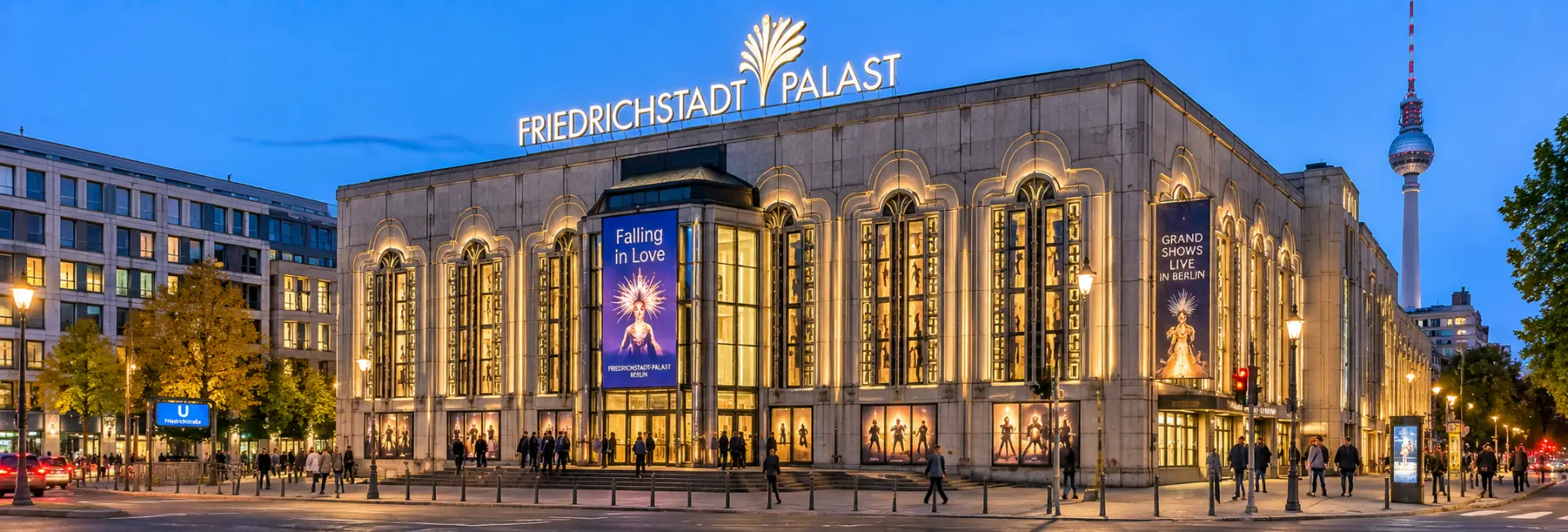
The Friedrichstadt-Palast is Europe's largest revue theatre, staging enormous, effects-driven variety shows on what the venue itself describes as the biggest theatre stage in the world. Located on Friedrichstraße in Berlin-Mitte, the Palast has been a fixture of the city's entertainment scene for more than a century, though the building visitors see today dates only to 1984, when it opened as one of the last major architectural statements of East Germany. Its name, referring to the surrounding Friedrichstadt district rather than any single founder, has stuck through several rebuildings and regime changes over that time. Inside, a resident ensemble of dancers, acrobats, and a large youth troupe perform in a rotating series of "Grand Shows," elaborate, large-cast productions built around spectacle rather than a single storyline. Alongside its regular programme, the Palast also hosts galas, the Berlinale film festival, and the German Film Awards, making it as much a working piece of Berlin's cultural infrastructure as a tourist attraction.
History
From Market Hall to Theatre
The Palast's story starts well before its current building, on a site near Schiffbauerdamm where a covered market hall stood from 1867 and was later converted into a circus arena. In 1919, theatre director Max Reinhardt reopened the building as the "Großes Schauspielhaus" (Great Playhouse), commissioning architect Hans Poelzig to remodel the interior into a dramatic, cave-like auditorium. The remodeled space became known for its striking stalactite-like ceiling and was considered one of the most innovative theatre interiors of its era, hosting monumental productions and lavish revues under directors such as Erich Charell.
Renamed Under Two Regimes
Under Nazi rule the theatre was renamed the "Theater des Volkes" (Theatre of the People) and its programme shifted to safer, apolitical operettas. After the war, in divided Berlin, the building was renamed once more, becoming the Friedrichstadt-Palast on 1 November 1947, and continued operating as East Germany's flagship revue venue for decades.
A New Building for a New Era
By the late 1970s the original building had developed serious structural problems, and it closed in 1980 before being demolished in 1985. Rather than simply rebuild on the same spot, East German authorities constructed an entirely new, much larger Friedrichstadt-Palast a short distance away at Friedrichstraße 107, inaugurated on 27 April 1984, five years before the fall of the Berlin Wall.
Life After Reunification
After 1989, the Palast quickly established itself as reunified Germany's leading venue for large-scale show entertainment, drawing performers and audiences from both former halves of the city and continuing to expand its technical capabilities in the decades since.
Recognition & Status
The current Friedrichstadt-Palast building is officially recognized as the last major architectural landmark constructed in East Germany, completed just five years before German reunification, which gives it a distinct place in the city's Cold War-era history alongside its role as a working theatre. The building's scale and design have also made it a frequently cited example of late-period East German state architecture. It is owned by the City of Berlin and operated as a public cultural institution rather than a private commercial theatre. In 2014, on the 30th anniversary of its opening, the venue was recognized with a Guinness World Record tied to the scale of its shows and cast size.
- Recognized as the last major historic landmark building constructed in the former East Germany
- Owned by the City of Berlin and run as a public cultural institution
- Holds a Guinness World Record connected to the scale of its shows and cast size
Architecture & the Building
A Deceptive Exterior
From Friedrichstraße, the Palast's front building looks relatively modest, but it conceals an enormous structure set back from the street: roughly 80 meters wide, around 100 to 110 meters long, and about 34 meters tall, enclosing some 195,000 cubic meters of space. Despite its comparatively narrow street frontage, the building occupies an entire city block. The design, credited to a collective of East German architects led by Walter Schwarz, prioritized technical capability over external grandeur.
The World's Largest Theatre Stage
Inside, the auditorium seats close to 1,900 people around a stage widely described as the largest in the world for a working theatre, engineered to support the elaborate sets, hydraulics, and large ensembles that the Palast's shows are built around.
The Shows & Ensemble
The Palast's identity rests on its resident production company rather than on touring shows booked from elsewhere. The company's approach favors visual spectacle, precision choreography, and technical stagecraft over spoken dialogue, a format that traces directly back to the venue's revue tradition from the 1920s.
- A rotating "Grand Show," a large-scale revue production that typically runs for several years before being replaced by a new one
- A resident ballet and dance ensemble of around 60 performers
- A youth ensemble drawing roughly 250 Berlin children and teenagers between the ages of 6 and 16
- Guest galas, award ceremonies, and film festival events, including the Berlinale and the German Film Awards
Past productions and events at the Palast have featured performers including Josephine Baker, Marlene Dietrich, Shirley Bassey, and Liza Minnelli, and its stage continues to be used for major national broadcasts and ceremonies alongside its regular show programme.
Ways to Experience It
Most visitors come specifically to see the current Grand Show, a multi-year production combining dance, acrobatics, and elaborate staging; as of 2026 the resident production is "BLINDED by DELIGHT," though the Palast typically replaces its Grand Show every few years, so it's worth checking the current programme before booking. Tickets are sold by seating category rather than a single flat price, and packages combining a show with dinner or a pre-show drink are also available.
- Evening performances of the current Grand Show, generally running most nights of the week
- Ticket packages that include dinner, drinks, or premium seating
- Guided building tours on select dates, covering the theatre's history and technical stage machinery not normally seen by audience members
- Occasional use of the venue for galas, concerts, and film premieres outside the regular show schedule
Best Time to Visit
Because the Palast operates on a fixed performance schedule rather than being open for casual daytime sightseeing, the best time to visit is simply whenever the current show is playing, typically evenings several nights a week. Booking a few weeks ahead is worthwhile for weekend performances and around holidays, when shows tend to sell out popular seating categories first. The building's public box office keeps regular daytime hours for ticket purchases and enquiries even on non-performance days.
Visitor Tips
- There's no fixed dress code; smart-casual is common, though very casual sportswear is generally discouraged for evening performances
- Ticket prices vary widely by seating category and show package, so compare options before booking
- The theatre is step-free and barrier-free throughout, with wheelchair spaces and an induction loop for hearing-impaired guests in the auditorium
- The nearest stops are Oranienburger Tor (tram) or Friedrichstraße (S-Bahn and U-Bahn), both a short walk away
- Arrive with time to spare, since the box office and cloakroom can be busy just before evening performances
- Shows are largely non-verbal or built around visual spectacle rather than dialogue, making them accessible to visitors regardless of German language ability
- Photography and video recording are generally not permitted once a performance begins, though the foyer areas are usually fine for photos beforehand
Nearby Attractions
The Palast sits in Berlin-Mitte's historic theatre district, close to several other cultural landmarks.
- Berlin Cathedral and Museum Island, a short walk to the south
- The Admiralspalast, another historic Berlin theatre, just down the street
- Hackescher Markt, with its shops, bars, and courtyards, a short walk east
- The Spree river promenade along Monbijoupark, running along the theatre's northern side and popular for a stroll before or after a show
- Unter den Linden and the Brandenburg Gate, a short walk to the southwest
FAQs about visiting the Friedrichstadt-Palast
What is the Friedrichstadt-Palast known for? +
It's Europe's largest revue theatre, known for large-scale "Grand Show" productions combining dance, acrobatics, and elaborate staging on the world's largest theatre stage.
What show is currently playing? +
As of 2026, the resident production is "BLINDED by DELIGHT," though the Palast typically runs a new Grand Show for several years at a time, so it's worth checking the current programme before booking.
Is there a dress code? +
No fixed dress code applies; smart-casual is common for evening performances, though very casual sportswear is generally discouraged.
How do I get to the Friedrichstadt-Palast? +
Oranienburger Tor (tram) and Friedrichstraße (S-Bahn and U-Bahn) are both a short walk from the theatre.
Is the venue wheelchair accessible? +
Yes, the building is step-free and barrier-free throughout, with wheelchair spaces and an induction loop for hearing-impaired guests in the auditorium.
Do I need to understand German to enjoy a show? +
No, the Grand Shows are built around visual spectacle, dance, and technical stagecraft rather than spoken dialogue, so they're accessible regardless of language ability.
What else can I combine with a visit? +
Museum Island, the Admiralspalast, and Hackescher Markt are all within easy walking distance, making it simple to pair a show with an afternoon of sightseeing.
