
Table of Contents
Overview
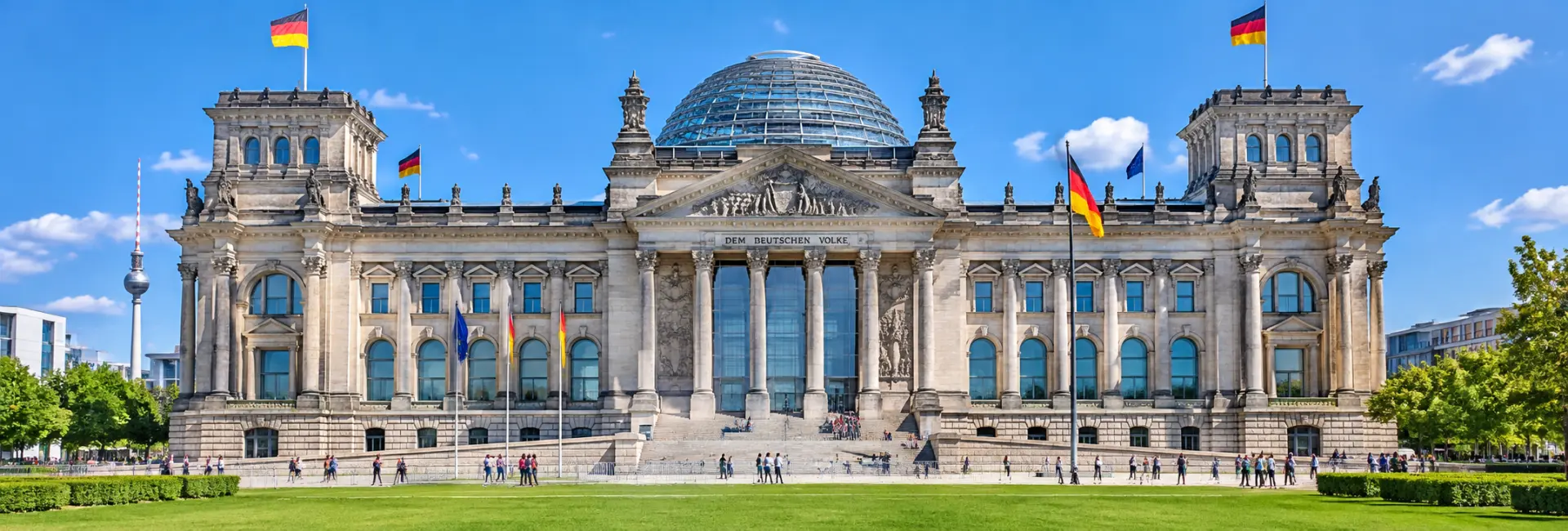
Few buildings anywhere have absorbed as much history as the Reichstag. It's been the seat of a fractured empire's first parliament, a fire-gutted ruin, a Cold War backdrop pressed right up against the Berlin Wall, and now the working home of Germany's modern Bundestag, all inside the same stone shell topped with a strikingly modern glass dome.
What draws most visitors today isn't politics, though, it's that dome. Free to enter with advance registration, it spirals up through the building's roof and offers one of the better panoramic views of central Berlin, all while sitting directly above the working chamber of German democracy. Few landmarks let you look down on the machinery of government quite so literally.
History
Built for a New Empire
Construction began in 1884, a few years after the newly unified German Empire made Berlin its capital and needed a proper home for its parliament. Architect Paul Wallot designed a grand neo-Renaissance building on the bank of the Spree, and it was finished a decade later, in 1894, complete with the now-famous inscription "Dem Deutschen Volke," or "To the German People," though that phrase wasn't actually added above the entrance until 1916.
Fire, War, and Ruin
The building's fortunes turned sharply in the 20th century. In February 1933, a fire tore through the plenary chamber and dome under circumstances the Nazi regime used to justify a sweeping crackdown on political opposition, a moment now remembered simply as the Reichstag fire. The building sat damaged and largely unused for years afterward, and it was hit hard again during the final Soviet push to take Berlin in 1945, when Red Army soldiers famously raised their flag over its battered roof.
Reunification and Rebirth
For decades after the war, the Reichstag sat in a kind of limbo, patched up just enough to survive but never fully restored, and standing close enough to the Berlin Wall to feel like a relic of a divided city. That changed after German reunification in 1990. The Bundestag voted in 1991 to make the building its seat again, and architect Norman Foster led a major reconstruction that reshaped the interior and added the glass dome, finishing in 1999. It's been the working home of the German parliament ever since.
Architecture & Design
The base of the building is still very much Paul Wallot's original vision: heavy stone, neo-Renaissance detailing, and a scale meant to project the authority of a young empire. That part of the Reichstag has changed surprisingly little since the 1890s, at least from the outside.
The dome is where the building's two eras collide most visibly. Norman Foster's glass structure sits directly on top of the historic stonework, spiraling walkways winding up its interior so visitors can climb toward the top while looking straight down into the parliamentary chamber below through a mirrored cone at its center. That cone also does double duty, funneling natural light into the chamber and helping ventilate the building, a rare case of a landmark feature that's genuinely functional rather than purely decorative.
- Original building completed in 1894 to designs by Paul Wallot
- Stands 47 meters tall, with six floors and over 61,000 square meters of floor space
- Glass dome and interior renovation completed in 1999 under architect Norman Foster
- Mirrored cone at the dome's center channels light and air into the plenary chamber
- Roof terrace and dome open to the public with free, advance registration required
Cultural Significance & Traditions
A Building That Mirrors German History
It's hard to think of another single structure that's witnessed quite as many turning points in one country's story. The proclamation of the German Republic was announced from one of its balconies in 1918, the 1933 fire helped pave the way for Nazi rule, and Soviet soldiers planted their flag on its roof in 1945 as the war in Europe wound down. Walking through the building today means walking through practically the entire arc of modern German history.
Wrapped in Fabric, Briefly
In the summer of 1995, the Reichstag became famous for something almost entirely apolitical: artists Christo and Jeanne-Claude wrapped the entire building in silvery fabric for two weeks, drawing enormous crowds and turning a somber political landmark into, briefly, a work of art in its own right.
Transparency as a Design Statement
The glass dome isn't just an architectural flourish. It was conceived as a deliberate symbol of openness, letting the public look down on their elected representatives at work, a pointed contrast to the building's more shadowed chapters earlier in the century. Whether or not you buy into that symbolism, it's rare for a working seat of government anywhere in the world to build public transparency this literally into its architecture.
What to See There
The dome is the main draw, but there's more to take in on a visit than just the glass itself.
- The glass dome and its spiraling interior walkway
- Views down into the Bundestag's plenary chamber through the central mirrored cone
- The roof terrace, with sweeping views over the Tiergarten and central Berlin
- The "Dem Deutschen Volke" inscription above the main entrance
- Historical exhibits inside the building tracing German parliamentary history
Visitors with more time can also book a guided tour or, when parliament is in session, watch a portion of a debate from the visitors' gallery, adding a layer most landmarks simply can't offer.
Ways to Experience It
How you approach a visit here depends mostly on how much lead time you have, since access to the dome isn't something you can just show up for.
- Register online in advance for free dome and roof terrace access, ideally well before your trip since slots fill up quickly
- Book a guided tour for more context on the building's architecture and political history
- Reserve a table at the rooftop restaurant, Käfer, for a meal with some of the best views in Berlin
- Check ahead about attending a plenary session if you're interested in seeing German democracy in action rather than just its architecture
Given how close it sits to the Brandenburg Gate, a Reichstag visit pairs naturally with a walk through that part of central Berlin either before or after.
Best Time to Visit
Early morning or late afternoon slots tend to offer the clearest light for photos from the roof terrace, and booking one of the first or last entry times of the day usually means smaller crowds inside the dome. Because access requires registration in advance, the "best time" here is as much about planning ahead as picking a season.
Spring and autumn bring milder weather for the open-air roof terrace, while summer evenings offer some of the longest daylight for sunset views over the city. Whatever the season, book your slot as early as you can, since dome registrations are limited and popular time windows disappear fast, especially during peak tourist months.
Visitor Tips
- Registration for the dome and roof terrace is free but required in advance through the Bundestag's official website
- Bring a valid photo ID, since it's checked against your registration at security
- Security screening is thorough, similar to an airport, so arrive a bit earlier than your slot time
- The nearest public transport options are the Brandenburg Gate S-Bahn and U-Bahn station or the Bundestag U-Bahn stop on Line U55
- An audio guide covering the building's history is included with dome access at no extra charge
Nearby Attractions
Sitting right at the edge of the Tiergarten and just steps from the Brandenburg Gate, the Reichstag anchors one of Berlin's most historically dense neighborhoods.
- Brandenburg Gate, a short walk away
- Tiergarten park, bordering the Reichstag grounds
- Memorial to the Murdered Jews of Europe, close by to the south
- Berlin Wall Memorial sites along the former path of the Wall nearby
- Museum Island, a bit further east along the Spree
FAQs about visiting the Reichstag Building
Is it free to visit the Reichstag? +
Yes, entry to the glass dome and roof terrace is free, but you need to register online in advance.
How old is the Reichstag Building? +
The original building was completed in 1894, though the current glass dome dates only to 1999, following a major renovation after German reunification.
Why does the Reichstag have a glass dome? +
The dome was added during a 1990s renovation led by architect Norman Foster, designed to symbolize transparency in government by letting visitors look down into the parliamentary chamber below.
What was the Reichstag fire? +
It was a 1933 fire that destroyed the building's plenary chamber and dome, an event the Nazi regime used as justification for cracking down on political opposition shortly after taking power.
How do I book dome access? +
Registration is handled through the Bundestag's official website, and it's worth booking well ahead of your visit since available slots fill up quickly.
How do I get to the Reichstag? +
The Brandenburg Gate S-Bahn and U-Bahn station or the Bundestag stop on U-Bahn Line U55 are both within easy walking distance.
Can I watch a parliamentary session? +
Yes, when the Bundestag is in session, visitors can sometimes observe debates from the visitors' gallery, though this requires separate advance arrangement.
How long does a visit typically take? +
Most visitors spend around one to two hours, including the security check, the walk up through the dome, and time on the roof terrace.
Is there a restaurant inside? +
Yes, the rooftop restaurant Käfer offers meals with panoramic views over Berlin, and reservations are recommended.
What's nearby if I want to keep exploring after my visit? +
The Brandenburg Gate, Tiergarten park, and the Memorial to the Murdered Jews of Europe are all within easy walking distance.
