
Table of Contents
Overview
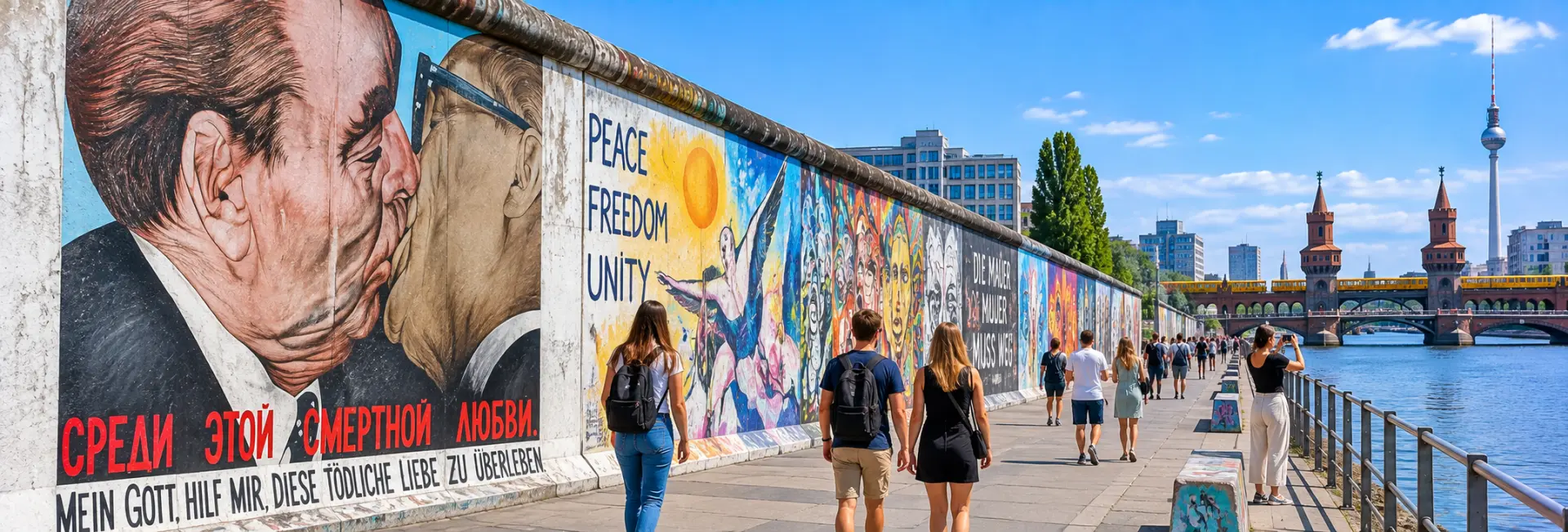
The East Side Gallery is a 1.3-kilometre stretch of the former Berlin Wall running along Mühlenstraße in the Friedrichshain district, between the Ostbahnhof train station and the Oberbaumbrücke bridge over the River Spree. Painted by more than a hundred artists shortly after the Wall fell, it is the longest continuously preserved segment of the barrier still standing and now functions as a permanent, publicly accessible outdoor art gallery.
Rather than marking the actual East–West border, this section was the "hinterland wall" that once sealed off the death strip from what was East Berlin. Its scale and setting along the riverbank make it one of Berlin's most photographed sites, drawing millions of visitors each year who come to see how a symbol of division was turned into a canvas for freedom.
History
From Border Wall to Blank Canvas
Until the autumn of 1989, this concrete wall faced inward toward East Berlin as part of the fortified "death strip" separating the city. When the border opened on 9 November 1989, the section along Mühlenstraße survived the wave of wall-breaking and dismantling that followed elsewhere in the city, largely because it stood apart from the busiest crossing points.
Painting the Wall, 1990
In the spring of 1990, 118 artists from 21 countries were invited to paint directly onto the eastern face of this surviving stretch, producing more than a hundred large-scale works within a matter of months. The paintings responded to the political upheaval of the moment, capturing feelings of relief, hope, and uncertainty as Germany moved toward reunification. The completed gallery opened officially on 28 September 1990 and was given the name East Side Gallery.
Decline, Restoration, and New Stewardship
Exposure to weather, graffiti, and souvenir hunters chipping away at the concrete steadily damaged the paintings through the 1990s. A partial restoration in 2000 refreshed around 300 metres of the wall, and in 2009, to mark the 20th anniversary of the Wall's fall, most of the original artists returned to repaint their own works using more durable materials. Responsibility for the monument's upkeep passed from the state of Berlin to the Berlin Wall Foundation (Stiftung Berliner Mauer) in November 2018, while the independent artists' initiative East Side Gallery e.V. continues to campaign for its protection.
A Wall Under Pressure from Development
Heritage status has not fully shielded the site from Berlin's building boom. In the early 2010s, developers won permission to remove short sections of the wall to open access for riverside apartment and hotel projects, most notably to build a residential tower known as Living Levels. The plans triggered street protests, with campaigners and some of the original 1990 artists physically blocking machinery, and drew brief international headlines as a reminder that the gallery's survival still depends on active advocacy rather than its monument listing alone.
Recognition & Protected Status
Just over a year after it opened, the East Side Gallery was added to Berlin's official list of protected historical monuments in November 1991, giving the wall and its paintings legal heritage status. That protection has not stopped disputes over the surrounding land: in the 2010s, sections of the gallery were temporarily removed to allow riverside construction projects, sparking public protests and drawing international attention to the site's vulnerability.
- Listed as a protected monument (Baudenkmal) by the Land of Berlin since November 1991
- Managed today by the Berlin Wall Foundation, a public body responsible for the city's Wall memorial sites
- Advocated for by East Side Gallery e.V., the artists' association founded around the original 1990 painting project
The Murals & the Artists Behind Them
What sets the East Side Gallery apart from other Berlin Wall remnants is the sheer scale of international participation. Painters travelled from across Europe, the Americas, and Asia to take part, giving the gallery a visual range that spans satire, abstraction, portraiture, and bold graphic slogans, all sharing a common thread of freedom, unity, and the end of division.
- Around 105 to 118 murals cover the wall, depending on how individual works and later additions are counted
- Artists came from 21 different countries, making it one of the most internationally diverse public art projects of its era
- Most works date from the original 1990 painting campaign, with many repainted by the same artists during the 2009 restoration
Because the murals were created quickly and collectively, they read less like a curated exhibition and more like a shared diary of a single historic moment, which is part of why the gallery continues to resonate with visitors who were not alive to see the Wall fall.
Notable Murals to Look For
With over a hundred works stretched along the riverbank, a handful of murals have become instantly recognisable symbols of the site and of Berlin itself.
- "My God, Help Me to Survive This Deadly Love" by Dmitri Vrubel — depicts the staged fraternal kiss between Soviet leader Leonid Brezhnev and East German leader Erich Honecker, and remains the gallery's single most photographed image.
- "Test the Best" by Birgit Kinder — shows an East German Trabant car breaking straight through the concrete, a lighthearted but pointed image of escape and mobility after decades of restriction.
- "It Happened in November" by Kani Alavi — a wide mural of hundreds of individual faces streaming through a break in the Wall, painted by an artist who watched the events of 9 November 1989 unfold from his own window nearby.
- "Dancing for Freedom" by Jolly Kunjappu — bright, linear figures rendered in an Indian visual style, carrying a message against war and division rather than one tied to a single country's history.
- "Tolerance" by Mary Mackey — a mural built around a diverse gathering of faces, painted by one of the few American artists included in the original 1990 project.
- Dozens of smaller works exploring themes of peace, tolerance, and rebuilding, many worth slowing down for rather than rushing past on the way to the famous few.
Ways to Experience It
The East Side Gallery is designed to be walked, and most visitors cover its full length on foot in well under an hour, though art lovers and photographers often take considerably longer.
- Walk the full 1.3-kilometre stretch between Ostbahnhof and the Oberbaumbrücke, reading the accompanying artist plaques along the way
- Join a guided Berlin Wall or Cold War history walking tour, many of which include the gallery as a stop alongside sites like Checkpoint Charlie
- Cycle along the riverside path, a popular option for visitors combining the gallery with a longer ride along the Spree
- Take a Spree river cruise, which passes directly alongside the wall and offers a different perspective on its scale
- Visit independently with a printed or digital map of the murals, since the wall itself carries no numbered sequence and it is easy to walk past lesser-known works without one
Best Time to Visit
The gallery is outdoors and unticketed, so it can be visited at any hour, but conditions vary considerably depending on when you go.
- Early morning offers the clearest views and the best light for photography, before tour groups and day-trippers arrive
- Late afternoon and evening bring larger crowds, especially near the most famous murals, along with a livelier atmosphere from nearby riverside bars
- Spring through early autumn is the most comfortable season for a long outdoor walk, while winter visits are quieter but colder along the exposed riverbank
Visitor Tips
A few practical points make a visit smoother and help protect the artwork for future visitors.
- Entry is free and the gallery is open around the clock, with no tickets or bookings required
- Warschauer Straße and Ostbahnhof stations, both served by S-Bahn and U-Bahn lines, sit at opposite ends of the gallery and make convenient start or end points
- Avoid touching, scratching, or adding graffiti to the murals; ongoing vandalism is one of the main threats to the artwork's preservation
- Weekend afternoons draw heavy foot traffic near the best-known murals, so plan around the crowds if a quieter walk matters to you
- Public toilets and food options are limited directly along the wall itself, but plentiful in the surrounding Friedrichshain streets
- The wall runs alongside a fairly narrow footpath shared with cyclists and joggers, so stay alert when stopping to take photographs
- Bring a portable charger or spare memory if photographing extensively — the sheer length of the gallery means most visitors take far more pictures than expected
Nearby Attractions
The gallery sits in a lively stretch of Friedrichshain, making it easy to combine with several other sights in a single outing.
- Oberbaumbrücke — the twin-towered brick bridge at the gallery's southern end, one of Berlin's most recognisable river crossings
- Molecule Man — a large aluminium sculpture standing in the Spree just beyond the bridge, visible from the riverside path
- Warschauer Straße — a busy transport hub surrounded by bars, clubs, and street food, popular well into the night
- RAW-Gelände — a former railway repair yard turned into a sprawling complex of markets, clubs, and street art a short walk away
- Uber Arena — a major concert and sports venue directly across the river from the gallery
- Boxhagener Platz — a leafy square a short walk into Friedrichshain, known for its weekend flea market and neighbourhood cafés
- Checkpoint Charlie — the former Cold War border crossing in Mitte, easily combined with the gallery as part of a broader Berlin Wall history route
FAQs about visiting the East Side Gallery
Is the East Side Gallery free to visit? +
Yes, the gallery is outdoors, unticketed, and open to walk along at any time of day or night.
How long does it take to see the East Side Gallery? +
Walking the full 1.3-kilometre stretch takes most visitors 45 minutes to an hour, though photographers and history enthusiasts often spend longer.
What is the most famous mural at the East Side Gallery? +
Dmitri Vrubel's "My God, Help Me to Survive This Deadly Love," showing the staged kiss between Brezhnev and Honecker, is the gallery's best-known and most photographed image.
How do I get to the East Side Gallery? +
Warschauer Straße and Ostbahnhof, both reachable by S-Bahn and U-Bahn, sit at either end of the gallery, making either station a good starting point.
Is the East Side Gallery the original Berlin Wall? +
It is an original section of Wall structure, though many of the paintings on it are 2009 repaintings by the original artists after the earlier murals weathered and degraded.
Is the East Side Gallery suitable for kids and visitors with mobility needs? +
Yes — it is a flat, open-air riverside path with no tickets, stairs, or turnstiles, making it accessible for strollers, wheelchairs, and children.
What's a common mistake visitors make at the East Side Gallery? +
Many visitors head straight to the famous kiss mural and turn back, missing dozens of other striking works further along the wall toward Ostbahnhof.
What should I combine an East Side Gallery visit with? +
The Oberbaumbrücke, Molecule Man sculpture, and RAW-Gelände complex are all within easy walking distance and pair well with a gallery visit.
