
Table of Contents
Overview
The Pergamon Museum is one of the five institutions that make up Museum Island in central Berlin, and historically its single most visited art museum, drawing more than a million visitors a year before its current renovation began. Built to house monumental reconstructions of ancient buildings and gateways, it brings together the Collection of Classical Antiquities, the Museum of the Ancient Near East, and the Museum of Islamic Art under one roof.
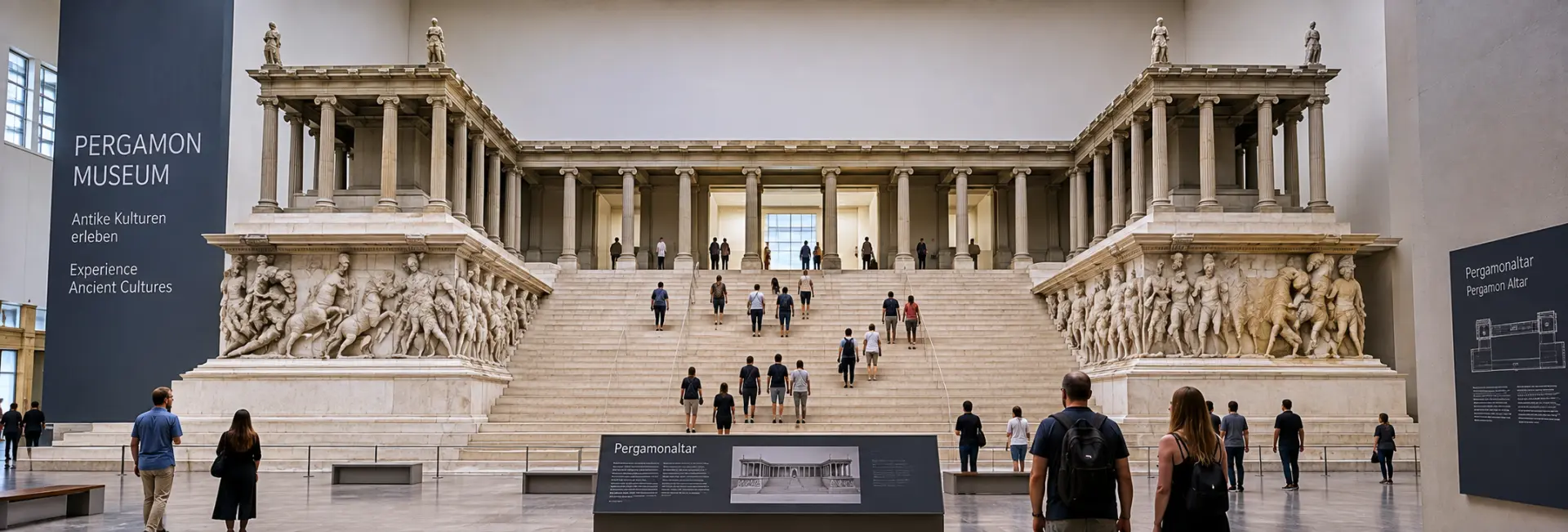
Its name comes from its best-known exhibit, the Pergamon Altar, a vast Hellenistic monument originally built in what is now Turkey. Alongside it, the museum has traditionally displayed the Ishtar Gate of Babylon, the Market Gate of Miletus, and other large-scale antiquities that are difficult to see anywhere else in the world. As of 2026, the museum is in the middle of a lengthy, multi-phase renovation, and anyone planning a visit should check the current status before arriving.
History
Building a Home for Monumental Archaeology
The Pergamon Museum was the last of the five Museum Island buildings to be constructed, designed by architect Alfred Messel and completed after his death by Ludwig Hoffmann. Commissioned by Emperor Wilhelm II, it was built between 1910 and 1930 specifically to house the oversized architectural finds that German-led excavations had brought back from sites in what is now Turkey, Iraq, and Syria, objects too large to display in the island's earlier, more traditionally scaled museum buildings.
War, Division, and a Split Collection
The building suffered damage during Allied air raids at the end of the Second World War, and in 1945 Soviet forces removed a large portion of the collection to the Soviet Union, both as war reparations and, in part, to protect items from the fighting and looting underway in Berlin. Most objects were returned to East Germany by 1958, though significant pieces remain in Russian museums today, their return a long-unresolved point of dispute between the two countries. With Germany divided, the Pergamon Museum reopened in East Berlin in 1959, while related holdings in the West were displayed separately at Schloss Charlottenburg until reunification allowed the collections to be reunited.
A Long-Term Restoration
Museum Island's five buildings have been undergoing a coordinated, decades-long renovation known as the Museum Island Master Plan since the 1990s, aimed at repairing wartime and Cold War-era damage and neglect while modernising the buildings for contemporary museum use. Three of the five museums, along with the shared James Simon Gallery entrance building, have already completed their renovations under this plan. The Pergamon Museum's turn came later than most of its neighbours, with renovation work beginning in stages from 2013 onward, first affecting the hall containing the Pergamon Altar and gradually expanding to cover the rest of the building.
Architecture & Building
The museum is built in a restrained, stripped-back classical style, its plain stone exterior designed to draw attention to the monumental ancient structures reassembled inside rather than to compete with them visually. Its three-wing layout was planned around the scale of its largest exhibits, with entire building sections effectively constructed as display cases for architecture rather than conventional museum galleries.
- Built between 1910 and 1930 to designs by Alfred Messel, completed by Ludwig Hoffmann after Messel's death
- Comprises a north wing, a central section, and a south wing, each historically dedicated to different parts of the collection
- Inscribed as part of the Museum Island UNESCO World Heritage Site in 1999, recognising both its architecture and its role in the history of museum design
- Connected to the neighbouring Bode Museum and to the James Simon Gallery, the shared entrance building for Museum Island that opened in 2019
Collections & Highlights
The Pergamon Museum's collections span more than two thousand years, brought together specifically because of their scale and archaeological significance rather than as a conventional art collection.
- The Pergamon Altar — a monumental 2nd-century BCE Hellenistic altar from the ancient city of Pergamon, decorated with a dramatic marble frieze depicting a battle between gods and giants
- The Ishtar Gate and Processional Way — glazed blue-tiled structures from ancient Babylon, dating to the reign of King Nebuchadnezzar II in the 6th century BCE
- The Market Gate of Miletus — a two-storey Roman-era gateway from the ancient city of Miletus in present-day Turkey, dating to around 120 CE
- The Mshatta Facade — an elaborately carved stone facade from an 8th-century Umayyad palace, a centrepiece of the Museum of Islamic Art
- The Aleppo Room — a wood-panelled reception chamber from a Syrian merchant's house, painted with intricate 17th-century decoration
- The Meissner fragment — a cuneiform tablet fragment from the Epic of Gilgamesh, among the museum's smaller but historically significant Near Eastern holdings
Because many of these pieces are architectural in scale, entire rooms of the museum were built specifically to accommodate them, which is part of why the building's phased renovation has been such a lengthy undertaking: the structures cannot simply be moved elsewhere while work continues around them.
Renovation & Current Visiting Status
The Pergamon Museum has been completely closed to visitors since October 2023 as part of an extensive, multi-year renovation under the Museum Island Master Plan. This is a significant step up from the partial closures of the 2010s, which had kept the south wing open while the Pergamon Altar hall and north wing underwent earlier phases of work.
- The renovated north wing and central building, including the hall housing the Pergamon Altar and the Museum of Islamic Art's new galleries, are scheduled to reopen on 4 June 2027
- The reopening coincides with celebrations marking the 200th anniversary of Museum Island, and will include a newly conceived presentation of the Museum of Islamic Art featuring the Aleppo Room, the Mshatta Facade, and the Alhambra Dome
- The south wing, which traditionally held the Ishtar Gate, the Processional Way, and the main Museum of the Ancient Near East collection, will remain closed for a further phase of construction, with a full reopening not expected until 2037
- From 2027, a preview presentation of the Ancient Near East collection is planned in the Schlütersaal while the south wing renovation continues
- Group bookings for the 2027 reopening are expected to become available from mid-2026, ahead of the general public opening
Because these dates can shift, anyone planning a trip around the reopening should confirm current status directly with the Staatliche Museen zu Berlin before travelling.
Ways to Experience It in the Meantime
Although the main building is closed, several alternatives let visitors engage with the Pergamon collections and story while renovation work continues.
- Visit Pergamonmuseum. Das Panorama, a separate exhibition space nearby that combines a 360-degree panoramic reconstruction of ancient Pergamon with original antiquities from the collection
- Explore related Berlin State Museums collections, since some objects and highlights have been relocated to other Museum Island buildings during the closure
- Follow updates from the Staatliche Museen zu Berlin for details on the 2027 partial reopening and any interim exhibitions announced in the lead-up
- Combine a Museum Island day with the Neues Museum, Altes Museum, or Bode Museum, all of which remain open and reachable on the same ticket system
Best Time to Visit
Once the museum reopens in phases from 2027, timing a visit well will matter for managing crowds at what has historically been Berlin's most popular art museum.
- Expect strong demand and likely timed-entry tickets in the months immediately following the 4 June 2027 reopening, given pent-up interest after more than a decade of partial or full closure
- Weekday mornings have traditionally been the quietest time to visit Museum Island's museums, a pattern likely to hold once the Pergamon reopens
- Until then, Pergamonmuseum. Das Panorama is best visited on weekdays outside school holiday periods to avoid the largest tour groups
Visitor Tips
A few practical points are worth keeping in mind given the museum's unusual current status.
- Do not plan a Berlin itinerary around visiting the main Pergamon Museum building before its scheduled 2027 partial reopening — it is entirely closed to the public
- A Museum Island combination ticket or the Museum Pass Berlin covers the other four Museum Island institutions, which remain open during the Pergamon's renovation
- Photography without flash has traditionally been permitted in the museum's public galleries, a policy expected to continue once it reopens
- Allow 60 to 90 minutes for Pergamonmuseum. Das Panorama as a substitute experience while the main building is closed
- Check official sources shortly before travelling, since renovation timelines for major museum projects are subject to change
Nearby Attractions
The Pergamon Museum sits at the heart of Museum Island, surrounded by other major Berlin sights within a short walk.
- Neues Museum — home to the bust of Nefertiti and extensive Egyptian and prehistoric collections, a short walk across the island
- Altes Museum — the island's oldest museum building, housing classical Greek and Roman antiquities
- Bode Museum — a Neo-Baroque building at the island's northern tip, known for its sculpture and coin collections
- Berlin Cathedral — the domed Protestant cathedral standing just south of Museum Island across the Lustgarten
- Humboldt Forum — the reconstructed Berlin Palace, housing ethnological and Asian art collections a short walk from the museum
- Lustgarten — the landscaped square between the museum and Berlin Cathedral, a pleasant place to pause between sights
- Nikolaiviertel — Berlin's reconstructed medieval old town quarter, a short walk to the southeast with restaurants and small museums
FAQs about visiting the Pergamon Museum
Is the Pergamon Museum open right now? +
No, the main building has been completely closed to visitors since October 2023 as part of a major renovation, with a partial reopening scheduled for 4 June 2027.
When will the Pergamon Altar be on display again? +
The hall housing the Pergamon Altar is part of the north wing and central building scheduled to reopen on 4 June 2027.
When will the Ishtar Gate be visible again? +
The south wing, which traditionally displayed the Ishtar Gate and Processional Way, is not expected to reopen until 2037 as part of a later renovation phase.
Can I still see anything related to the Pergamon Museum while it's closed? +
Yes, Pergamonmuseum. Das Panorama, a separate nearby exhibition, offers a 360-degree reconstruction of ancient Pergamon along with original objects from the collection.
Is the Pergamon Museum part of Museum Island? +
Yes, it is one of five museums on Museum Island, a UNESCO World Heritage Site in central Berlin, alongside the Altes Museum, Neues Museum, Alte Nationalgalerie, and Bode Museum.
Will tickets be needed for the 2027 reopening? +
Specific ticketing details had not been finalised at the time of writing, but strong demand is expected, so checking official sources closer to the reopening date is recommended.
What can I visit on Museum Island while the Pergamon is closed? +
The Neues Museum, Altes Museum, Bode Museum, and Alte Nationalgalerie all remain open and can be combined into a full day of sightseeing.
Why has the Pergamon Museum's renovation taken so long? +
The building requires extensive structural repair after decades of wartime damage and limited maintenance during the Cold War, and the work is being carried out in stages so parts of the collection can eventually reopen before the entire project is finished.
