
Table of Contents
Overview
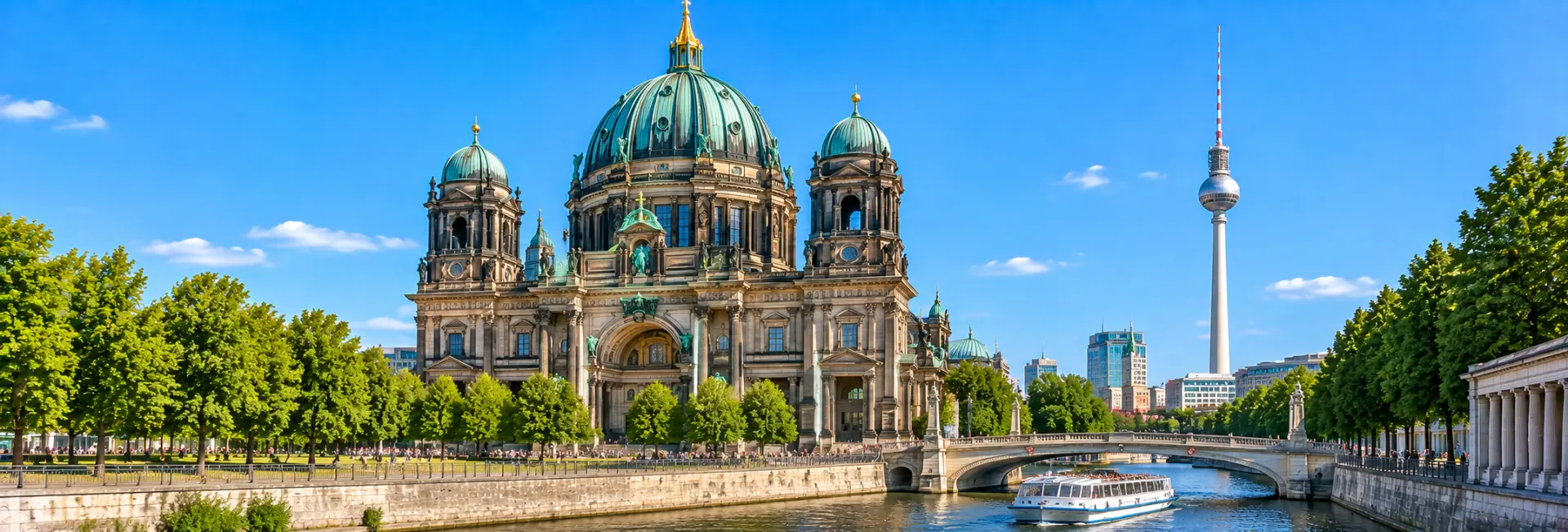
Berlin Cathedral, known in German as the Berliner Dom, is a monumental domed church standing on Museum Island in the heart of the city. Despite its name, it is not technically a cathedral, since it has never been the seat of a bishop; it instead serves as the supreme parish church of Germany's Protestant state church and doubles as a dynastic burial site, concert hall, and museum.
Built at the turn of the twentieth century on the orders of Emperor Wilhelm II, its towering dome and lavishly decorated interior were meant to give German Protestantism a landmark to rival the great Catholic basilicas of Rome. Today it remains one of Berlin's most visited sights, drawing people in for its architecture, its panoramic dome walkway, and the Hohenzollern family crypt beneath its floor.
History
From Court Chapel to Royal Church
A church has stood on or near this site since the mid-fifteenth century, originally serving as the private chapel of the Hohenzollern family, whose city palace stood just across the square. Over the following centuries the building was rebuilt several times, first in a Baroque style in the 1740s under architect Johann Boumann, and again between 1817 and 1822, when Karl Friedrich Schinkel remodelled it into a Neoclassical court church.
Wilhelm II's Grand Rebuilding
After taking the throne in 1888, Wilhelm II judged the existing church too modest for an imperial capital and ordered it demolished in 1893. Architect Julius Raschdorff, working with his son Otto, designed an entirely new building in a Renaissance and Baroque Revival style, deliberately conceived as a Protestant counterpart to St Peter's Basilica. Construction ran from 1894 to 1905, when the cathedral was consecrated in its current, much larger form.
War, Division, and Reconstruction
An air raid in 1944 caused a fire that destroyed the dome's lantern and badly damaged the interior. The ruined building stood largely untouched through the postwar years, falling within East Berlin after the city's division, and it was not until 1975 that reconstruction work began under the East German government, initially in a simplified form that permanently removed the cathedral's northern memorial hall. A temporary roof kept the weather out while the shell awaited a fuller rebuild, and for decades the cathedral stood as one of the more visible reminders of wartime damage still unresolved in the city centre.
Restoration of the interior continued after German reunification, with the main structure reopening in 1993 and a second consecration held in 1996. Further work on decorative details and finishes continued until 2002, and the building's sandstone exterior has required ongoing conservation since, owing to decades of weathering and exposure to exhaust fumes from the surrounding city.
Architecture & Design
The cathedral was built primarily from Silesian sandstone in a High Renaissance style layered with exuberant Baroque ornamentation, a combination chosen to project imperial confidence rather than Protestant restraint. At roughly 114 metres long and 73 metres wide, with a dome originally rising some 116 metres above the ground, it dwarfed every church that had previously stood on the site.
- The central copper-clad dome has an interior diameter of about 33 metres and is topped with a lantern and cross
- A round window at the crown of the dome depicts the dove of the Holy Spirit, surrounded by eight mosaics illustrating the Beatitudes, created by painter Anton von Werner
- The main altar, carved from white marble and yellow onyx, was originally made for an earlier version of the church and later incorporated into Raschdorff's building
- An ornate gilded screen bearing figures of the twelve apostles stands at the east end, backed by a mosaic based on a seventeenth-century painting of St Peter
Visitors can climb around 270 stone steps inside the dome's gallery to reach an open-air walkway roughly 50 metres above the ground, which circles the drum of the dome and offers uninterrupted views across central Berlin.
The Hohenzollern Crypt & Other Notable Features
The Hohenzollern Crypt
Beneath the main sanctuary lies the Hohenzollern Crypt, one of the largest dynastic burial sites in Europe and the resting place of the Brandenburg-Prussian ruling family across roughly five centuries. It holds 91 preserved sarcophagi and burial monuments, including those of the Great Elector Frederick William and of Frederick I and Sophie Charlotte, the first king and queen of Prussia. The crypt suffered serious damage during the Second World War and underwent a major renovation lasting six years, reopening to the public again on 1 March 2026 with a newly designed exhibition on the history of the burial site.
The Sauer Organ
The cathedral's main organ, built by the Wilhelm Sauer workshop and completed in 1905, contains more than 7,000 pipes across 113 registers, making it the largest late-Romantic organ preserved close to its original condition anywhere in Germany. It survived wartime damage and later plundering before being fully restored to its early-twentieth-century specification, and it remains in regular use for services and concerts.
Cathedral Museum and Imperial Staircase
A small museum inside the building displays sketches, models, and archival material documenting the cathedral's design and construction, while the ornate Imperial Staircase once led directly to a private gallery used by Wilhelm II to attend services separately from the congregation.
Baptismal and Wedding Chapel
Alongside the main sanctuary sits a smaller, more intimate chapel used for baptisms and weddings, decorated in a lighter style than the grand central nave. It houses its own organ, used for smaller recitals in the annual International Organ Summer series, and offers a quieter contrast to the scale and ornamentation of the main church.
Cultural & Religious Significance
As the supreme parish church of the Evangelical Church in Germany's older Prussian provinces, Berlin Cathedral occupies a role in German Protestant life comparable to that of a national cathedral, even without formal cathedral status. It functions as a Personalgemeinde, meaning any baptised Protestant in the Berlin area may join its congregation regardless of where they live, and it hosts regular services, two choirs, and a resident brass ensemble.
Beyond its religious role, the building carries deep significance as a Hohenzollern dynastic monument and as a site that survived the destruction of the Second World War and the decades of division that followed. Its slow, deliberate postwar restoration, spanning both East German and reunified Germany, mirrors the city's own path back from division, and the building today hosts state ceremonies and civic events alongside regular worship.
Ways to Experience It
A standard visit combines several distinct areas, most of which are covered by a single admission ticket.
- Walk the main sanctuary at ground level to see the altar, organ, and mosaics up close
- Descend to the Hohenzollern Crypt to view the royal sarcophagi and the exhibition on the burial site's history
- Climb the dome gallery stairs for a panoramic outdoor view across Museum Island and the surrounding city
- Use the included multilingual audio guide, which covers the cathedral's history, architecture, and notable features section by section
- Attend a service, organ recital, or one of the cathedral's regular concerts, which take advantage of the building's exceptional acoustics
Visitor Tips & Etiquette
A few practical points help make a visit run smoothly and keep it respectful of the building's role as an active church.
- An admission ticket is required to enter as a sightseer; access is free during scheduled worship services, when visitors are welcome to attend but not to sightsee
- Modest dress is appreciated, as it remains an active place of worship rather than a purely secular monument
- The dome walkway involves roughly 270 steps with no lift, so plan accordingly if mobility or stamina is a concern
- Photography is generally permitted inside, but flash and tripods are typically discouraged during services and concerts
- The last admission is usually around an hour before closing, since the crypt, dome, and museum are closed in sequence ahead of the building shutting for the day
Best Time to Visit
The cathedral is a popular stop on Museum Island, and timing a visit well can make a noticeable difference to crowd levels.
- Arriving at opening time on weekday mornings offers the quietest conditions for exploring the interior and crypt
- Midday and early afternoon tend to be busiest, particularly when combined with tour groups visiting the neighbouring museums
- Clear days are worth prioritising for the dome climb, since the outdoor walkway rewards good visibility with sweeping views over the city
- Checking the schedule in advance is worthwhile if a concert, organ recital, or choral service is of interest, as these often run in the evening
Nearby Attractions
Standing at the heart of Museum Island, the cathedral is within easy walking distance of several of Berlin's leading cultural sites.
- Humboldt Forum — the reconstructed Berlin Palace directly across the square, housing ethnological and Asian art collections
- Pergamon Museum — home to the Pergamon Altar and other monumental antiquities, a short walk along Museum Island
- Altes Museum and Neues Museum — neighbouring institutions holding classical antiquities and the bust of Nefertiti respectively
- Lustgarten — the landscaped square directly in front of the cathedral, a popular spot to pause and photograph the building's façade
- Nikolaiviertel — Berlin's reconstructed medieval old town quarter, a short walk to the southeast with restaurants and small museums
- Fernsehturm (Berlin TV Tower) — the city's tallest structure, visible from the cathedral's dome gallery and reachable on foot in about fifteen minutes
- Unter den Linden — Berlin's historic boulevard, running from the Museum Island bridge toward the Brandenburg Gate
FAQs about visiting Berlin Cathedral (Berliner Dom)
Is Berlin Cathedral an actual cathedral? +
Not technically — it has never been the seat of a bishop, but it functions as the supreme parish church of the Protestant state church and is commonly called a cathedral due to its scale and grandeur.
Do I need a ticket to visit Berlin Cathedral? +
Yes, sightseeing visits require an admission ticket, which typically includes the sanctuary, the Hohenzollern Crypt, the dome gallery, and an audio guide.
How many steps are there to the dome? +
Reaching the outdoor dome gallery involves climbing roughly 270 steps, with no elevator available.
Is the Hohenzollern Crypt open to visitors? +
Yes, the crypt reopened to the public on 1 March 2026 after a six-year renovation, and its 91 sarcophagi can once again be viewed as part of a standard visit.
How long does a visit to Berlin Cathedral take? +
Most visitors spend around one to two hours covering the sanctuary, crypt, and dome climb at a comfortable pace.
Can I attend a service at Berlin Cathedral for free? +
Yes, worship services are open to the public without an admission ticket, though sightseeing during a service is not appropriate.
Is Berlin Cathedral wheelchair accessible? +
The main sanctuary and crypt are accessible, but the dome gallery is reachable only by stairs and is not accessible to wheelchair users or those with limited mobility.
What else is nearby Berlin Cathedral? +
The Humboldt Forum, Pergamon Museum, and the other Museum Island institutions are all within a few minutes' walk, making the cathedral easy to combine with a wider museum visit.
