Table of Contents
Overview
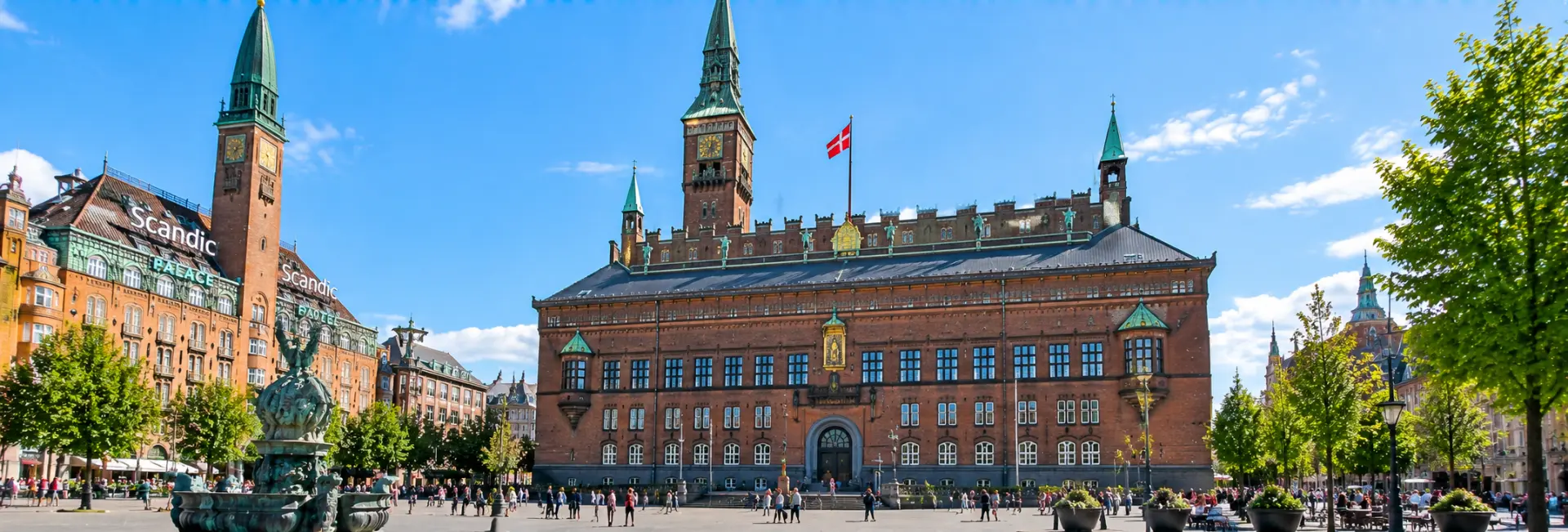
Copenhagen City Hall, or Rådhus, sits at the head of Rådhuspladsen and marks the start of Strøget, the city's long pedestrian shopping street. Completed in 1905, it remains the working seat of Copenhagen's municipal council and Lord Mayor, and its tall clock tower has been one of the most recognizable landmarks on the city's low skyline for well over a century.
Beyond its role as a functioning government building, City Hall draws visitors for its ornate red-brick architecture, its richly decorated interior, and Jens Olsen's World Clock, an astronomical clock famous for its extraordinary mechanical precision. A visit combines a sense of civic history with genuinely striking design, all in the middle of Copenhagen's busiest square.
History
A Long Line of City Halls
The current building is Copenhagen's sixth city hall, following a string of predecessors dating back to around 1479 that were repeatedly lost to the city's historic fires. Earlier versions stood elsewhere in the city center, including one on Nytorv that still functions today as Copenhagen's city court after the municipal government moved on.
Designing the Present Building
Plans for a new, larger city hall took shape in the late 1880s, and architect Martin Nyrop won the competition to design it, drawing inspiration from the medieval town hall of Siena in Italy as well as Danish and Nordic architectural traditions. Construction began in 1892, and the building was formally inaugurated on 12 September 1905, giving Copenhagen a city hall built to reflect its growing importance as a modern European capital.
A Century as a Civic Landmark
In the decades since, the building has remained in continuous use as the headquarters of Copenhagen's local government while also becoming a familiar backdrop for public gatherings, celebrations, and even Danish film and television productions, cementing its place in the city's everyday cultural life.
Architecture & Design
Nyrop's design blends Danish medieval brickwork with the arcaded courtyards and civic grandeur of northern Italian town halls, producing a style often described as National Romantic. The most prominent feature is the slender clock tower, rising to roughly 105.6 meters and standing as one of the tallest structures in central Copenhagen, still offering one of the most commanding views over the city's rooftops.
Inside, an arcaded courtyard modeled loosely on Italian civic architecture brings light into the building's core, while the Main Hall, a large covered space used for events and official functions, sits at the heart of the building alongside a series of ceremonial rooms decorated with ironwork, carved wood, and painted detail.
Recognition & Status
As the seat of Copenhagen's municipal council and Lord Mayor, City Hall continues to function as an active government building rather than a museum piece, which gives a visit an unusually direct connection to the city's day-to-day administration. Its tower held the distinction of being one of Copenhagen's tallest structures for most of the 20th century, and the building is widely regarded as one of the finest examples of National Romantic architecture in Denmark.
What to See There
A handful of features consistently draw visitors inside and around the building.
- Jens Olsen's World Clock, an astronomical clock completed in 1955 after decades of design work, with thousands of moving parts tracking solar time, sidereal time, planetary positions, and a centuries-long calendar cycle
- The gilded statue of Bishop Absalon, traditionally credited as the founder of Copenhagen, positioned above the main entrance
- The arcaded inner courtyard, a quieter architectural highlight often overlooked by visitors focused on the tower and clock
- Decorative details throughout the facade and roofline, including carved figures and ornamentation that reward a slow look from the square outside
- The view from the clock tower itself, reached by a long climb but offering a genuinely wide panorama over the city center
Ways to Experience It
City Hall can be visited on several levels, from a quick look at the exterior to a full guided exploration of its upper floors.
- Step into the main hall and public ground-floor areas independently, free of charge, during opening hours
- View Jens Olsen's World Clock, displayed in its own area near the entrance and included with general access to the building
- Join a guided tour, offered in English and Danish, for access to ceremonial rooms and additional historical background not covered in a self-guided visit
- Climb the roughly 300 steps of the clock tower on a separate, guided-only schedule for panoramic views over Copenhagen
Best Time to Visit
Because most of the interior sits indoors, City Hall makes a solid option regardless of the weather, and mornings on weekdays tend to be quieter than the middle of the day. The building is closed to general visitors on Sundays, so it is best worked into a weekday or Saturday itinerary.
The tower climb is particularly weather-dependent for views, so a clear day is worth prioritizing if the panorama from the top is the main goal of a visit.
Visitor Tips
A few practical notes make it easier to plan a visit around City Hall's mixed role as both a government building and a tourist attraction.
- Confirm current opening hours for the main hall, guided tours, and the tower climb on the official visitor website, since schedules vary by day and season
- Access to the main hall and Jens Olsen's World Clock is generally free, while guided tours and the tower climb typically require a separate ticket
- The tower climb involves several hundred steps with no elevator, so it is not suitable for visitors with mobility limitations
- The main floor and public spaces are wheelchair accessible, though the tower and some upper floors are not
- Since the building remains an active government office, some areas may be closed to visitors during official events
Nearby Attractions
City Hall's position at the top of Strøget makes it a natural starting point for exploring central Copenhagen on foot.
- Strøget, Europe's longest pedestrian shopping street, beginning directly at Rådhuspladsen
- Tivoli Gardens, the historic amusement park, a short walk to the southwest
- Ny Carlsberg Glyptotek, the art museum just beyond Tivoli, within easy walking distance
- Nyhavn's colorful harbor front, reachable on foot through the city center
- The Round Tower and Latin Quarter, a walk of about ten minutes into Copenhagen's historic university district
FAQs about visiting Copenhagen City Hall
What is Copenhagen City Hall known for? +
It is known for its National Romantic architecture, its tall clock tower, and Jens Olsen's World Clock, an intricate astronomical clock displayed inside the building.
Is Copenhagen City Hall still an active government building? +
Yes, it remains the working headquarters of Copenhagen's municipal council and Lord Mayor, while also being open to visitors for parts of its interior.
Is it free to visit City Hall? +
Access to the main hall and Jens Olsen's World Clock is generally free, though guided tours and the clock tower climb typically require a separate ticket.
Can I climb the City Hall tower? +
Yes, the tower can be climbed on a guided-only schedule, involving several hundred steps with no elevator, and it rewards visitors with sweeping views over central Copenhagen.
How much time should I plan for a visit? +
A quick look at the main hall and the World Clock takes well under an hour, while a guided tour plus the tower climb can fill closer to two hours.
Is City Hall accessible for visitors with mobility needs? +
The main floor and public areas are wheelchair accessible, but the clock tower and some upper floors are reachable only by stairs.
How do I get to Copenhagen City Hall? +
It sits at Rådhuspladsen in the heart of the city, at the top of the Strøget pedestrian street, within easy walking distance of Tivoli Gardens and Copenhagen Central Station.
What else is nearby if I want to keep exploring? +
Strøget, Tivoli Gardens, and the Ny Carlsberg Glyptotek are all within a short walk, making City Hall an easy starting point for a day in central Copenhagen.