Table of Contents
Overview
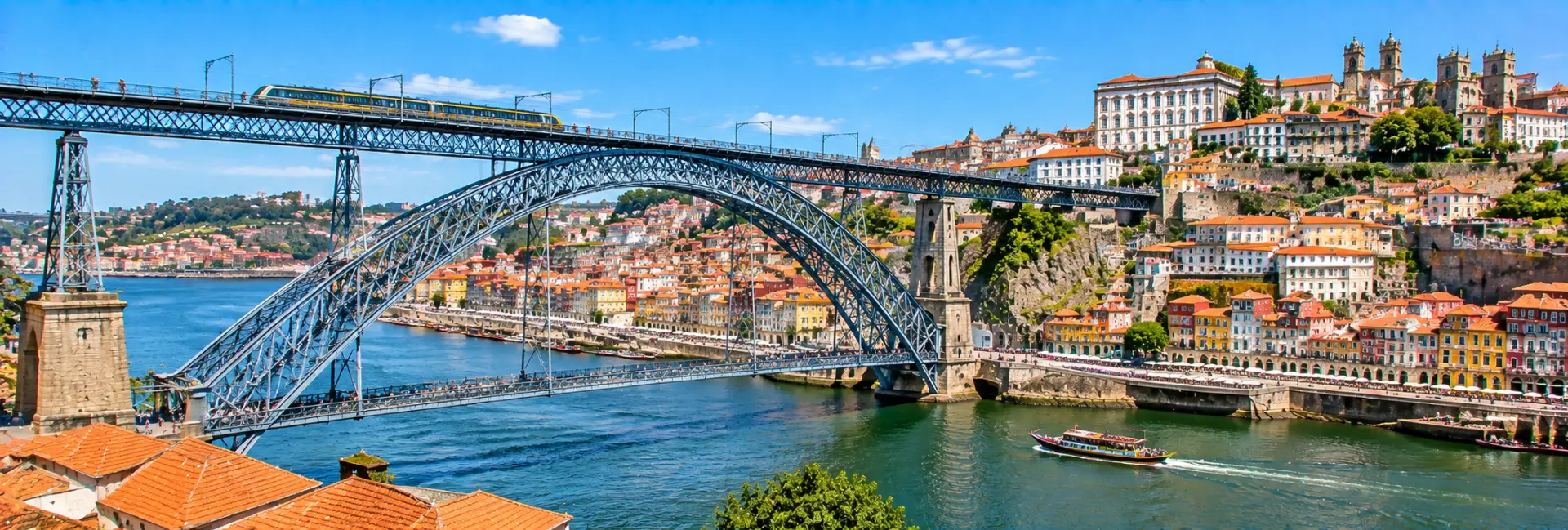
The Dom Luís I Bridge is Porto's most recognizable structure, a double-decked iron arch spanning the Douro River between the historic Ribeira district and Vila Nova de Gaia. Completed in 1886, it has become the defining image of the city, appearing on postcards and skyline photographs more often than any other single landmark in Porto.
Unlike many historic bridges preserved mainly for their looks, the Dom Luís I Bridge remains fully in daily use, carrying metro trains and pedestrians on its upper deck and road traffic and pedestrians on its lower deck. Walking across either level is free and offers some of the best views in the city, making it as much a destination in its own right as a way to get from one side of the river to the other.
History
Replacing an earlier crossing
Before any permanent bridge existed at this location, crossings of the Douro relied on boats and pontoon bridges, a method that proved fatal in 1809 when a bridge of boats collapsed during the chaos of Napoleon's invasion, drowning many people fleeing across it. A suspension bridge called the Ponte Pênsil was built in 1843 to provide a safer crossing, but by the late 19th century Porto's booming trade and growing population had outgrown its capacity.
A design competition
In 1879 the Portuguese government opened a competition for a new metal bridge to replace the aging suspension crossing. A single-deck proposal from Gustave Eiffel's firm was rejected as the city's rapid growth called for a structure that could carry more traffic, and the commission instead went to a design by Belgian engineer Théophile Seyrig, submitted through the firm Société Anonyme de Construction et des Ateliers de Willebroeck.
Construction and opening
Construction began on 21 November 1881 and finished in 1886, with the bridge formally inaugurated on 31 October of that year. At the time of its completion, its 172-metre arch span was the longest of any arch bridge in the world, a record that underscored how ambitious the design was for its era. The bridge charged a toll from its opening until 1944, and was later recognized as a Portuguese national monument in 1982 and, alongside Porto's historic center, as a UNESCO World Heritage Site in 1996.
Engineering & Design
Théophile Seyrig, who had earlier worked alongside Gustave Eiffel on Porto's Maria Pia railway bridge, designed the Dom Luís I Bridge as a two-hinged iron arch carrying two separate decks, one high above the river and one closer to the water. This double-deck approach let the bridge serve very different kinds of traffic on each level without requiring two separate structures.
The bridge rises to a height of around 70 metres above the Douro at its tallest point, with a total structure stretching nearly 400 metres across the river when both approach spans are included. Its ironwork, with its open lattice arch and slender verticals, is often mistaken for the work of Gustave Eiffel himself, though Seyrig completed the design independently after leaving Eiffel's firm.
Two Decks, Two Experiences
The upper deck runs at the height of the city's old town and carries both a line of the Porto Metro and a wide pedestrian walkway, giving walkers a level, open crossing with sweeping views over the Ribeira rooftops on one side and the Douro Valley opening out on the other.
The lower deck sits much closer to the water and carries road traffic, buses, and taxis alongside a separate pedestrian path, offering a different, closer perspective on the river and the boats that pass beneath. Visitors uneasy with heights generally find the lower crossing considerably less exposed than the upper one.
Ways to Experience It
- Walk the upper deck for the widest views over Porto's old town, the Douro, and the port wine cellars of Vila Nova de Gaia.
- Cross the lower deck for a closer, less exposed view of the river, suitable for visitors who prefer to avoid the bridge's greatest heights.
- Ride the Porto Metro across the upper deck for a quick crossing between the two cities without walking the full span.
- Combine a bridge crossing with the Gaia cable car, which offers aerial views back toward the bridge from across the river.
- View the bridge from Jardim do Morro on the Gaia side, a popular spot for photographing the full structure against the Porto skyline.
Best Time to Visit
Sunset is widely considered the best time to see the bridge, when the warm evening light catches the ironwork and the river below, particularly viewed from the Gaia side looking back toward Porto. Both decks are open and free to cross at any hour, making the bridge accessible for an early morning walk before the day's crowds arrive as well.
Because the crossing is entirely outdoors and exposed, clear weather makes the biggest difference to the experience, and the upper deck in particular can feel windy on blustery days.
Visitor Tips
- Crossing the bridge on foot is free, whether on the upper or lower deck.
- The upper deck's height and open railings can be uncomfortable for visitors with a fear of heights, who may prefer the lower crossing instead.
- Allow around 20 to 30 minutes to walk the bridge at an easy pace, longer if stopping frequently for photographs.
- The metro provides a quick alternative for crossing without walking the full span, useful if time is limited or weather is poor.
- Evening crossings can be busy with other visitors seeking the same sunset views, so arriving a little early secures a better spot along the railing.
Nearby Attractions
- The Ribeira district sits directly at the bridge's northern end, with its riverside promenade and colorful streets.
- Vila Nova de Gaia and its port wine cellars lie at the southern end of the bridge, an easy walk across.
- Jardim do Morro, a hillside park on the Gaia side, offers some of the best photo views of the bridge and the Porto skyline beyond.
- The Monastery of Serra do Pilar, included in the same UNESCO listing as the bridge, stands on the hill above Jardim do Morro.
FAQs about visiting the Dom Luís I Bridge
Can you walk across the Dom Luís I Bridge? +
Yes, both the upper and lower decks have pedestrian walkways that are free to cross at any time.
Who designed the Dom Luís I Bridge? +
It was designed by Belgian engineer Théophile Seyrig, who had earlier worked with Gustave Eiffel on Porto's Maria Pia railway bridge, though the Dom Luís I Bridge was Seyrig's own independent design.
Which deck of the bridge has the best views? +
The upper deck offers the widest panoramic views over Porto's old town and the Douro Valley, while the lower deck gives a closer, less exposed view of the river for those who prefer to avoid the greatest heights.
Is the metro line on the Dom Luís I Bridge still in use? +
Yes, the upper deck carries an active line of the Porto Metro alongside its pedestrian walkway.
How long does it take to walk across the bridge? +
Most visitors take around 20 to 30 minutes to cross at a relaxed pace, though it can take longer with frequent stops for photographs.
When was the Dom Luís I Bridge built? +
Construction began in 1881 and the bridge was completed and formally opened on 31 October 1886.
Is the Dom Luís I Bridge part of a UNESCO World Heritage Site? +
Yes, it has been included since 1996 in the UNESCO listing for the Historic Centre of Porto, alongside the Monastery of Serra do Pilar.