Table of Contents
Overview
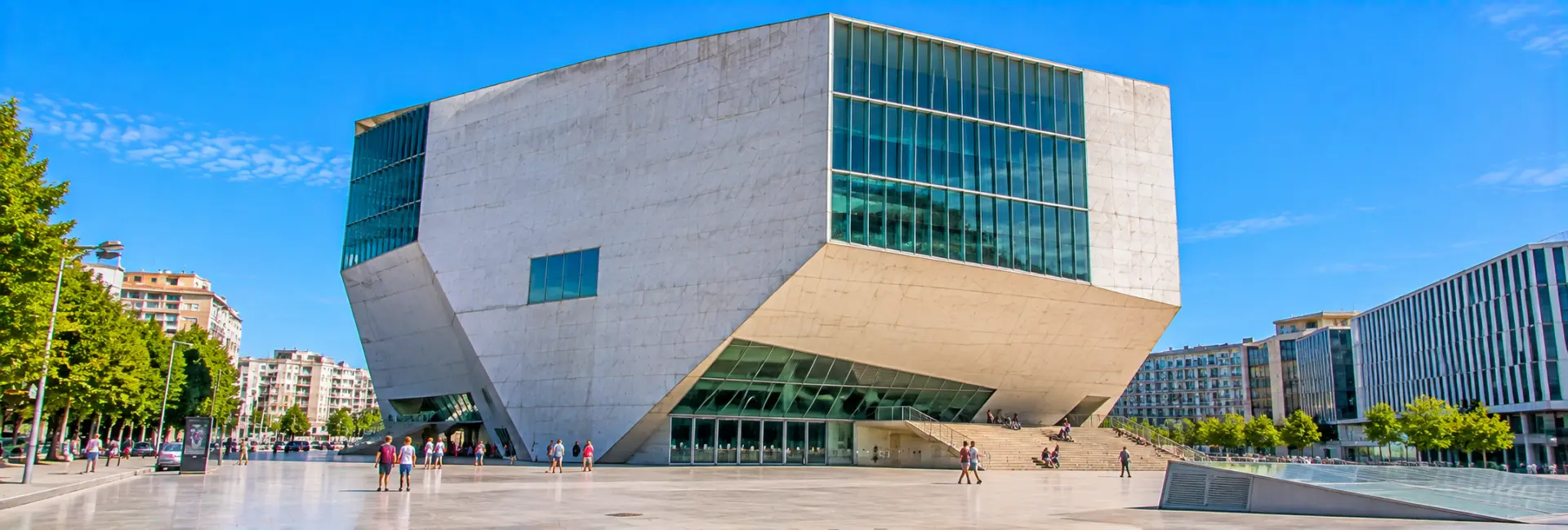
Casa da Música is impossible to mistake for anything else on Porto's skyline: a faceted, angular block of white concrete and glass that looks almost carved rather than built, sitting at the heart of the busy Boavista roundabout. Designed by Dutch architect Rem Koolhaas, it was the first building in Portugal created solely for music, covering everything from public concerts to music education and artistic creation under one roof.
Since opening in 2005, the building has become one of the defining works of contemporary architecture in Portugal and a genuine cultural hub rather than a monument to be admired only from outside. It houses several performance spaces, five resident ensembles and a full calendar of concerts spanning classical, jazz, electronic and world music, while its plaza and sloped public square have become an everyday gathering spot for the surrounding neighbourhood, skateboarders included.
History
A Building for the European Capital of Culture
Casa da Música was conceived in 1998, when Portugal's Ministry of Culture announced plans for a dedicated music venue to mark Porto's year as European Capital of Culture in 2001. An international architecture competition followed, and in 1999 the commission went to Rem Koolhaas and his firm, the Office for Metropolitan Architecture, working alongside engineers from Arup and the Porto firm Afassociados.
From Tram Depot to Concert Hall
The chosen site, decided in March 1999, was the former Remise do Porto, an old tram terminus and depot at the Rotunda da Boavista, a location that placed the new building right on the boundary between the historic city centre and a more workaday residential district. Construction began that same year, but the project ran well past its original 2001 deadline, and Casa da Música was not inaugurated until 15 April 2005, in a ceremony attended by the Portuguese president, at a total cost of around 100 million euros.
An Unlikely Design Origin
The building's distinctive form has an unusual backstory: at the time of the competition, Koolhaas's office was already developing an unrealised private villa design known as "Y2K" for a Dutch client. The architects adapted that house's layout and internal voids to a much larger scale, and the villa's central living room evolved into what became Casa da Música's main concert hall, complete with the two great glazed openings that let the hall look out over the city.
Architecture & Design
Clad largely in white concrete with sections of corrugated glass, Casa da Música takes the form of an irregular polyhedron, its faceted planes cut at sharp, seemingly random angles that give the building a crystalline, almost sculptural quality. That deliberate irregularity was a conscious departure from the closed, boxy concert halls of the past, and it announced early on that Casa da Música would treat music-making as something to be seen and experienced from multiple angles rather than sealed away.
The building's structural engineering, developed with Cecil Balmond, had to accommodate the demands of that unconventional shape, including a main hall suspended within the larger volume and large uninterrupted spans free of visible support. Inside, interior designer Petra Blaisse of Inside Outside shaped finishes ranging from gold-leaf woodgrain surfaces in the main auditorium to bold colour schemes used to distinguish the building's smaller rooms, giving each space its own identity within the larger structure.
Inside Casa da Música
Sala Suggia
The building's centrepiece is the Sala Suggia, a grand auditorium seating around 1,238 people across floors two to four. Lined with warm golden wood panelling and soft fabric surfaces, the hall is unusual among concert venues worldwide for its two glazed end walls, which let daylight or the lit-up city skyline become part of the concert experience, so audiences can watch both the performance on stage and Porto itself through the glass.
Sala 2 and the Smaller Rooms
A second, more flexible hall known as Sala 2 occupies the fifth floor, distinguished by its dramatic red colour scheme, flat floor and lack of fixed seating, which lets it host anything from rock and jazz concerts to conferences and family-friendly performances, with capacity for up to around 650 people standing. Elsewhere in the building, smaller rooms such as the aqua-toned Cibermúsica space and colour-coded education rooms support workshops, rehearsals and children's programming.
The VIP Room and Terrace
On the upper floors, the VIP Room functions as a kind of architectural calling card for the building, its walls covered in hand-painted azulejo tile panels that reference the shared ceramic traditions of Portugal and the Netherlands, a nod to Porto and Rotterdam's joint status as European Capitals of Culture in 2001. Just above it, the VIP Terrace, originally intended as a purely technical space, was reworked during construction into an unusual indoor plaza topped by a mechanically operated skylight, used today for talks, receptions and informal gatherings.
Resident Orchestras & Programming
Casa da Música is home to five resident ensembles that anchor its year-round programming: the Orquestra Sinfónica do Porto Casa da Música, which holds national orchestra status, the contemporary-music specialists of the Remix Ensemble, the Orquestra Barroca performing on period instruments, and the Coro Casa da Música and Coro Infantil choirs. Between them, they cover repertoire from Baroque and Classical works through to newly commissioned contemporary pieces.
Beyond its resident groups, the building's calendar regularly mixes classical concerts with jazz, fado, electronic and world music performances, along with themed festivals held at different points in the year. An extensive education programme brings in around a thousand events annually, ranging from concerts for babies and young children to workshops designed to introduce new audiences to music and to the building itself.
Ways to Experience It
Attending a Concert
Hearing a performance in the Sala Suggia is widely considered the best way to experience the building, since the glazed end walls mean the hall itself becomes part of the show, framing the surrounding city behind the performers. Tickets for the resident orchestras and visiting artists are sold through the venue's own box office and website, with prices varying considerably by event.
Guided Tours
For visitors not attending a concert, guided tours run regularly and take in the building's public halls, some of its more unusual rooms and, on many tours, areas not normally open to the public, giving a sense of the architectural logic behind Koolhaas's design. Tours are typically offered in several languages, and larger groups are generally asked to book in advance.
- Concerts across classical, jazz, electronic and world music, most weeks of the year
- Regular guided tours of the building's public and backstage spaces
- Family and children's programming through the Casa Educa initiative
- Free access to the surrounding public square, popular with skateboarders and passersby
Best Time to Visit
Because Casa da Música functions first as a working concert hall, the richest way to experience it is on a night with a performance in the programme, when the building is at its most animated and the Sala Suggia's glazed walls come into their own after dark, framing the illuminated city outside. Checking the online programme in advance makes it possible to plan a visit around a specific genre or ensemble.
For those more interested in the architecture itself, daytime hours are better suited to a guided tour, when natural light fills the interior and the building's sharp angles and concrete surfaces are easiest to appreciate both inside and out. The exterior plaza and public square can be visited at any time, and are a natural stop when exploring the wider Boavista area on foot.
Visitor Tips
- Book concert tickets online in advance for popular performances, since the Sala Suggia's roughly 1,200 seats can sell out for headline events
- Guided tours are offered in multiple languages, but exact times can vary by day, so check the current schedule before arriving
- The building is certified accessible, with resources in place to assist visitors with reduced mobility
- The surrounding square and plaza are free to explore even without a concert or tour ticket
- Casa da Música is a short walk or metro ride from central Porto, making it easy to combine with a day of sightseeing in the historic centre
- Arrive a little early for concerts to take in the building's public foyers, which are part of the overall experience
Nearby Attractions
Casa da Música sits in the Boavista district, an area better known for modern architecture and business than for Porto's medieval core, but still within easy reach of several other cultural stops. The Centro Português de Fotografia and the Museu Soares dos Reis, one of Portugal's oldest art museums, are both a short walk away, offering a contrasting look at the city's artistic heritage.
From Casa da Música, Porto's historic centre, with its riverside Ribeira district, the Clérigos Tower and the city's famous port wine cellars across the Douro in Vila Nova de Gaia, is easily reached by metro or a longer walk, making the building a natural starting or end point for a broader day exploring Porto.
FAQs about visiting Casa da Música
What is Casa da Música? +
It's a concert hall and cultural centre in Porto designed by architect Rem Koolhaas, the first building in Portugal created exclusively for music, combining public concert halls with education and rehearsal spaces.
When did Casa da Música open? +
It was inaugurated on 15 April 2005, several years after originally being planned to coincide with Porto's year as European Capital of Culture in 2001.
Can you visit Casa da Música without attending a concert? +
Yes, regular guided tours let visitors explore the building's public halls and several distinctive rooms even without buying a concert ticket.
How many concert halls does the building have? +
The two main performance spaces are the Sala Suggia, seating around 1,238 people, and the smaller, more flexible Sala 2, along with several additional rooms used for workshops, rehearsals and events.
What makes the Sala Suggia unusual? +
Its two end walls are glazed rather than solid, meaning concertgoers can see the city of Porto through the glass while a performance is underway, a rare feature among concert halls worldwide.
Which orchestras perform at Casa da Música? +
Five resident ensembles are based there, including the Orquestra Sinfónica do Porto Casa da Música, the contemporary-focused Remix Ensemble, the period-instrument Orquestra Barroca, and two resident choirs.
Is the public square outside free to visit? +
Yes, the sloped plaza and square surrounding the building are open public space at any time, popular with skateboarders and a common meeting point in the neighbourhood.
Where is Casa da Música located? +
It stands at the Rotunda da Boavista in Porto's Boavista district, on the site of a former tram depot, a short metro ride from the city's historic centre.
Is Casa da Música accessible for visitors with reduced mobility? +
Yes, the building holds an accessibility certification confirming that it has the technical resources in place to support visitors with reduced mobility or disabilities.