Table of Contents
Overview
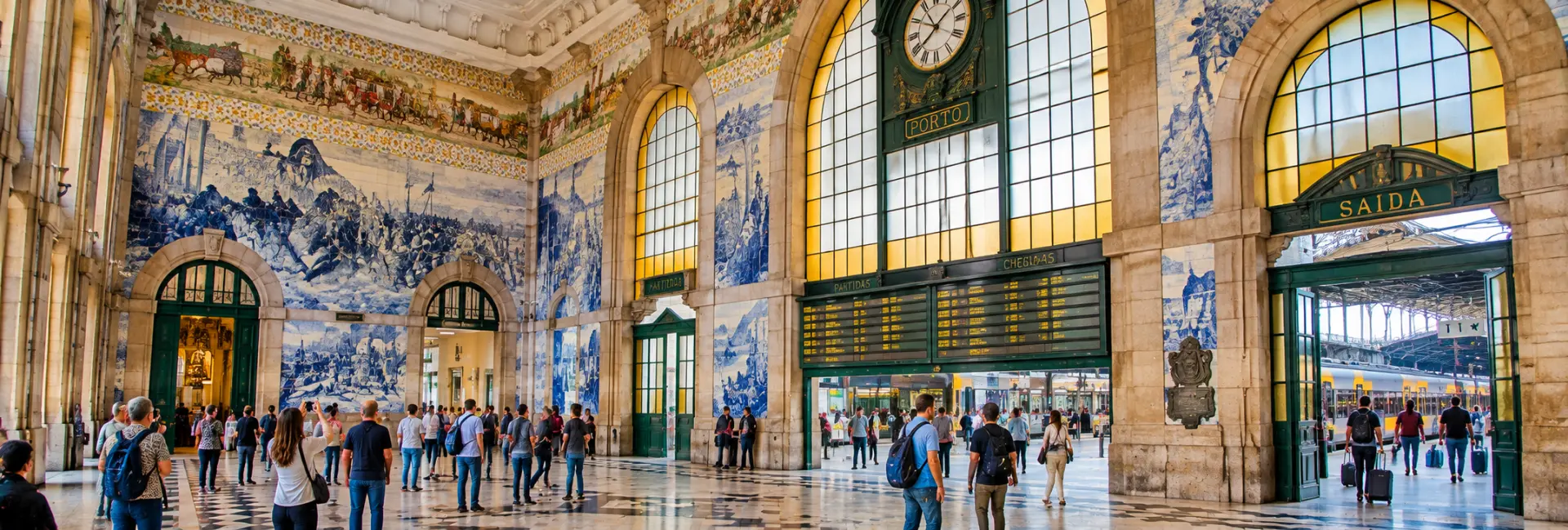
São Bento Railway Station sits in the heart of central Porto, a working train terminal that also ranks among the most visited free attractions in the city. Its plain stone exterior gives little hint of what waits inside, where the main atrium is lined floor to ceiling with roughly 20,000 hand-painted ceramic tiles depicting scenes from Portuguese history.
Unlike many architectural landmarks that have been converted into museums, São Bento remains a fully functioning station, serving regional and suburban trains from platforms just beyond the tiled hall. Travelers and sightseers move through the same space side by side, giving the station an unusual character as both an everyday transit point and a genuine work of public art.
History
Built on monastery grounds
The station takes its name from the Benedictine monastery of São Bento de Avé-Maria, which had stood on the site since the 16th century before being destroyed by fire in 1783 and later demolished as the site was cleared for Porto's growing railway network. The first stone of the new station was laid by King Carlos I in 1900, connecting the project directly to the Portuguese monarchy of the period.
A long construction
Designed by Portuguese architect José Marques da Silva in the French Beaux-Arts style, the station took over a decade to complete, finally opening to the public in 1916. Its tiled interior took even longer to finish, with artist Jorge Colaço mounting the station's signature azulejo panels over an eleven-year period between 1905 and 1916.
Recognition and restoration
The station underwent conservation and restoration work in 2010, and the following year Travel and Leisure magazine named it one of the most beautiful railway stations in the world, cementing its reputation well beyond Portugal. It sits within Porto's historic center, part of the wider UNESCO World Heritage Site inscribed in 1996.
Architecture & Design
The station's exterior reflects the French Beaux-Arts style favored for major public buildings in the early 20th century, built in solid granite with a restrained, formal facade that gives little indication of the ornate interior beyond its doors. Marques da Silva, one of Porto's most significant architects of the period, designed the building to serve as both a functional transport hub and a civic showpiece for the city.
Inside, the atrium opens into a grand hall where the architecture recedes almost entirely behind the tilework covering its walls, a deliberate design choice that turns the entrance itself into the station's primary attraction.
The Azulejo Tile Panels
The station's main hall is covered with around 20,000 individual azulejo tiles, together forming roughly 551 square metres of painted ceramic surface, one of the largest such installations in the world. Artist Jorge Colaço designed and painted the panels in traditional blue and white, working over more than a decade to complete the full scheme.
- Large historical panels depict pivotal moments in Portuguese history, including the Battle of Valdevez in 1140 and the Conquest of Ceuta in 1415.
- A scene showing the arrival of King John I and Philippa of Lancaster in Porto in 1387 marks a significant royal and diplomatic moment tied directly to the city.
- Smaller, colorful panels depict rural and ethnographic scenes, showing everyday life and traditional dress from different regions of Portugal.
- A decorative frieze running around the hall traces the evolution of transportation, tying the artwork's subject matter back to the building's function as a train station.
Using the Station Today
São Bento continues to operate as an active station, serving regional and suburban lines including routes to Braga, Guimarães, Aveiro, and the scenic Douro Line running along the river valley. Longer-distance intercity and international trains generally use Porto's larger Campanhã station instead, with São Bento connected to it by a short regional rail link.
An underground passage links the station directly to the São Bento stop on the Porto Metro's Line D, making it a convenient interchange point for visitors moving between rail and metro travel in the city center.
Ways to Experience It
- Walk into the main atrium to view the azulejo panels up close, an experience that is free and requires no ticket.
- Take time to pick out specific historical scenes within the tilework, many of which are labeled or explained in guidebooks and walking tours.
- Combine a visit with an actual train journey along the Douro Line, one of Portugal's most scenic regional rail routes, departing from the same station.
- Join a walking tour of central Porto that includes the station as one of several architectural and historical stops.
Best Time to Visit
Because it is a working train station, São Bento is at its calmest outside of morning and evening commuting hours, when fewer travelers are moving through the main hall. Weekday mid-mornings and early afternoons tend to offer the clearest view of the tilework without needing to navigate around rush-hour crowds.
The station is indoors and unaffected by weather, making it a reliable stop regardless of the season, and its central location means it is easy to combine with a visit to nearby Clérigos Tower or Livraria Lello on the same walk.
Visitor Tips
- Viewing the main hall and its tiles is free, since the space functions as a public station concourse rather than a ticketed attraction.
- The station is a functioning transit hub, so visitors should be mindful of travelers moving through the hall with luggage.
- Photography is generally permitted in the atrium, though it is worth being considerate of other passengers when taking pictures.
- The station connects directly to the Porto Metro, making it a convenient stop to combine with a wider day of sightseeing by public transport.
- For those planning to ride the Douro Line, tickets can be purchased directly at the station before departure.
Nearby Attractions
- Livraria Lello, the well-known bookstore, is a short walk from the station in the same central district.
- Clérigos Tower rises nearby and can easily be combined with a station visit on foot.
- Porto Cathedral sits within walking distance downhill toward the Douro.
- The Avenida dos Aliados, Porto's main civic avenue, begins a short distance from the station's main entrance.
FAQs about visiting São Bento Railway Station
Is it free to visit São Bento Railway Station? +
Yes, walking into the main atrium to see the azulejo tile panels is free, since the space is a public station concourse rather than a ticketed attraction.
How many tiles are inside São Bento Railway Station? +
The main hall is covered with approximately 20,000 individual azulejo tiles, covering around 551 square metres of wall space.
Who painted the tiles at São Bento Station? +
The tiles were designed and painted by Portuguese artist Jorge Colaço, who completed the work over an eleven-year period between 1905 and 1916.
What historical scenes are shown on the tiles? +
The panels depict events including the Battle of Valdevez in 1140, the arrival of King John I and Philippa of Lancaster in Porto in 1387, and the Conquest of Ceuta in 1415, alongside rural and ethnographic scenes.
Can I take a train from São Bento Station to the Douro Valley? +
Yes, the scenic Douro Line, one of Portugal's most popular regional rail routes, departs from São Bento Station.
Is São Bento Station the same as Porto Campanhã? +
No, they are separate stations. São Bento mainly serves regional and suburban trains in the city center, while longer-distance intercity and international trains generally use Porto Campanhã station.
How do I get to São Bento Station from central Porto attractions? +
The station is centrally located and within easy walking distance of Clérigos Tower, Livraria Lello, and Porto Cathedral, and is also connected to the Porto Metro's Line D.