Table of Contents
Overview
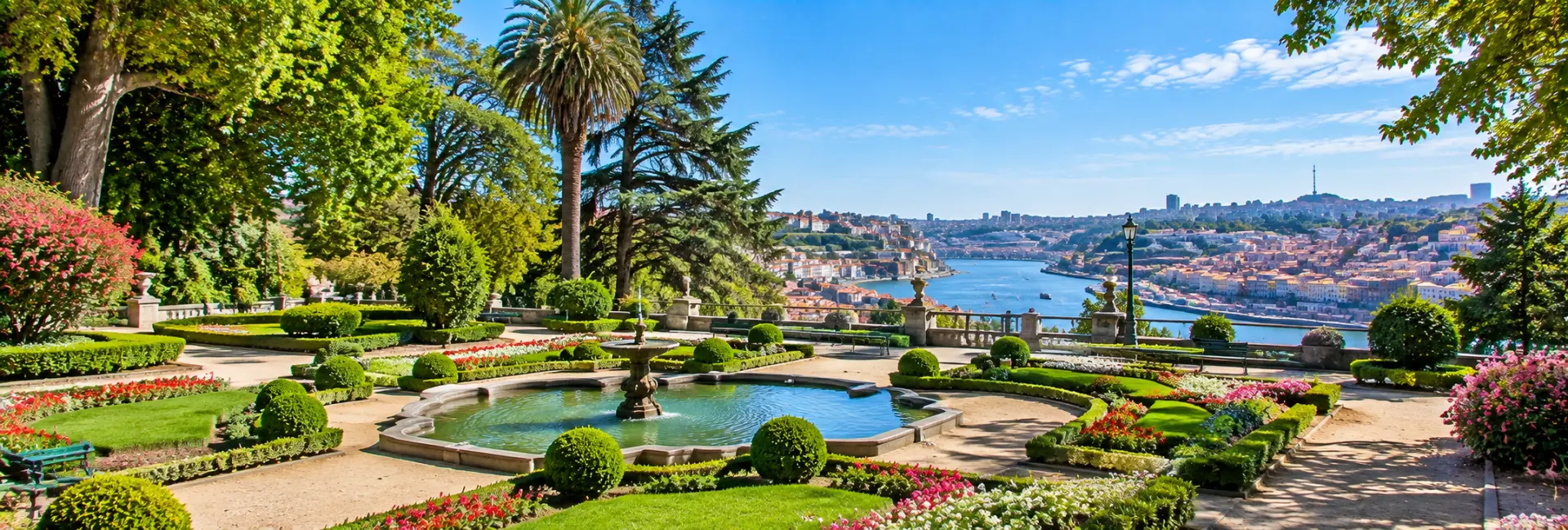
The Jardins do Palácio de Cristal sit on a bluff above the Douro River, a short walk west of Porto's historic centre. Spread across roughly eight hectares of terraced lawns, groves and flowerbeds, the park is one of the city's best-loved green spaces and a favourite spot for locals to walk, picnic or simply watch the sun set over the river.
The gardens take their name from a 19th-century glass-and-iron pavilion that once stood at their centre, built for an international exhibition in 1865. Although that structure is long gone, the romantic landscape planted around it has survived largely intact, mixing formal flowerbeds with looser, wooded areas and framing some of the widest panoramic views in Porto.
History
A Riverside Lookout
Long before the gardens existed, this hilltop was known as the Campo da Torre da Marca, named for a tower that once stood here to help guide ships safely into the mouth of the Douro. In the mid-19th century, a small memorial chapel was added to the site in honour of Charles Albert of Sardinia, the exiled King of Piedmont-Sardinia, who died in Porto not long after arriving following his defeat at the Battle of Novara.
The Crystal Palace and the 1865 Exhibition
Construction of the original Palácio de Cristal began in 1861, following a design by the English architect Thomas Dillon Jones with engineering by Francis Webb Sheilds. Built from granite, iron and glass, and directly inspired by London's Crystal Palace, the pavilion opened on 18 September 1865 to host the Porto International Exhibition, which drew thousands of exhibitors from across Europe and Brazil. The German landscape architect Émile David laid out the surrounding gardens at the same time, in what was his first major commission in the city.
Demolition and a New Landmark
Upkeep of the glass pavilion proved costly, and after the exhibition years the building settled into a quieter life as a venue for concerts and smaller shows before falling into disrepair. The site eventually passed to Porto's municipal council in 1933, and the original structure was demolished in 1951. A domed sports pavilion rose in its place to host the 1952 World Roller Hockey Championship, drawing a new kind of public event to the same hilltop that had once staged an international exhibition.
That pavilion was later renamed the Pavilhão Rosa Mota, after the Portuguese Olympic marathon champion, and today it is known commercially as the Super Bock Arena following a thorough renovation completed in 2019. Its concrete dome remains visible from across the park and now hosts concerts, trade fairs and sporting events rather than the world's fair exhibits the site once welcomed. The gardens surrounding it, by contrast, have kept much of their original 19th-century layout for well over a century, making the park an unusually long-lived example of Portuguese romantic landscape design.
The Gardens & Landscape Design
Émile David shaped the site's steep hillside into a series of terraces, connecting them with paths that descend gradually toward the river. His plan deliberately combined two contrasting styles: neatly geometric flowerbeds close to the main entrance, and looser, more naturalistic woodland further from the centre, giving the park a layered, almost storybook character as visitors move through it.
Throughout the grounds, artificial grottoes, ponds and fountains sit alongside sculptures and shaded avenues. The Avenida das Tílias, lined with lime trees, and the Avenida dos Plátanos, lined with plane trees, form the park's main axes, while camellias, rhododendrons, araucarias, ginkgos, magnolias, beeches, olives and cypresses fill out the planting. Many of these specimens have had well over a century to mature, giving parts of the park a genuinely old-growth feel that's unusual to find this close to a city centre.
The terraced design also does double duty as a viewing platform. Because the hillside steps down toward the Douro rather than dropping in a single slope, several of the balconies and clearings along the way open onto framed views of the river and the rooftops of Vila Nova de Gaia on the opposite bank, so the walk down through the garden becomes a slow reveal of the city rather than a single lookout point.
- Terraced hillside layout descending toward the Douro
- Formal beds near the entrance, informal woodland further in
- Grottoes, ponds, fountains and sculptures throughout
- Two tree-lined avenues forming the main circulation routes
Themed Gardens & Key Areas
Rather than one continuous lawn, the park is broken into a series of smaller themed gardens, each with its own character. Near the main entrance, the Jardim Émile David centres on fountains and a set of statues representing the four seasons. Elsewhere, visitors can wander through a rose garden, a garden devoted to aromatic herbs, and one planted with medicinal species.
On the park's western side, the Bosque das Camélias, or Camellia Wood, showcases the more informal side of David's design and is at its best when the camellias bloom in late winter and early spring. Camellias also appear throughout the rest of the park, particularly along the path linking the central pavilion to the rose garden, which means the flowering season plays out gradually across several areas rather than all at once. A smaller garden known as the Jardim dos Sentimentos holds a sculpture titled "Dor" ("Pain") by the Portuguese sculptor Teixeira Lopes, adding a reflective note to this corner of the grounds, in contrast to the brighter, more ornamental character of the rose garden and the seasonal statues nearby.
- Jardim Émile David – fountains and four-seasons statues
- Roseiral – the park's dedicated rose garden
- Bosque das Camélias – informal woodland, best in late winter/spring
- Aromatic and medicinal plant gardens
- Jardim dos Sentimentos – home to the sculpture "Dor"
Notable Landmarks & Cultural Venues
Capela de Carlos Alberto
This small chapel was commissioned in the mid-1850s by Princess Augusta of Montléart as a memorial to Charles Albert of Sardinia. It stands as one of the few structures on site that predates the Crystal Palace itself, tucked along the Avenida das Tílias.
Biblioteca Municipal Almeida Garrett
Also facing the Avenida das Tílias, this municipal library houses the Galeria Municipal do Porto, a public gallery that hosts rotating exhibitions of contemporary art. It's a popular stop for visitors looking to pair the greenery outside with something cultural indoors.
Concha Acústica
An open-air acoustic shell sits along the same avenue, used over the years for concerts, theatre and other outdoor performances that bring the park to life beyond its usual quiet daytime rhythm.
Pavilhão Rosa Mota / Super Bock Arena
Standing on the exact footprint of the original Crystal Palace, this domed arena is the park's most visible modern landmark. While it now functions as a commercial concert and events venue rather than a garden feature in its own right, its dome is a useful orientation point when navigating the different themed areas around it.
Ways to Experience It
Most visitors simply wander the paths at their own pace, moving between the themed gardens, the viewpoints and the shaded avenues. Because entry is free and the park has multiple gates, it also works well as a shortcut or a rest stop for anyone exploring this part of Porto on foot.
Beyond a simple stroll, the park regularly doubles as a venue for public life in this part of the city. Book fairs, traditional games days and children's events have all been held on its lawns over the years, alongside open-air concerts staged either at the Concha Acústica or across the wider grounds, so a visit timed around one of these can turn a quiet walk into a livelier outing.
- Self-guided walking through the themed gardens and terraces
- Photography from the panoramic viewpoints over the Douro
- Exhibitions at the Galeria Municipal do Porto inside the library
- Concerts and outdoor events at the Concha Acústica or wider park during the year
- Combining a visit with the neighbouring Museu Romântico and Solar do Vinho do Porto
Best Time to Visit
Late winter into spring is the best window for garden enthusiasts, when the camellias and rhododendrons are in bloom across the Bosque das Camélias and the Jardim Émile David. For photography and views, aim for the late afternoon, when the light over the Douro and Vila Nova de Gaia is softest and the terraces are less crowded.
The park is well suited to a visit at almost any time of year, since much of its appeal lies in the mature trees and layered garden design rather than any single seasonal highlight. As with any city park, opening hours can shift with the seasons, so it's worth checking the current schedule before planning a visit.
Visitor Tips
- Entry to the gardens themselves is free
- Set aside roughly 1.5 to 2 hours to explore the different themed areas at a relaxed pace
- Wear comfortable shoes, since the terraced paths involve gentle but repeated changes in elevation
- Peacocks and ducks roam freely around the grounds; admire them from a distance rather than feeding them
- Trams 1 and 18, along with several city bus routes, stop within easy walking distance
- Check current opening hours and any scheduled events before visiting, since these can change with the season
Nearby Attractions
Immediately next to the gardens, the Quinta da Macieirinha houses the Museu Romântico, a house museum furnished in period style, along with the Solar do Vinho do Porto, a Port wine institute where visitors can sample local wines. A short walk further along Rua de Dom Manuel II leads to the Museu Nacional Soares dos Reis, one of Porto's principal art museums, while the riverside neighbourhoods of the historic centre are within easy reach by tram or on foot.
FAQs about visiting the Jardins do Palácio de Cristal
What are the Jardins do Palácio de Cristal? +
They're a terraced hillside garden in central Porto, laid out in the 1860s around a glass-and-iron exhibition pavilion that has since been replaced by a domed sports arena; the gardens themselves remain one of the city's most popular green spaces.
Is there an entrance fee? +
No, the gardens are free to enter; only certain venues nearby, such as the Museu Romântico, charge separate admission.
How much time should I plan for a visit? +
Around 1.5 to 2 hours is enough to walk through the main themed gardens, take in the viewpoints and enjoy a slower pace without feeling rushed.
What happened to the original Crystal Palace? +
The 19th-century glass-and-iron pavilion was demolished in 1951 after decades of high upkeep costs, and a domed sports pavilion, later renamed the Pavilhão Rosa Mota, was built in its place.
When is the best time to visit? +
Late winter and spring bring the camellias and rhododendrons into bloom, while late afternoon offers the softest light for the panoramic views over the Douro; the gardens are pleasant year-round.
How do I get there? +
Trams 1 and 18 stop nearby, along with several STCP city bus routes, and the gardens are also an easy uphill walk from Porto's historic centre.
Is it suitable for families and visitors with limited mobility? +
Families tend to enjoy the open lawns and the peacocks and ducks that roam the grounds, though the terraced, sloped layout involves some uneven paths and gentle inclines that are worth keeping in mind for anyone with mobility needs.
What else can I combine with a visit? +
The neighbouring Museu Romântico and Solar do Vinho do Porto sit right next door, and the Museu Nacional Soares dos Reis is a short walk away along the same street.