Table of Contents
Overview
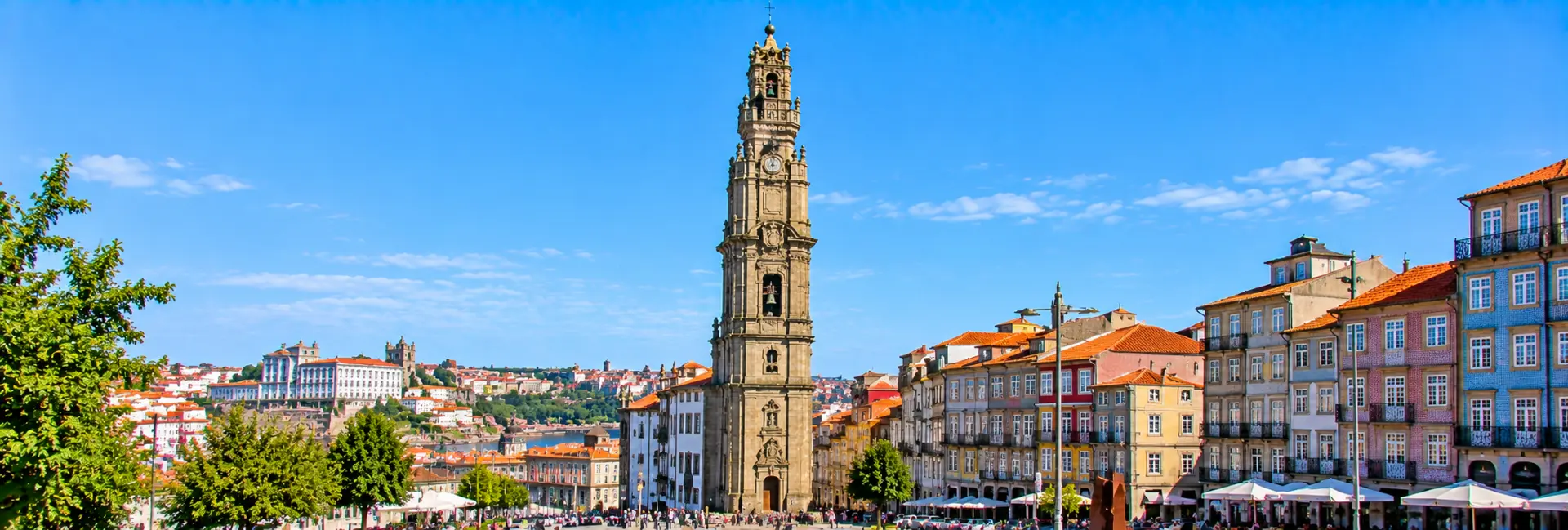
The Clérigos Tower rises from the top of a hill in central Porto, its slender granite form visible from streets and rooftops across much of the city. Designed by the Italian architect Nicolau Nasoni and completed in 1763, it remains the tallest bell tower in Portugal and one of the most recognized symbols of Porto's skyline.
Beyond the tower itself, the site includes an unusually shaped oval church and a small museum housed in the former brotherhood building, together forming a single complex that traces both Nasoni's architectural career and the charitable order that commissioned it. A climb to the top remains one of the most popular things to do in Porto, rewarded with a sweeping panorama over the city's rooftops and the Douro beyond.
History
A brotherhood's commission
The Clérigos complex was commissioned by the Brotherhood of the Clérigos, formed in 1707 through the merger of three earlier charitable organizations dedicated to caring for Porto's poor. The brotherhood was granted a plot of land at the top of a hill just outside the city's old walls, where it set out to build a church grand enough to reflect its ambitions.
Nasoni's masterwork
Italian architect Nicolau Nasoni, who had settled in Porto and shaped much of the city's baroque architecture, was commissioned to design the church, with construction running from 1732 to 1750. The building survived the major earthquake that devastated Lisbon in 1755 largely intact, a fact often cited as a testament to the strength of Nasoni's design.
Building the tower
Construction of the freestanding bell tower began in 1754 and finished in 1763, later than the church itself due to funding that depended entirely on donations from the clergy and public. The original plans called for two symmetrical towers, but the design was scaled back to a single tower as costs were weighed against available funds. At its completion, the roughly 75-metre tower was the tallest building in Portugal, a record that held for the bell tower category for generations afterward.
Architecture & Design
The Clérigos Church is built on an unusual oval floor plan, a rare choice for church architecture that gives the interior an intimate, curved quality distinct from the long rectangular naves typical of the period. Baroque detailing throughout the church and tower reflects Nasoni's wider body of work in Porto, which also includes the loggia of Porto Cathedral and the Church of Mercy.
The tower itself rises through a series of rhythmic stages marked by baroque ornamentation, growing gradually more delicate toward the top, where a spherical clock house crowns the structure. Its granite construction and slender proportions were a deliberate departure from heavier, more solid bell towers built elsewhere in Portugal at the time.
Climbing the Tower
An interior spiral staircase of more than 200 steps winds up through the tower's six levels to the belfry near the top, where visitors are rewarded with a 360-degree panoramic view over Porto's rooftops, the Douro River, and Vila Nova de Gaia across the water. The narrow stairwell can be a tight fit when visitors are passing in both directions, so the climb is generally taken at an unhurried pace.
The tower houses a carillon of 49 bells, a large enough set to produce full melodic tunes rather than simple chimes, and the bells remain functional as part of the church's ongoing use. In 1917, the tower gained an unusual footnote in its history when two Spanish acrobats known as the Puertullanos, a father and son, climbed its exterior in front of a large crowd, a feat still recounted in guides to the tower today.
The Church & Museum
Entry to the complex includes access to the Clérigos Church, where visitors can view Nasoni's oval nave from an elevated gallery, taking in the richly carved altarpiece and gilded woodwork from above rather than only at ground level. Nasoni himself, who joined the Clérigos brotherhood in his later years, is buried in an unmarked tomb somewhere within the church's crypt, at his own request.
The former Casa da Irmandade, or Brotherhood House, has been converted into the Clérigos Museum, displaying a collection of religious art and historical objects connected to the brotherhood's centuries of charitable work in the city.
Ways to Experience It
- Climb the tower's interior staircase for a 360-degree view over Porto and the Douro from the belfry level.
- Visit the church's elevated gallery for a view down into Nasoni's oval nave and its baroque altarpiece.
- Explore the Clérigos Museum for a closer look at religious art and artifacts connected to the Brotherhood of the Clérigos.
- Visit during extended evening hours in peak season, when the tower opens after dark for a different perspective on the illuminated city.
Best Time to Visit
Clear days offer the best reward for the climb, since the view from the top depends heavily on visibility across the city and toward the river. Early morning or the hour before closing tend to be quieter times to climb, avoiding the middle of the day when the tower draws its largest crowds.
During Easter and the summer peak season, the tower opens for extended evening hours, offering a chance to see Porto lit up at night from the top, a markedly different experience from a daytime visit.
Visitor Tips
- A single ticket covers the tower, church, and museum, making it worth allowing time for all three rather than rushing straight to the climb.
- The staircase is narrow and can involve waiting for other visitors to pass, so those with mobility concerns or a fear of tight spaces should consider this before climbing.
- Comfortable shoes are worth wearing given the number of steps involved in reaching the top.
- Booking tickets online in advance can reduce waiting time, particularly in peak season.
- The tower sits at the top of a hill, so the walk up from lower parts of the city adds to the overall effort of a visit.
Nearby Attractions
- Livraria Lello, the famed bookstore, is a short walk from the tower along the same cluster of central streets.
- The buildings of the University of Porto sit close by, within easy walking distance.
- Porto Cathedral, which also carries Nasoni's architectural influence in its loggia, is a walkable distance downhill toward the river.
- Porto's main shopping streets and cafes surround the base of the hill on which the tower stands.
FAQs about visiting Clérigos Tower
How many steps are there to the top of Clérigos Tower? +
There are just over 200 steps leading up the tower's interior spiral staircase to the belfry level near the top.
How tall is Clérigos Tower? +
The tower stands at roughly 75 to 76 metres, making it the tallest bell tower in Portugal.
Who designed Clérigos Tower? +
It was designed by the Italian architect Nicolau Nasoni, who also designed the adjoining Clérigos Church and contributed to other Porto landmarks including Porto Cathedral's loggia.
Is a ticket to Clérigos Tower also valid for the church and museum? +
Yes, a single ticket typically covers entry to the tower, the Clérigos Church gallery, and the Clérigos Museum.
Is Clérigos Tower open at night? +
During Easter and the summer peak season, the tower extends its hours into the evening, allowing visitors to see the city lit up at night from the top.
Why is the Clérigos Church oval shaped? +
Its architect, Nicolau Nasoni, chose an unusual oval floor plan for the church, a rare design choice for the period that gives the interior a more intimate, curved character than a typical rectangular nave.
Is climbing Clérigos Tower difficult? +
The climb involves over 200 steps up a narrow spiral staircase, which can be tiring and involves passing other visitors, but is manageable for most visitors in reasonable health.