Table of Contents
Overview
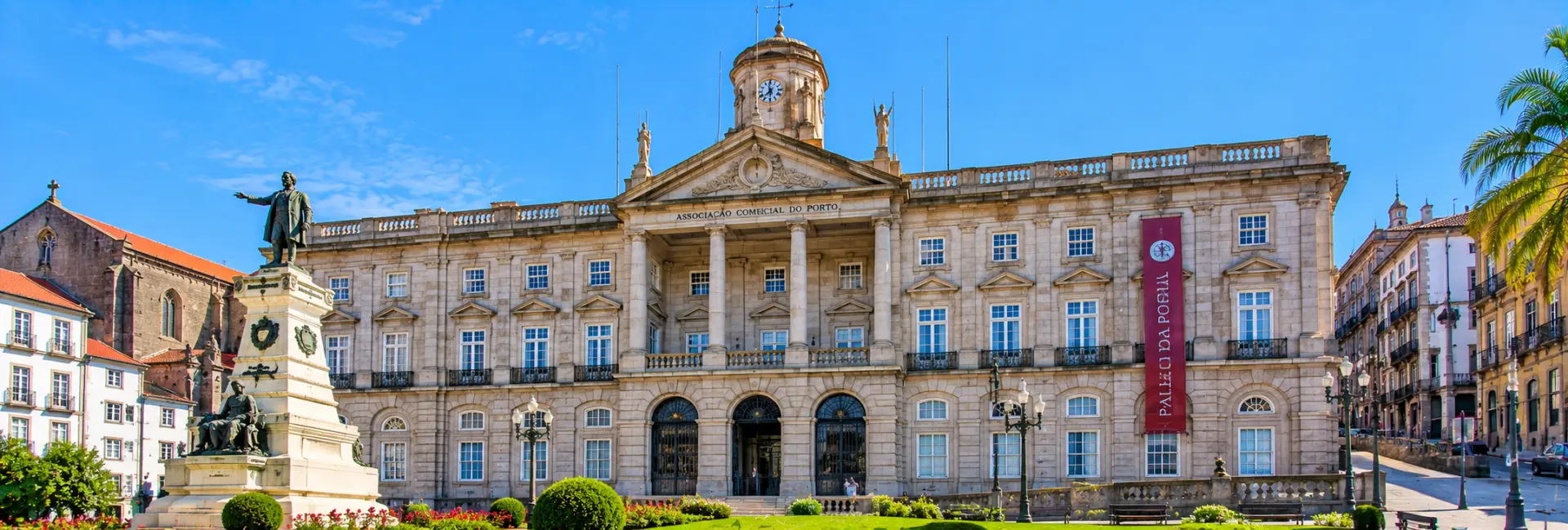
Palácio da Bolsa, the Stock Exchange Palace, stands in the heart of Porto's historic center, right beside the Gothic Church of São Francisco. From the street its grey granite facade looks calm and businesslike, which makes what waits inside all the more surprising.
The building was raised in the 19th century as the headquarters of Porto's Commercial Association, and it still serves that role today. Its main courtyard, grand staircases and a sequence of richly decorated halls were built to impress visiting merchants and dignitaries, and they still have that effect on modern visitors.
The undisputed highlight is the Arab Room, a ballroom covered almost entirely in gilded, Moorish-inspired plasterwork. Because the palace remains a working institution, the interior can only be seen on a guided tour, which adds a bit of ceremony to the whole experience. It sits within Porto's historic centre, a UNESCO World Heritage Site, and ranks among the city's most visited landmarks.
History
From Convent to Ruin
The site once belonged to the Convent of São Francisco. During the Liberal Wars, a fire in 1832 destroyed the convent's cloisters, though the adjoining Gothic church survived and still stands next door. Two years later, religious orders were suppressed across Portugal, which freed the ruined land for other use.
A Palace for Porto's Merchants
In 1841 Queen Mary II donated the site to the city's merchants, who wanted a proper home for their commercial association after being forced to trade in the open air. The first stone was laid on October 6, 1842, and architect Joaquim da Costa Lima drew up a neoclassical design influenced by the Palladian tradition.
A Very Long Build
Most of the exterior was finished by around 1850, but decorating the interior took far longer. Several architects and artists worked on the palace over the following decades, among them Gustavo Adolfo Gonçalves e Sousa, Tomás Augusto Soller, José Marques da Silva and sculptors Soares dos Reis and Teixeira Lopes. The building was not considered complete until 1910, some 68 years after construction began. It was classified as a National Monument in 1982.
Architecture & Design
A Restrained Exterior
The facade is deliberately sober: grey granite, careful symmetry and a columned entrance, in a neoclassical style with Palladian influence. It was meant to project the confidence and stability of a serious financial institution, without hinting at the elaborate rooms hidden behind it.
The Pátio das Nações
Just past the entrance lies the Pátio das Nações, or Hall of Nations, which served as the original trading floor. It is topped by a large glazed dome on a metal frame, designed by Tomás Soler and built from 1880, that fills the space with natural light. The coats of arms of trading-partner nations decorate the walls, a reminder of the room's original commercial purpose.
A Building That Kept Growing
Because construction stretched across decades, the palace absorbed the changing tastes of the 19th century. Neoclassical structure gives way to increasingly ornate interiors as you move deeper into the building, culminating in the exotic style of the Arab Room. That contrast between plain shell and lavish interior is part of what makes a visit so memorable.
The Arab Room
The Salão Árabe, or Arab Room, is the reason many visitors come to Palácio da Bolsa in the first place. Designed by Gustavo Adolfo Gonçalves e Sousa, it draws on the Alhambra Palace in Granada and took eighteen years to complete, from 1862 to 1880.
Every surface is covered in ornament: stucco arabesques, gilded plasterwork and inscriptions rendered in a Moorish revival style. Thousands of small gilded details cover the walls and ceiling, giving the whole room a warm, glowing quality. In keeping with the Islamic art tradition it references, the decoration favors geometric and plant-based patterns rather than figures of people or animals.
The floor is made of fine woods, including mahogany and rosewood, laid in detailed patterns. Historically the room hosted concerts, balls and official receptions, and it has welcomed heads of state and other dignitaries over the years. It remains the grand finale of the guided tour and the room most visitors remember best.
Other Notable Rooms
- Sala dos Retratos: the Portrait Room, decorated in a style linked to Louis XVI, displays portraits of the last kings and queens of the House of Braganza around a large table crafted by Zeferino José Pinto.
- Tribunal do Comércio: the former Commercial Court, a formal chamber that reflects the palace's original legal and administrative functions.
- Sala do Presidente: the President's Room, used for official business and noted for its refined furnishings.
- The Grand Staircase: designed by Gonçalves e Sousa, the same architect behind the Arab Room, it leads visitors up through the building in suitably dramatic style.
- The general assembly room: still used today for meetings of the Commercial Association, a reminder that the palace is a living institution rather than a museum piece.
Cultural Significance
Palácio da Bolsa reflects a specific moment in Porto's history, when a wave of commercial prosperity during the Industrial Revolution gave local merchants the wealth and ambition to build something spectacular. The palace was meant to declare that Porto belonged among Europe's serious trading cities.
It has kept that ceremonial role ever since. Today the Commercial Association still uses parts of the building, and the palace regularly hosts official receptions for presidents, ministers and other dignitaries, continuing more than a century of tradition as one of the city's grandest reception spaces.
As part of Porto's historic centre, a UNESCO World Heritage Site, the palace also stands for the wider story of the city's growth along the Douro river, from a medieval port to an important European commercial hub. Its decoration, drawing on Islamic, French and Portuguese traditions, mirrors how open Porto's merchant class was to outside influence in the 19th century.
Ways to Experience It
Take the Guided Tour
Because the interior is only open through guided visits, the tour is really the only way to experience the palace. Groups move through the main rooms in sequence, finishing with the Arab Room, and a guide explains the history and decoration along the way. Tours run in several languages, including Portuguese, English, Spanish and French.
Look Up in the Pátio das Nações
Even amid a full tour group, it is worth pausing under the glazed dome of the Pátio das Nações to take in the ironwork and the coats of arms lining the walls.
Combine It with the Church Next Door
The Igreja de São Francisco stands immediately behind the palace and shares its history, since both sit on the site of the old convent. Many visitors tour both in a single stop.
Photograph the Exterior
The neoclassical facade and the surrounding square make for a good photograph even for visitors who skip the interior tour, especially in the softer light of early morning.
Visiting Etiquette & Tips
- The palace can only be seen on a guided tour, and there is no option for independent, self-paced visits inside.
- Tours are popular and group sizes are limited, so arrive early or reserve in advance, especially in high season.
- Ticket prices and exact tour lengths change, so check the official Palácio da Bolsa website before you go rather than relying on an older guide.
- Choose your preferred tour language when you book or purchase tickets, since each time slot runs in only one language.
- Photography inside is generally allowed, but flash and tripods may be restricted in some rooms, so check with your guide.
- Wear comfortable shoes, since the tour includes stairs and a fair amount of standing.
- The palace closes on Christmas Day and New Year's Day, and hours can shift seasonally, so confirm before planning a special trip.
- Because the tour follows a fixed route and schedule, it is not easy to skip ahead to a favorite room or linger indefinitely, so factor that into your visit.
Best Time to Visit
Time of Day
Mornings tend to draw the biggest tour groups, as many visitors arrive early to secure a same-day slot. Arriving right when the palace opens, or later in the afternoon, can mean shorter waits.
Season
Summer and other peak travel months bring the longest queues and the fullest tour schedule. Visiting in the shoulder seasons of spring or autumn usually means smaller crowds and a more relaxed pace, while still enjoying comfortable weather for exploring Porto's historic centre on foot.
Combining with Other Sights
Since a visit here revolves around a fixed tour time, it pairs well with a flexible activity either before or after, such as a walk along the riverside Ribeira district or a stop at the neighboring church.
Nearby Attractions
Palácio da Bolsa sits in the middle of Porto's riverside historic quarter, so several major sights are within easy walking distance.
- Igreja de São Francisco: the Gothic church next door, known for its extraordinarily ornate gilded woodwork.
- Ribeira district: the colorful riverside neighborhood along the Douro, a short walk downhill, lined with cafes and river cruises.
- Porto Cathedral: the city's fortress-like cathedral, roughly a ten-minute walk uphill.
- São Bento railway station: famous for its azulejo tile panels, about eight to ten minutes on foot.
- Ponte Luís I: the double-deck iron bridge across the Douro, connecting Porto to Vila Nova de Gaia and its port wine cellars.
FAQs about visiting Palácio da Bolsa
What is Palácio da Bolsa? +
It is a 19th-century neoclassical palace in Porto, built as the headquarters of the city's Commercial Association. It is best known for its lavish Arab Room and remains an active institution today.
Can I visit the palace without a guided tour? +
No, the interior can only be seen on a guided tour. There is no option to walk through independently, so plan around the tour schedule.
How much does it cost to visit? +
Admission is paid, and it usually includes the guided tour, with reduced rates for students and seniors and free entry for young children. Prices and conditions change, so check the official website before you go.
How long does the tour take? +
Most guided tours last around 30 to 45 minutes, though total time at the site, including any wait for your slot, can run closer to an hour.
What is the Arab Room? +
It is the palace's most celebrated space, a ballroom covered in gilded, Moorish-inspired decoration inspired by the Alhambra in Granada. It took eighteen years to complete and remains the highlight of the guided tour.
How do I get to Palácio da Bolsa? +
It sits on Rua Ferreira Borges in Porto's historic centre, close to Praça do Infante D. Henrique. It is roughly a ten-minute walk from São Bento railway station.
Should I book tickets in advance? +
It is a good idea, especially in high season, since tours have limited capacity and can sell out for the day. Check the official website for current booking options.
Is Palácio da Bolsa connected to the church next door? +
Yes, both stand on the former site of the Convent of São Francisco. The Igreja de São Francisco survived a fire that destroyed the convent's cloisters, and the palace was later built on the cleared land.