Table of Contents
Overview
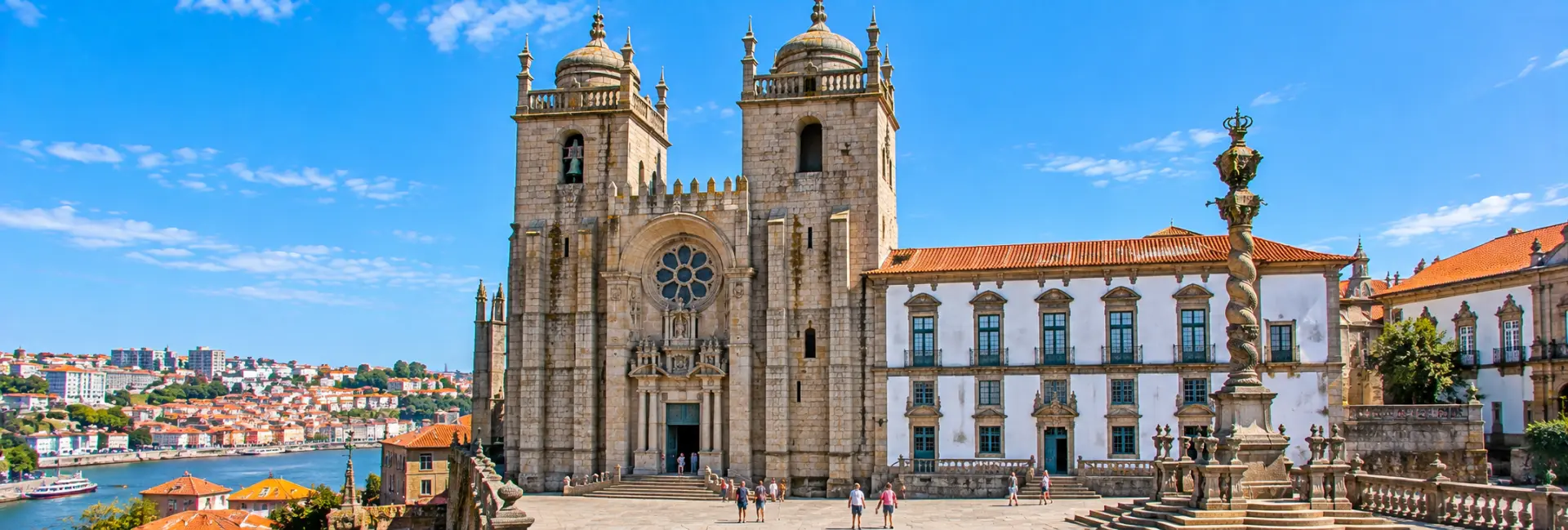
Porto Cathedral, known in Portuguese as the Sé do Porto, stands on a hilltop above the old town, its thick granite walls and twin towers giving it the appearance of a fortress as much as a church. As one of the city's oldest monuments, it has watched over Porto since the 12th century, surviving sieges, earthquakes, and centuries of renovation that layered Gothic and Baroque additions onto its original Romanesque core.
Despite its imposing exterior, the interior rewards a slower, closer visit rather than a grand one, with a plain Romanesque nave giving way to a richly tiled Gothic cloister and a scattering of Baroque chapels and altarpieces. Its elevated position also makes it a natural stop for views over Porto's rooftops and the Douro beyond.
History
A fortress-church for a young kingdom
Construction began around 1110, when Porto was emerging as a key stronghold for the newly forming Kingdom of Portugal. The original Romanesque design reflected the period's political instability, with thick defensive walls, narrow windows, and a crenellated silhouette built to withstand attack as much as to host worship.
Gothic and Baroque additions
As the immediate threat of invasion faded and Porto grew into a more settled city, the cathedral's role shifted from defensive stronghold to civic showpiece. A Gothic cloister and side chapels were added in the 14th century, and further Baroque alterations followed in the 17th and 18th centuries, including a chapel of the Blessed Sacrament completed in 1717. The building was not fully finished in its present form until 1737, the result of more than six centuries of intermittent construction and renovation.
A royal wedding and later changes
In 1387, the cathedral hosted the wedding of King John I of Portugal and Philippa of Lancaster, a marriage that marked the formal start of the long-running Anglo-Portuguese Alliance. In the 18th century, the Italian architect Nicolau Nasoni, also known for Porto's Clérigos Tower, renovated the cathedral's main portal and added a Baroque loggia decorated with azulejo tiles to the building's side. The south tower was later rebuilt following the 1755 earthquake that devastated much of Portugal, giving it a distinctly Baroque character that contrasts with the more severe Romanesque lines of the north tower.
Architecture & Design
Porto Cathedral's mixture of styles is visible at a glance: a plain, fortress-like Romanesque facade and nave, a Gothic cloister added in the 14th century, and Baroque flourishes concentrated in the side chapels, portal, and loggia added centuries later. This layering, rather than a single unified design, is part of what makes the cathedral a useful physical record of Porto's architectural history.
Inside, tall pillars give the narrow Romanesque nave a sense of height despite its restrained, largely undecorated walls, with ornamentation concentrated instead in the high altar and select chapels finished in gilded Baroque style.
The Cloister & Treasury
The cathedral's Gothic cloister, dating to the 14th century, is decorated with 18th-century azulejo tile panels painted by Valentim de Almeida, depicting scenes from the life of the Virgin Mary across thousands of individual tiles. The cloister's upper gallery, reached by a separate ticket, preserves defensive architectural details including narrow arrow slits, a reminder of the building's fortress origins.
From the cloister, visitors can access the Casa do Cabido, which houses the Cathedral Treasury, a collection of the cathedral's most valuable liturgical objects. Among its most notable pieces is a silver altarpiece that was once disguised as plain wood to protect it from being looted during the Napoleonic invasions of Portugal in the early 19th century.
Cultural & Historical Significance
As Porto's principal cathedral, the Sé remains the seat of the Roman Catholic Diocese of Porto and continues to hold regular services alongside its role as a major visitor attraction. Its long association with pivotal moments in Portuguese history, from royal weddings to wartime concealment of its treasures, has made it a recurring reference point in the story of the city itself.
The cathedral forms part of the historic center of Porto recognized as a UNESCO World Heritage Site in 1996, standing as one of the anchor monuments of that designation alongside the Dom Luís I Bridge and the Ribeira district below it.
Visiting Etiquette & Tips
- Entry to the main body of the cathedral is free, while a separate small fee applies for the cloister and its upper gallery.
- As an active place of worship, the cathedral may restrict visitor access during services, so checking hours in advance is worthwhile.
- Modest, respectful dress is appropriate throughout the building, in keeping with its continued religious use.
- Visitors should keep voices low inside the nave, particularly if a service or private prayer is underway.
- Photography is generally permitted in most areas, though flash should be avoided near the more delicate tilework and artwork.
Best Time to Visit
Early morning, before 10:00 am, tends to offer the quietest visit, with soft natural light filling the cloister and fewer crowds moving through the nave. Late afternoon is popular for a different reason, when golden hour light suits photographs from the cathedral's terrace overlooking the city.
Because much of the cathedral is indoors, it makes a reasonable stop in any season or weather, though the elevated terrace views are best enjoyed on a clear day.
Nearby Attractions
- São Bento Railway Station, known for its own azulejo tile panels, is a short walk downhill from the cathedral.
- The Dom Luís I Bridge is within easy walking distance, with its upper deck roughly level with the cathedral's hilltop position.
- The Ribeira district and its riverside promenade lie just below the cathedral, reachable on foot down a series of steep streets.
- The Bishop's Palace, adjoining the cathedral square, adds to the cluster of historic buildings in the immediate area.
FAQs about visiting Porto Cathedral
Is Porto Cathedral free to visit? +
Entry to the main body of the cathedral is free, while a small separate fee applies to visit the cloister and its upper gallery.
How old is Porto Cathedral? +
Construction began around 1110, making it one of Porto's oldest monuments, though the building was not completed in its current form until 1737 after centuries of Gothic and Baroque additions.
What styles of architecture does Porto Cathedral combine? +
It combines a fortress-like Romanesque core with a 14th-century Gothic cloister and later Baroque additions to the portal, loggia, and side chapels.
What is inside the cathedral's cloister? +
The Gothic cloister is decorated with 18th-century azulejo tile panels depicting the life of the Virgin Mary, and leads to the Casa do Cabido, which houses the Cathedral Treasury.
Why does Porto Cathedral look like a fortress? +
Its original 12th-century design used thick granite walls and narrow windows deliberately, reflecting the political instability of the period when Porto was a key stronghold for the newly forming Kingdom of Portugal.
What historical event took place at Porto Cathedral? +
In 1387, it hosted the wedding of King John I of Portugal and Philippa of Lancaster, a marriage that marked the formal start of the Anglo-Portuguese Alliance.
How do I get to Porto Cathedral? +
It sits on a hilltop in the historic Batalha district, a short walk from São Bento Railway Station and near the upper deck approach to the Dom Luís I Bridge.