Table of Contents
Overview
Occupying an entire city block in the heart of Porto's Baixa district, Mercado do Bolhão is the kind of market that locals talk about the way you'd talk about an old relative: fondly, a little possessively, and with strong opinions about how it's changed. Built in 1914 and reopened in 2022 after a long and closely watched restoration, it remains the city's best-known place to buy fresh fish, cheese, flowers, and produce, even as its upper floor has picked up a growing crowd of restaurants and tourists.
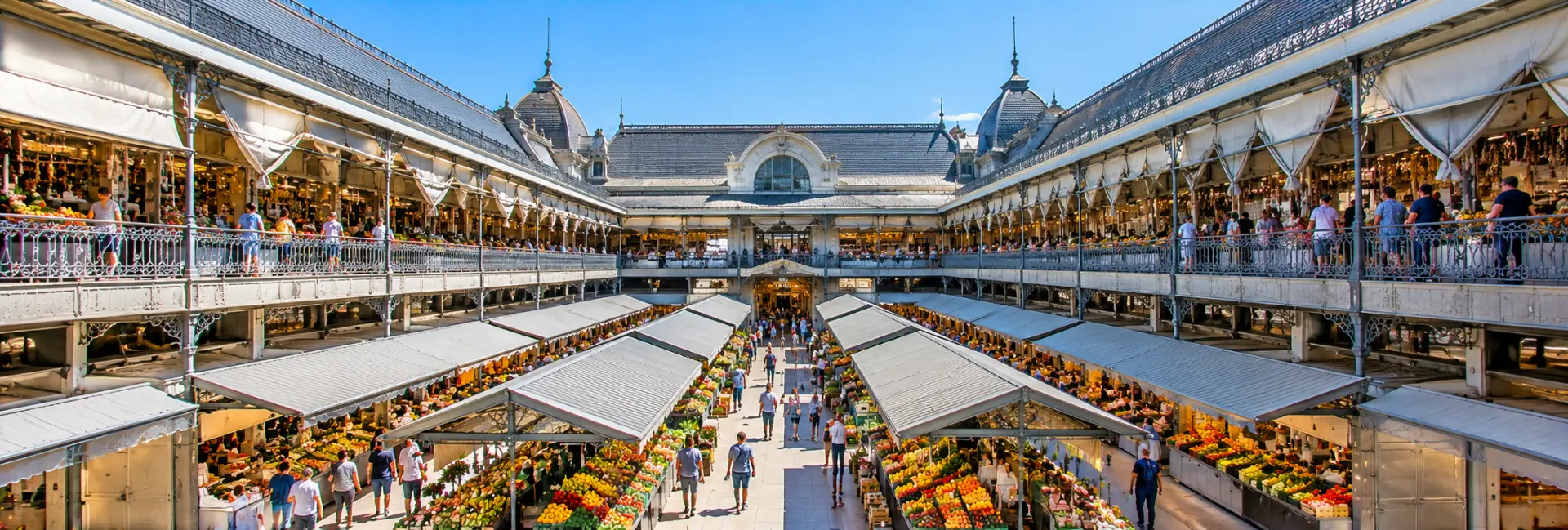
The building itself is worth the visit on its own merits, a handsome two-tiered structure of iron, granite, and glass wrapped around a central courtyard. But it's the daily rhythm of the place, vendors calling out prices, the smell of the fish counters, the ring of the bell that still marks the start of trading, that gives Bolhão its reputation as one of the most genuine slices of everyday Porto still open to visitors.
History of the Market
From Marshy Meadow to City Market
The site takes its name from a small stream that once crossed a marshy meadow here, pooling into a bubble, or "bolhão," in the local dialect. Porto's city council bought the land from the cathedral chapter in the late 1830s, and the first market opened on the site in 1839 as a simple square lined with wooden stalls. That first, fairly makeshift arrangement served the city for decades before officials decided Porto needed something more permanent.
Building the Landmark
The market building visitors see today was designed by architect António Correia da Silva and constructed in 1914, during an ambitious period of civic building projects in Porto. It was considered strikingly modern for its time, combining reinforced concrete and metal framing with wooden roof structures and granite stonework, a genuine engineering hybrid rather than a simple update of older market-hall designs. A connecting floor linking the building's side entrances was added later, in the 1940s, giving the market roughly the layout it retained for the rest of the century.
Decades of Decline and Delay
By the 1980s, structural problems were starting to show, and the first serious defects in the market's floors were identified in 1984. The building spent years propped up by scaffolding, and from 2005 it was widely considered at risk of collapse, a closure only avoided because the market's own vendors resisted efforts to shut the building down. Porto attempted to fix the market on four separate occasions over roughly three decades before a renovation finally went ahead, each earlier attempt derailed by funding gaps, political changes, or disputes over how much of the original character should be preserved. Recognizing its cultural weight regardless, authorities declared Bolhão a Property of Public Interest in 2006 and upgraded that to a full Monument of Public Interest in 2013, a designation that shaped how much of the original fabric any future restoration would be legally required to keep.
The Renovation & Restoration
A large-scale restoration was finally commissioned in 2018, led by architect Nuno Valentim and carried out by a consortium of Portuguese construction firms. The project closed the market for more than four years, a disruption that hit long-standing vendors hard and stirred genuine anxiety among Porto residents that the rebuilt market would end up priced out of reach for the traditional traders who had worked there for generations. Costs rose well above the original budget, partly due to delays from the COVID-19 pandemic, and the final bill came in at roughly 26 million euros.
The work respected the historic ironwork, slate roofing, and cast-iron colonnades of Correia da Silva's original design while overhauling almost everything visitors don't see: new drainage, refrigeration, modern hygiene systems, accessible entrances, and a new underground level built to handle deliveries, cold storage, and even ice production, keeping delivery trucks and loading operations out of the surrounding streets. A direct connection to the adjacent Bolhão metro station was also added, making the market easier to reach than ever.
Mercado do Bolhão reopened to the public on 15 September 2022. Fittingly, the market's patron saint, Nossa Senhora da Conceição, was moved back into the building first, and the reopening ceremony preserved an old daily custom: a bell rung each morning to signal the start of trading, just as it always had before the market closed.
What's Inside
The finished market holds around 129 commercial spaces spread across two levels, a mix of fresh-food stalls, small specialty shops, and restaurants. Four years after reopening, the large majority of those spaces remained in the hands of the market's original, historic vendors rather than new arrivals, something Porto's city government has pointed to as evidence that the restoration didn't simply push out the traders it was built to protect.
The ground floor keeps the market's traditional character most intact, with stalls selling fruit and vegetables, fresh fish, meat, bread, and cheese, alongside a scattering of more unusual specialists, including vendors dedicated to wild mushrooms and bulk spices. Upstairs, a ring of restaurants overlooks the open central courtyard, giving diners a view down onto the bustle of the stalls below; live fado music has become a regular fixture there on Wednesday evenings.
- Ground floor: fresh produce, fishmongers, butchers, cheesemongers, bakers, and florists
- Upper floor: restaurants and food stalls arranged around the central courtyard
- Around 129 total commercial spaces, mostly held by long-standing local vendors
- An underground logistics level with cold storage, ice production, and loading access, out of public view
Ways to Experience It
Most visitors simply wander the ground floor at their own pace, taking in the fish counters and produce stalls before heading upstairs to eat. The market's oyster stalls have become a particular draw since the reopening, with freshly shucked oysters sold individually right beside the ice beds; they're best enjoyed during the colder months, when the Atlantic catch is at its peak.
For a slower visit, guided tours occasionally run through the market's restricted areas, including the underground logistics level built during the renovation, giving a rare look at how a modern fresh-food market actually operates behind the scenes. These tours are organized periodically rather than offered daily, so checking ahead for current schedules is worthwhile if that's the main draw.
- Self-guided wandering through the ground-floor stalls
- Oyster tasting at the counters, best in the colder months
- Upstairs dining with courtyard views, including live fado on Wednesdays
- Occasional guided tours of the market's restricted underground areas
Best Time to Visit
Mornings are the best time to see Bolhão at its most functional and least crowded, particularly around opening time, when vendors are still setting up and the light through the glass roof falls cleanly across the courtyard. By late morning and into early afternoon, especially around the popular oyster and wine stalls, the aisles can become genuinely difficult to move through as tour groups arrive in numbers.
The market keeps a fairly traditional working schedule: open Monday through Saturday, with earlier closing on Saturdays, and closed entirely on Sundays and public holidays. That makes weekday mornings the most reliable window for a relaxed visit, while Saturday can get particularly busy as locals do their weekend shopping alongside visiting tourists.
Visitor Tips
Entry to the market is free, and most of what you'll spend goes directly to the vendors, whether that's a bag of fruit, a wedge of cheese, or a plate of grilled fish upstairs. Because the market closes on Sundays and holidays, it's worth double-checking the day of your visit if Bolhão is a priority stop, since arriving on a closed day is a common disappointment for first-time visitors.
The direct entrance from Bolhão metro station makes the market one of the easiest attractions in Porto to reach without a car, and the surrounding streets, Rua Formosa, Rua de Fernandes Tomás, Rua Alexandre Braga, and Rua Sá da Bandeira, are lined with long-established grocers worth a look even if the market itself is closed.
- Free to enter; you only pay for what you buy or eat
- Closed Sundays and public holidays; check hours before visiting
- Direct access from Bolhão metro station on the Porto Metro network
- Weekday mornings are noticeably quieter than midday and Saturday
Nearby Attractions
Bolhão sits right at the edge of Porto's Baixa, within easy walking distance of the Avenida dos Aliados and the grand Porto City Hall at its northern end. The colorful, tile-lined Rua de Santa Catarina, one of the city's main shopping streets, runs close by, as does the ornate Livraria Lello bookshop, one of Porto's most photographed interiors.
A short walk further brings visitors to São Bento railway station, famous for the sweeping azulejo tile murals lining its entrance hall, and on to the Sé do Porto cathedral, from which it's a scenic downhill route toward the Ribeira riverfront and the Dom Luís I Bridge. Many visitors treat Bolhão as a natural starting or ending point for a day spent exploring the Baixa on foot, since it sits within a few minutes of nearly everything else on this list and offers a convenient spot to pick up a snack or a bottle of local wine before moving on.
- Avenida dos Aliados and Porto City Hall
- Rua de Santa Catarina shopping street
- Livraria Lello bookshop
- São Bento railway station and its azulejo tile murals
FAQs about visiting Mercado do Bolhão
When did Mercado do Bolhão reopen after renovation? +
It reopened on 15 September 2022, after a restoration that closed the market for more than four years and began in 2018.
Is the market still used by locals, or is it mainly for tourists? +
Both: the ground floor remains dominated by long-standing local vendors selling fresh produce, fish, and cheese, while the upper floor has become more tourist-oriented with restaurants and food stalls.
What are the market's opening hours? +
It's generally open Monday through Saturday, with earlier closing on Saturdays, and closed on Sundays and public holidays; it's worth confirming current hours before visiting.
Is it free to enter the market? +
Yes, there's no entrance fee; visitors simply pay for whatever food or goods they buy from individual vendors.
How do I get to Mercado do Bolhão? +
The market has a direct connection to the Bolhão metro station, making it one of the easiest historic sites in Porto to reach by public transport.
What should I try at the market? +
Fresh oysters at the ground-floor stalls are a popular choice, especially in the colder months, alongside local cheeses, cured meats, and a meal upstairs with a view over the courtyard.
How old is the current market building? +
The current structure dates to 1914, though the site itself has hosted a market since 1839, when the original square with wooden stalls first opened.
Why was the market closed for so long before 2022? +
Structural problems dating back to the 1980s left the building at risk of collapse, and after several failed renovation attempts over the following decades, a full restoration finally began in 2018.