
Table of Contents
Overview
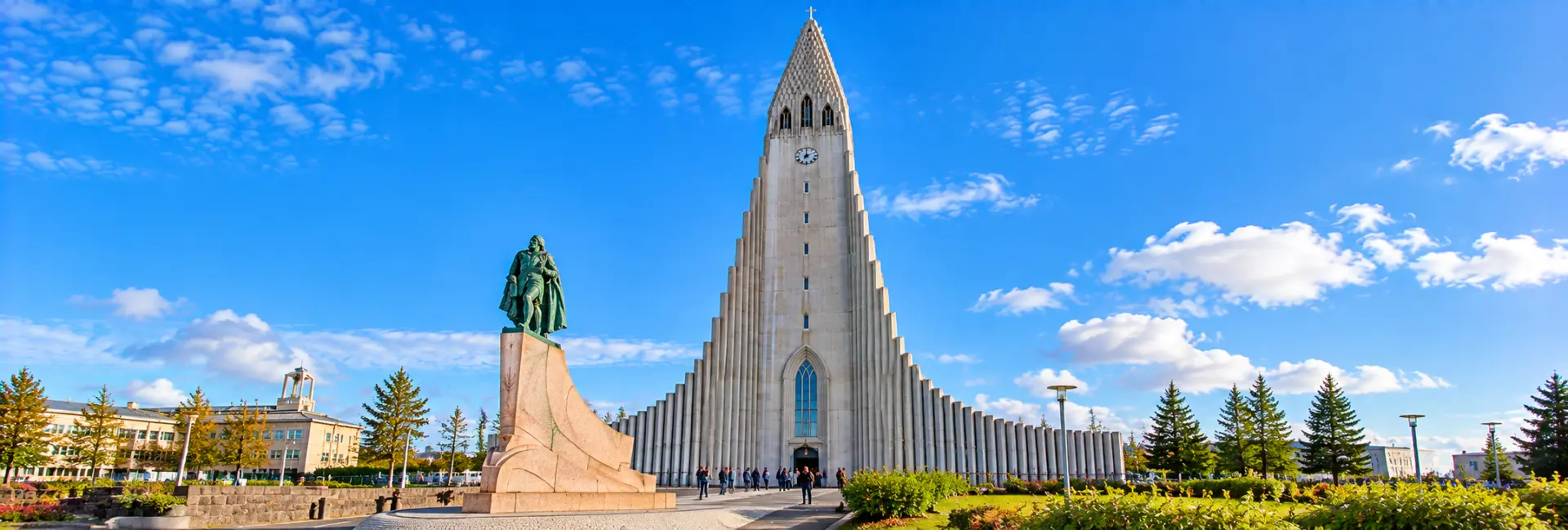
Hallgrímskirkja is the church you see first and remember longest in Reykjavik. Its white concrete tower rises about 74.5 meters above the hill of Skólavörðuholt and can be spotted from almost anywhere in the city, which makes it both a landmark and a handy way to find your bearings. It is the largest church in Iceland, a Lutheran parish church rather than the national cathedral, and one of the most photographed buildings in the country.
The design is unmistakable. Stepped concrete wings sweep up on either side of the tower like columns of cooled lava, and the whole structure seems to grow out of the Icelandic landscape. Inside, the mood changes completely: the nave is calm, bright and almost bare, with a huge pipe organ and a high vaulted ceiling that draw your eyes upward.
Visitors come for three things: the architecture, the music and the view. Entry to the church is free, and a lift takes you up the tower to an observation deck with sweeping views over the city rooftops, the harbor and the mountains beyond.
History of the Church
A Church for the Nation
The church is named after Hallgrímur Pétursson, a 17th-century poet and clergyman best known for his Passion Hymns, which became part of Icelandic spiritual life. The project was conceived in the 1930s as a parish church and a national monument at the same time. State architect Guðjón Samúelsson was commissioned to design it in 1937, and the plans grew more ambitious once it was decided that the spire should rise above that of Landakotskirkja, the city's Catholic cathedral.
Four Decades of Building
Construction started in 1945 and took more than forty years, because it advanced in stages as money allowed. The crypt under the choir was consecrated in 1948, and Samúelsson died in 1950, leaving others to carry his design forward. The tower and side wings were finished in 1974, and the nave was consecrated on 26 October 1986. The tower was in place long before the rest was complete, so for years residents saw an unfinished landmark above their city.
Architecture & Design
Samúelsson is said to have drawn his inspiration from Iceland's basalt formations, the hexagonal columns that form when lava cools slowly, such as those seen around the Svartifoss waterfall. The church reflects that idea in its upward-stepping concrete forms, which also give it a strong sense of rhythm and light. Architecturally it is often described as Expressionist, because of its dramatic shape and its rejection of traditional church styles.
The building has three main parts: the central tower, the curved side wings that hold service rooms, and the nave with the choir. The original requirements were ambitious, calling for seating for around 1,200 people and a tower tall enough to act as a radio transmitter as well as a landmark.
Many visitors compare the shape to a pipe organ or a mountain, and it is fun to walk around the square and see how the profile changes from different angles. The white concrete also changes color through the day, glowing in low sun and standing out sharply against dark winter skies. Some people also see a nod to Viking heritage in the profile, comparing it to a hammer with its handle pointing skyward, although that reading is more folklore than documented intent.
Inside the Church
The interior is a deliberate contrast to the dramatic exterior. The walls are white and nearly bare, the lines are clean, and a high vaulted ceiling gives the nave a calm, luminous feel that suits the building's role as both a place of worship and a concert hall.
The Klais Organ
The organ is the main attraction inside. Built by Johannes Klais of Bonn and installed in 1992, it stands about 15 meters tall, weighs roughly 25 tonnes and contains 5,275 pipes across 72 stops. It is the largest pipe organ in Iceland and the centerpiece of the church's busy concert program.
Art and Details
Just inside the nave stands a statue of Christ by the sculptor Einar Jónsson, next to the candle stand. The artist Leifur Breiðfjörð designed the main door, the window above it, the pulpit and the baptismal font. The tower also holds a carillon of 29 bells, which you will hear ringing out over the surrounding streets.
The church is also an active parish. Services are held in Icelandic on Sundays, and English-language services have been offered on a monthly basis, so the space is used for worship just as much as for sightseeing.
The Tower & Observation Deck
The tower is open to visitors, and it is the most popular reason to come inside. A lift carries you up to the observation deck, where you can look out in all directions. The view takes in the colorful rooftops of the city center, the harbor and the Harpa concert hall, the Atlantic Ocean and the mountains around the capital. On a clear day you may even see as far as the Snæfellsjökull glacier on the horizon.
The tower charges a small admission fee, and tickets are sold in the church shop. Access is by lift only, so there is no climbing involved, though queues can form at busy times. Remember that it is a working bell tower, so expect the bells to sound while you are up there.
The deck has openings on all sides, so you can walk around and look in every direction. Because the church stands on a hill in the middle of the city, the panorama is hard to beat, and the deck is a great spot for photographs of Reykjavik's candy-colored houses, laid out in a patchwork below you.
Leifur Eiríksson & the Square
In front of the church stands a bronze statue of Leifur Eiríksson, the Norse explorer believed to have reached North America around the year 1000, centuries before Columbus. The statue is by the American sculptor Alexander Stirling Calder and was a gift from the United States to Iceland in 1930, marking the thousandth anniversary of the Althing, Iceland's ancient parliament. It was placed here long before the church was built, and Leifur faces west toward the land he is said to have found.
The square around the statue, Hallgrímstorg, is a lively place to linger. It makes a good spot for photographs of the church's full height, particularly with the statue in the foreground, and it is the starting point of the shop-lined street that leads down toward the harbor.
Ways to Experience It
Hallgrímskirkja offers more than a quick look from outside. Here are the best ways to experience it:
- Step inside to enjoy the quiet nave, the Klais organ and the minimalist design
- Ride the lift up the tower for the city panorama
- Attend an organ concert: the church is known for its acoustics, and the International Organ Summer Festival and other recitals bring musicians from around the world
- Join a service if you want to experience the church as a living parish, remembering that visitors are asked to be respectful
- Check for noon organ concerts, which have been held on the first Saturday of many months outside the summer season, and for the popular Advent and Christmas concerts
- Browse the church shop and walk the square for photographs of the exterior
- Combine the visit with a stroll down the colorful Skólavörðustígur street toward the center
Most people spend between 30 and 60 minutes here, a little longer if they attend a concert or wait for the lift.
Best Time to Visit
By Season
Summer brings long days and extended opening hours, and the soft light of the midnight sun can make the tower views magical. In winter the days are short, but the church can look especially dramatic against the dark sky, and there is a chance of seeing the northern lights in the area on clear nights. Advent and Christmas concerts are among the most atmospheric times to be inside.
By Time of Day
Mornings are usually quieter, with fewer tour groups and shorter waits for the lift. Late afternoon and evening bring warm light and softer photos. Clear weather matters most if you want the best view from the tower, so check the forecast and choose a bright day if you can.
Visitor Tips
- Entry to the church is free, while the tower requires a ticket bought on site in the church shop; tickets cannot be reserved in advance.
- Hallgrímskirkja is a living church, so it may close at short notice for services, weddings, funerals and concerts. Check the opening calendar on the church's website before you go.
- The tower is closed during Sunday mass, and the last admission is shortly before closing time.
- Opening hours are longer in summer and shorter in winter.
- The tower is reached by lift only, which makes it a good option for visitors who prefer not to climb stairs.
- Dress warmly, as the observation deck is exposed and Reykjavik weather can change quickly.
- Keep voices low inside the nave, and avoid photographing people at prayer.
- Parking nearby is limited, so walking or public transport is easiest.
Nearby Attractions
The church sits at the top of one of Reykjavik's most pleasant streets, so there is a lot within a short walk:
- Skólavörðustígur, the colorful shopping street that runs downhill from the church, lined with design shops, galleries and cafes
- The Einar Jónsson Museum, devoted to the sculptor whose work is also found inside the church
- Laugavegur, Reykjavik's main shopping and dining street
- Harpa Concert Hall, the glass-fronted waterfront landmark
- The Sun Voyager sculpture and the harbor promenade
- Tjörnin, the city-center pond, and the Old Harbour area
FAQs about visiting Hallgrímskirkja
Is Hallgrímskirkja a cathedral? +
No. Despite its size, it is a Lutheran parish church. It is the largest church in Iceland, but the city's cathedral is a different building.
How tall is the tower? +
The tower is about 74.5 meters (244 feet) high, which makes Hallgrímskirkja the tallest church in Iceland and one of the tallest structures in the country.
Is it free to enter? +
Entry to the church is free. A fee applies for the lift to the tower observation deck.
Can I buy tower tickets in advance? +
Tickets are sold on site in the church shop and cannot be reserved ahead of time. Check the church's calendar for opening times and any closures.
What is the church's design based on? +
The design is inspired by Iceland's basalt columns and lava formations, which the stepped concrete shapes of the tower and wings echo.
Who is the statue outside? +
It depicts Leifur Eiríksson, the Norse explorer believed to have reached North America around the year 1000. The statue was a gift from the United States in 1930 to mark the Althing's thousandth anniversary.
Can I hear the organ? +
Yes, the church hosts regular organ concerts, especially in summer during the International Organ Summer Festival. Check the concert calendar for dates and ticket information.
How long should I spend there? +
Plan for 30 to 60 minutes to see the nave and go up the tower. Allow extra time if you want to attend a concert or if the lift queue is long.
