
Table of Contents
Overview
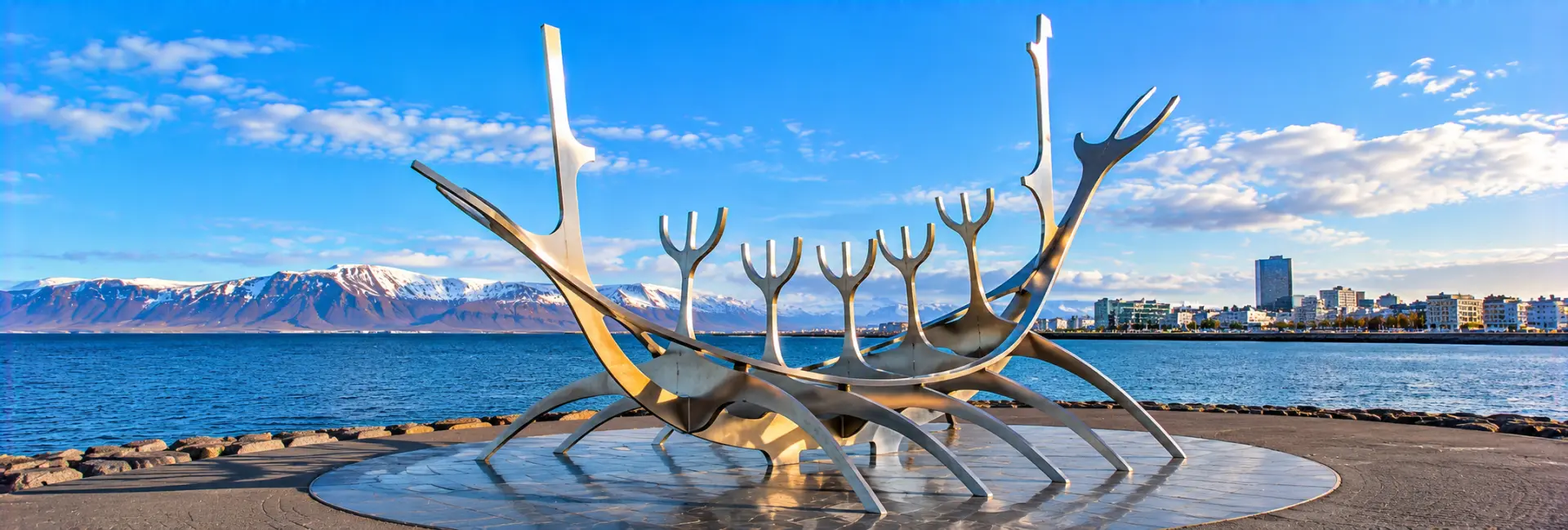
The Sun Voyager, known in Icelandic as Sólfar or Sólfarið, is a polished stainless steel sculpture on the Reykjavik waterfront. Its sleek, ribbed shape looks like the skeleton of a ship about to set sail, and it points out across Faxaflói Bay toward Mount Esja. It is one of the most photographed landmarks in Iceland and an easy, free stop for almost anyone visiting the capital.
Many visitors assume it is a Viking ship, which is understandable given Iceland's history. The artist, however, described it as a dreamboat and an ode to the sun. It stands for hope, progress, freedom and the promise of undiscovered territory rather than a particular piece of the past.
Part of its appeal is the setting. The sculpture sits on a small headland at the edge of the sea, with open sky on every side, so the light, the weather and the mountains across the bay are all part of the artwork. It is open at all hours, costs nothing to visit and fits easily into a walk along the seafront.
History of the Sculpture
A Gift for the City's Bicentennial
The story begins in 1986, when Reykjavik was preparing to celebrate its 200th anniversary as a chartered town. The district association of the western part of the city funded a competition for a new outdoor sculpture to mark the occasion. Jón Gunnar Árnason's design for the Sun Voyager won, and a small aluminium model, only about 88 centimeters long, was presented to the city to be enlarged. It is remarkable to think that the monumental steel work on the shore grew from such a modest maquette.
Choosing a Location
There was some debate about where the sculpture should stand. In the end, with the artist's agreement, it was placed on a small headland on the Sæbraut shore road, a spot Árnason jokingly called Jónsnes, or Jón's Peninsula. The location gives the piece open water and sky behind it and a clear view of the mountains across the bay.
Unveiling
The full-size sculpture was unveiled on 18 August 1990, the birthday of the city of Reykjavik. It has since become one of the most recognizable symbols of the capital, appearing in countless photographs, postcards and guidebooks.
The Artist
Jón Gunnar Árnason, who lived from 1931 to 1989, was an Icelandic sculptor, and the Sun Voyager is among his best-known works. Sadly, he died in 1989, before the finished sculpture was installed, and never saw it standing on the shore.
The full-scale work was carried out according to his enlarged drawings. His assistant, the artist Kristinn E. Hrafnsson, oversaw the construction, together with a technologist who supervised the engineering, and the metalwork was done at a workshop in Mosfellssveit, just outside Reykjavik. The result is a piece that stays faithful to the artist's own vision, even though others completed it.
Design & Symbolism
The sculpture is made of stainless steel and stands on a circle of granite slabs, surrounded by the kind of concrete paving used around public buildings in Reykjavik. The polished metal reflects the sea, the clouds and the light, so its appearance changes through the day and through the seasons. On bright days it flashes silver, and at dusk it can pick up shades of pink, gold and blue.
The form suggests a boat with a row of slender ribs and a rising prow. Because it appears to be mostly frame, with the sky showing through it, many people describe it as a ship made of light. The artist's own idea was a dreamboat, a vessel that carries its passengers toward the sun and the promise of a new horizon.
That idea gives the work a hopeful, forward-looking meaning. Instead of looking back at Viking voyages, it points to the future: a journey that is still to be taken, a land still to be found. Visitors are free to read it in their own way, and part of the pleasure is walking around it and noticing how the shape changes as you move.
One popular reading sees the boat as the last leg of a long voyage, carrying its passengers toward the promised land of the setting sun. Others simply enjoy it as a graceful abstract form. Either way, the sculpture works best when you take your time, stand at a few different points and let the sea and sky do part of the work.
The Setting & Views
The sculpture faces Faxaflói Bay, the broad stretch of sea on which Reykjavik sits, so the water in front of you is part of the city's everyday landscape as much as a scenic backdrop. The long view across the water takes in Mount Esja, the flat-topped mountain that dominates the skyline north of Reykjavik. On a clear day the mountain seems to rise straight out of the sea behind the steel ribs, which makes for one of the best-known photographs in the city.
The spot is open and exposed, with a stretch of coast, a path and the road behind you. Seabirds often pass overhead, and the wind coming off the bay is a constant companion, so dress warmly even if the city feels calm.
Light is the other star of the scene. In summer the midnight sun means you can visit at almost any hour and still find unusual light. In winter the open, north-facing shoreline is a decent place to watch for the northern lights on a clear night, though there is no guarantee. Because the coast here is open and free of tall buildings, the horizon feels very wide, and the sculpture seems to hover between the water and the sky.
The Sculpture and Shore Walk
The Sun Voyager sits on Reykjavik's Sculpture and Shore Walk, a popular path along the coast that links the Old Harbour, Harpa Concert Hall and other public artworks. The route is level and easy, so it is a pleasant stroll for almost anyone, whether you walk, jog or cycle.
Along the way you can see more public art, including the Partnership sculpture by Pétur Bjarnason, and enjoy views of the harbor, the mountains and the sea. Many visitors treat the Sun Voyager as a natural halfway point on a longer waterfront walk, and some continue east to Höfði House, the site of the 1986 meeting between Ronald Reagan and Mikhail Gorbachev.
Ways to Experience It
The Sun Voyager does not need much time, but there are several ways to enjoy it:
- Walk around the sculpture slowly to see how its shape changes from different angles
- Take photographs with Mount Esja and the bay as the backdrop
- Visit at sunrise or sunset, when the horizon glows behind the ship
- Combine it with a walk along the seafront path to Harpa and the Old Harbour
- Cycle or jog along the coastal route and stop here to rest
- Return on a clear winter night to watch for the northern lights over the bay
Most people spend 15 to 30 minutes at the sculpture, longer if they combine it with a longer waterfront walk.
Best Time to Visit
By Season
Summer offers the longest days, with the midnight sun casting a golden light at hours when most cities are dark. Spring and autumn bring dramatic skies and fewer crowds. Winter is cold and short on daylight, but the polished steel looks striking against a blue-black sky, and the chance of the northern lights adds a bit of magic.
By Time of Day
Early morning is the quietest time, with soft light and few other visitors. Sunrise and sunset, which fall at very different times through the year, are the most photogenic moments, as the horizon glows behind the sculpture. Midday can be busy with tour groups, particularly in summer.
Visitor Tips
- Visiting is free, and the site is outdoors and open around the clock.
- The path along the shore is flat and generally easy for wheelchairs and strollers.
- Dress for the wind, even in summer, because the headland is exposed to the bay.
- There is a public parking lot across from the sculpture, and several city bus routes run along Sæbraut, but walking from the city center is easy and pleasant.
- Be patient with photographs, as it can get crowded around the sculpture, especially in summer.
- If you arrive on a small cruise ship at the Old Harbour, the sculpture is roughly a 15-minute walk along the seafront.
- Do not climb on the sculpture, which is a public artwork and should be treated with care.
- Bring a camera and consider returning at a different time of day, as the light changes the look of the steel completely.
Nearby Attractions
The Sun Voyager sits between the city center and the eastern waterfront, so you can add other sights on foot:
- Harpa Concert Hall, the glass-fronted concert hall a short walk west along the shore
- The Old Harbour, with its restaurants, shops and boat tours
- Höfði House, the historic seaside house that hosted the 1986 Reagan and Gorbachev summit
- The Partnership sculpture by Pétur Bjarnason, one of several public artworks along the shore path
- Laugavegur and the central shopping streets, a short walk inland
- Hallgrímskirkja, the landmark church on the hill above the city
FAQs about visiting the Sun Voyager
What is the Sun Voyager? +
It is a stainless steel sculpture on Reykjavik's waterfront, known in Icelandic as Sólfar. It was created by Jón Gunnar Árnason and unveiled in 1990.
Is it a Viking ship? +
It looks a bit like one, but the artist described it as a dreamboat and an ode to the sun, a symbol of hope, freedom and the promise of undiscovered territory.
When was it made? +
It was designed for a competition in 1986 to mark the 200th anniversary of Reykjavik. The full-size sculpture was unveiled on 18 August 1990.
Is it free to visit? +
Yes. The sculpture is outdoors, free to see and accessible at any time of day or night.
How do I get there? +
It is on the Sæbraut waterfront road, about a 10 to 15 minute walk from Harpa along the shore path and roughly a 15-minute walk from the city center. Several city buses also stop nearby.
How long should I spend there? +
Plan on 15 to 30 minutes for photographs and a look around. Allow more time if you are walking the full waterfront path.
What is the best time for photos? +
Sunrise and sunset give the most dramatic light, and clear days show Mount Esja across the bay. In winter you might also catch the northern lights.
Is it suitable for children and wheelchair users? +
Yes. The area is flat and open, and the shore path is easy to walk or roll along, though the wind can be strong.
